
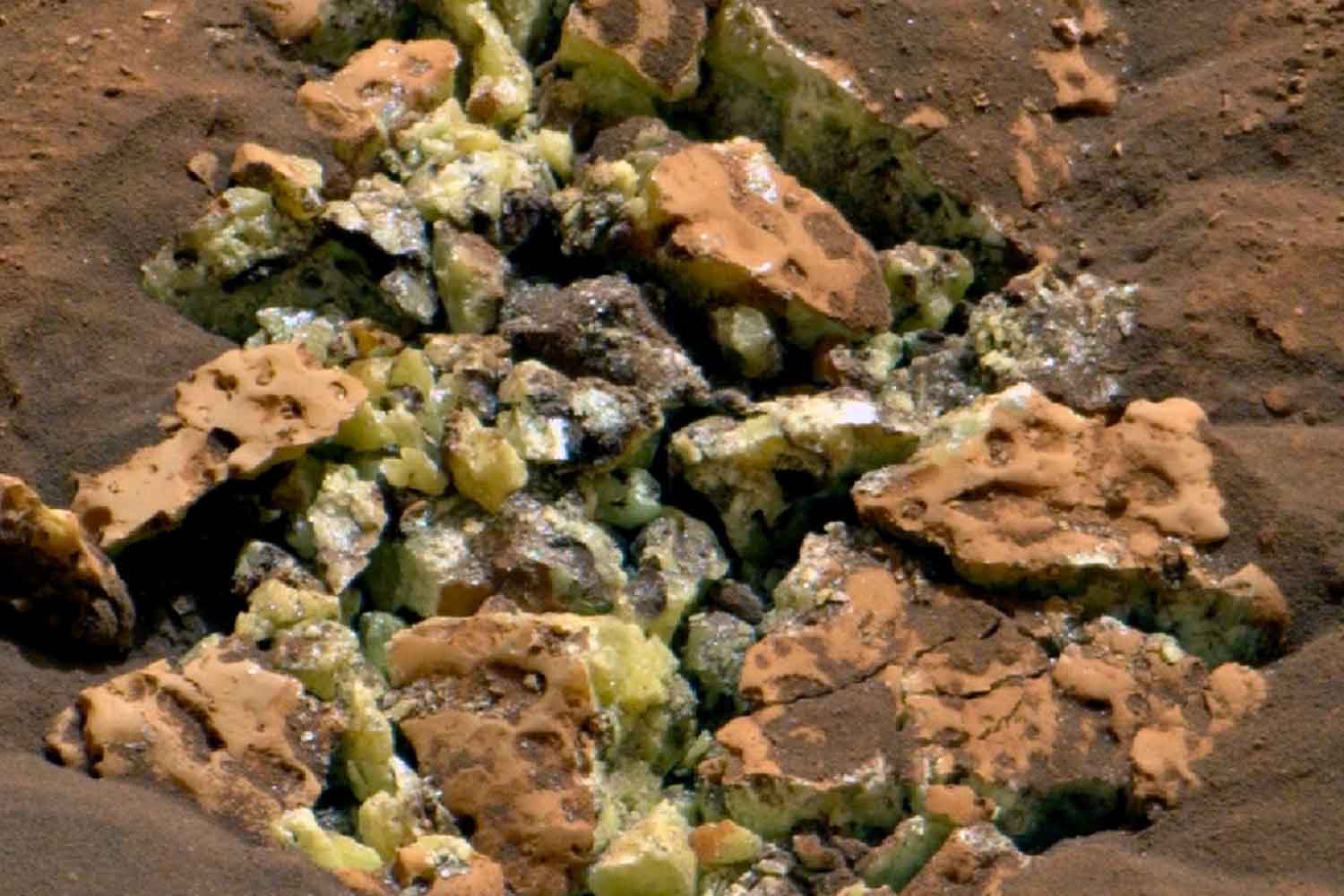
Sometimes the most important discoveries come when you least expect it. That’s what happened to Curiositythe NASA rover that has been exploring Mars for years with the patience of an old craftsman. Last year, passing over a small, rather fragile boulder, the rover practically crumbled it with its weight. So far, nothing strange: it happens often. But this time, a surprise emerged from the crack that left scientists speechless: yellow crystals of pure sulphuras bright as a handful of confetti that fell in the wrong place.
Sulfur on Mars is nothing new. THE sulfatesthat is, salts that form when sulfur binds to other minerals in the presence of water, are quite common. But it elemental sulphurthe one in its pure state, without ties, is a completely different story. It is also rare on Earth and requires very specific conditions to form. And, according to what we know, those conditions have nothing to do with where Curiosity is wandering.
The matter becomes even more interesting if we think that, in the same channel, the rover has identified many other rocks that seem identical to the one it broke. I mean, there could be an entire expanse of pure sulphurthere where no one expected even a speck.
Why this sulfur creates so many questions
When Ashwin Vasavadaone of the scientific managers of the mission, commented on the discovery, using an image that gives the idea: finding stones made of pure sulfur in that point of the planet is like finding an oasis in the desert. Something that shouldn’t be there. And when something shouldn’t be there… it means we’ve missed an important piece of history.
The Gediz Vallis Channelan ancient river route, is a sort of natural archive of Mars’ water history. Its rocks bear the traces of what happened billions of years ago. And precisely for this reason the presence of elemental sulfur creates a puzzle: it suggests that geological processes occurred on Mars that .
This is not a sign of life – sulfur is useful to the living, it is true, but it is certainly not enough to shout “we have found something”. However, it seems the planet continues to litter pieces of the puzzle: water, interesting chemistry, ancient conditions that could have harbored something. Nothing certain, but every time a step further.
Curiosity, meanwhile, moves forward. He analyses, photographs, smells through his instruments. And if he hadn’t stepped on that very rock, perhaps we wouldn’t know anything about this sulfur today. It’s funny to think that such a huge revelation was born from an almost comical accident: a robot steps on a pebble, and that pebble decides to tell a secret kept hidden for an eternity.
And while Curiosity proceeds at its slow and stubborn pace, too Perseverance continues his journey. In June 2025 he set a record: more than 400 meters traveled in a single day. A distance that, on Mars, means a lot. And in the midst of his explorations he found a rock that looked more like an object from who knows where than a Martian fragment.
Robotic missions to Mars continue to remind us who we are: curious, stubborn, unable to resist the temptation to discover what lies around the corner. Even when that corner is millions of kilometers away.
