
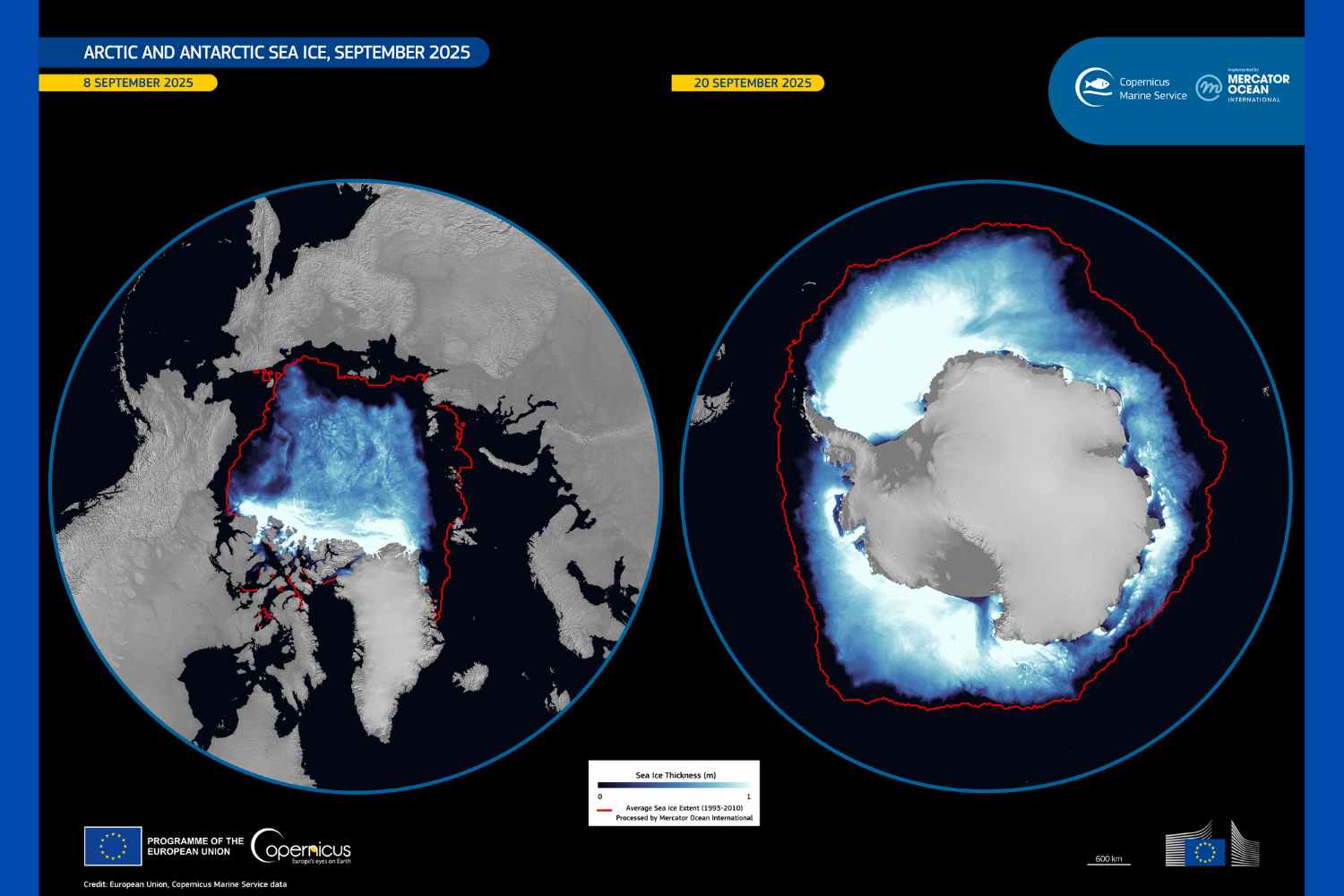
The image of the day, provided by the Copernicus Marine Service, is not just a map: it is a visual testimony of the climate crisis at its extremes. The left panel, taken on 8 September 2025, and the right one, dated 20 September, show the Poles at the most critical moment of their annual cycle, transforming data and numbers into an immediate and understandable story. The strength of the photography lies in its clarity: by comparing the two hemispheres, the anomaly is immediately perceived, making it clear how the reduction of sea ice is no longer a distant phenomenon, but concrete and measurable.
Each September marks the end of the polar summer in the Arctic, when sea ice reaches its annual minimum extent. At the same time, Antarctica emerges from the southern winter, reaching its maximum extent of sea ice. These cycles are fundamental to Earth’s climate system, showing how each hemisphere responds to seasonal warming and cooling.
This year, however, the Copernicus images document worrying anomalies. The data analysis conducted by Mercator Ocean International highlights a double negative record:
The Copernicus images make it immediately clear that both the Arctic minimum and the Antarctic maximum are below the average for the 1993-2010 period. The simultaneous photography of the Poles demonstrates that ice loss is not an isolated phenomenon, but a global and constant one. By observing the difference between current extensions and historical averages, we understand the rapidity with which the planet’s natural balance is changing, a visual warning that surpasses words.
The Copernicus Marine Service provides high-resolution data on sea ice extent and thickness, turning it into visual tools that help understand the scale of the crisis. The double photo from September 2025 is not just informative: it becomes a tool for immediate understanding, clearly showing how both Poles are crossing territories never seen before, with possible knock-on effects on the global climate, ocean currents and marine ecosystems.
