
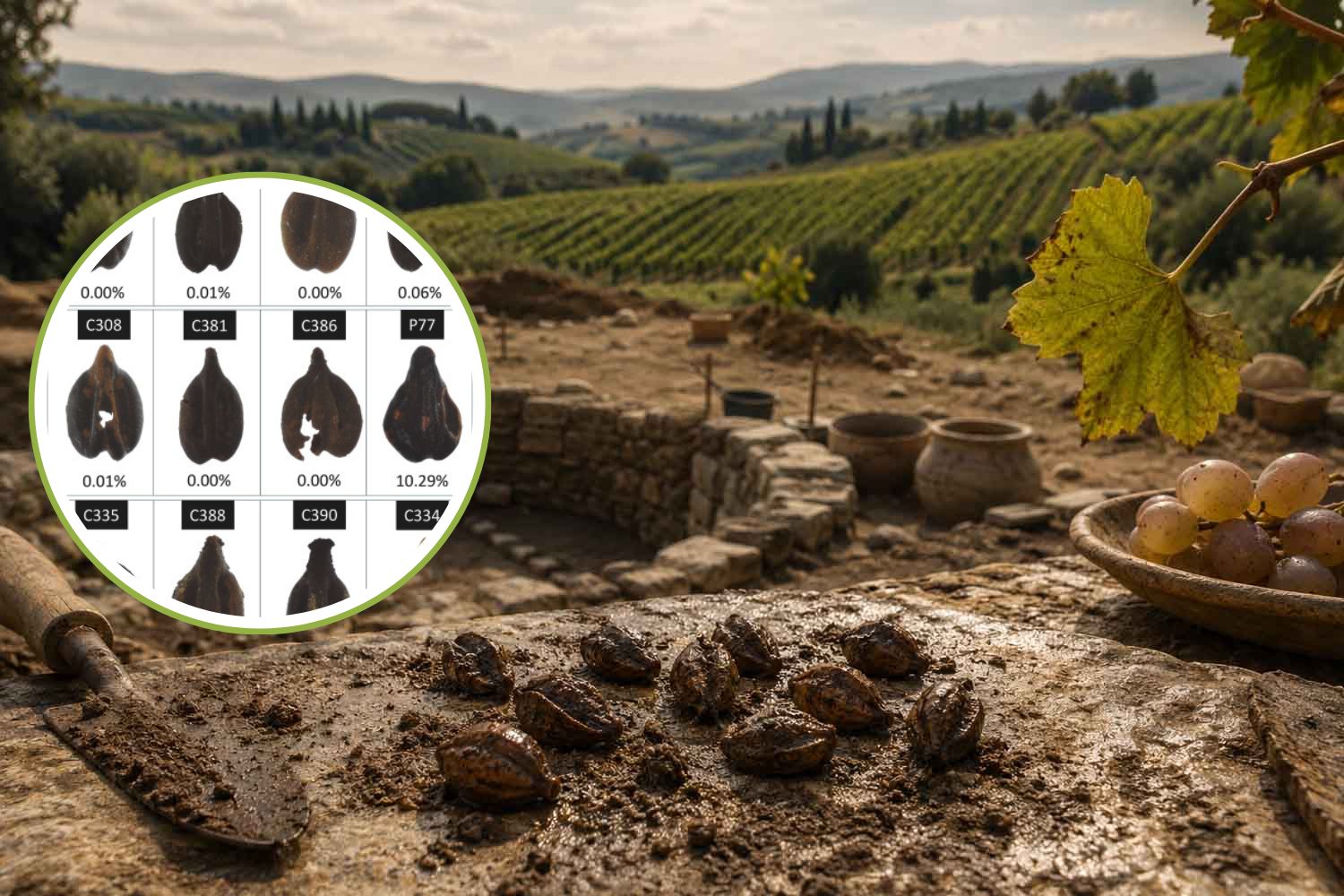
In Chianti we expect red. The full glass, the Sangiovese, the Sienese hills with that dark color that now seems written on the territory. And instead, from some grape seeds that remained for centuries in the mud of ancient Tuscan wells, a more surprising story emerges: before the global fame of red wine, a white grape variety was cultivated with great continuity in that area, passed from the Etruscans to the Romans and maintained for generations.
A new study published in the Journal of Archaeological Sciencewhich analyzed the Ancient grape DNA recovered in Cetamura del Chianti, a high-altitude settlement in the territory of Gaiole in Chianti, about thirty kilometers from Siena, where excavations have been ongoing since the 1970s. The site, inhabited in Etruscan, Roman and medieval phases, has yielded thousands of grape seeds preserved in rare conditions, inside deep wells where the oxygen-poor mud has done the work that time usually enjoys destroying.
Chianti before the red
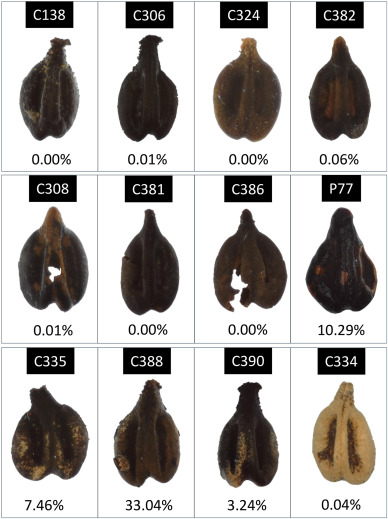
Between 300 BC and 300 AD, the inhabitants of Cetamura threw grape seeds into wells. Ordinary gestures, residues of agricultural life, tiny waste. Two thousand years later, those seeds have become a kind of genetic archive of wine. The researchers sequenced the DNA of 80 seeds and found surprising continuity: most belonged to the same variety, genetically identical, cultivated first by the Etruscans and then by the Romans for centuries.
The most unexpected data concerns the color. Genetic markers indicate that dominant clone produced white grapes. Curious news, almost distorted compared to the contemporary imagination of Chianti, today linked above all to red and Sangiovese. In the same area there still exist white grapes, of course, but the symbolic weight of the territory is now elsewhere. Here, however, the past puts a clearer, older Chianti on the table, less aligned with the postcard we have in our heads.
Nancy De Grummond, one of the scholars involved in the project, spoke about an important chapter in the history of wine in the Chianti region: today’s famous red would have been preceded by a sort of white harvest, cared for and maintained for centuries in the Etruscan and Roman ages. Put like this, it almost seems like a small revenge from the past against modern labels. The territory already had a strong agricultural memory, just with different colors from those we stuck on it.
The vine was already traveling
@Journal of Archaeological Science
After the Roman conquest of the settlement, new varieties appear in Cetamura. This detail moves the story from the local field to the empire’s network: the vine circulated, was selected, taken elsewhere, probably chosen for precise characteristics. The study talks about varieties introduced by Roman expansion and a viticulture that was anything but improvised, inserted in an agricultural system capable of moving plants, techniques and tastes over enormous distances.
There is also another element, more rough and interesting: some analyzes on the shape of the seeds suggest the harvesting of wild grapes. Therefore in Cetamura organized cultivation, selection of varieties and contact with spontaneous vines coexisted. An agricultural scene much more lively than the usual museum idea, with farmers, waste, grafts, trials, practical choices, grapes that came from outside and grapes that grew nearby.
The dominant white clone found in Cetamura is close to two ancient seeds already analyzed in southern France. This genetic link offers biological proof of a large agricultural network, developed in Roman times to make wine production more stable and recognizable. In simple words: ancient wine traveled even before ending up in amphorae. The screws, the knowledge, the preferences travelled. And the Mediterranean, more than a line of water, functioned as a road full of dirty hands.
A vine still alive
@Journal of Archaeological Science
Among the Cetamura seeds there is one that belongs to a family of grapes still present in central and eastern Europe. The closest modern relative resembles a rare Hungarian variety called Baratcsuha szürke, but the most evocative connection leads to Maribor, Slovenia, where the famous Žametovka vine, or Modra kavčina, grows, recognized by the Guinness Book of Records as the oldest still productive vine in the world. The official Slovenian tourism page presents it as a plant over 450 years old, still capable of bearing fruit.
This connection gives the discovery a different weight. The Ancient grape DNA of Cetamura brings modern glasses closer to an agricultural landscape of two thousand years ago, without the need to invent legends. Nathan Wales, one of the authors of the study, explained that some families of grape varieties show remarkable resilience: the grapes drunk by the Romans are genetically closer than we would imagine to certain varieties still cultivated today. The distance between a Roman dinner and a contemporary glass, in this case, becomes much shorter.
Of course this does not mean that we are drinking the same wine served on a Roman table. The soils, the climate, the techniques, the fermentations, the containers, the tastes, even the very idea of wine change. But those seeds tell of a concrete, material, stubborn continuity. A vine selected, maintained, moved, survived in some branch of the great European family of viticulture.
