
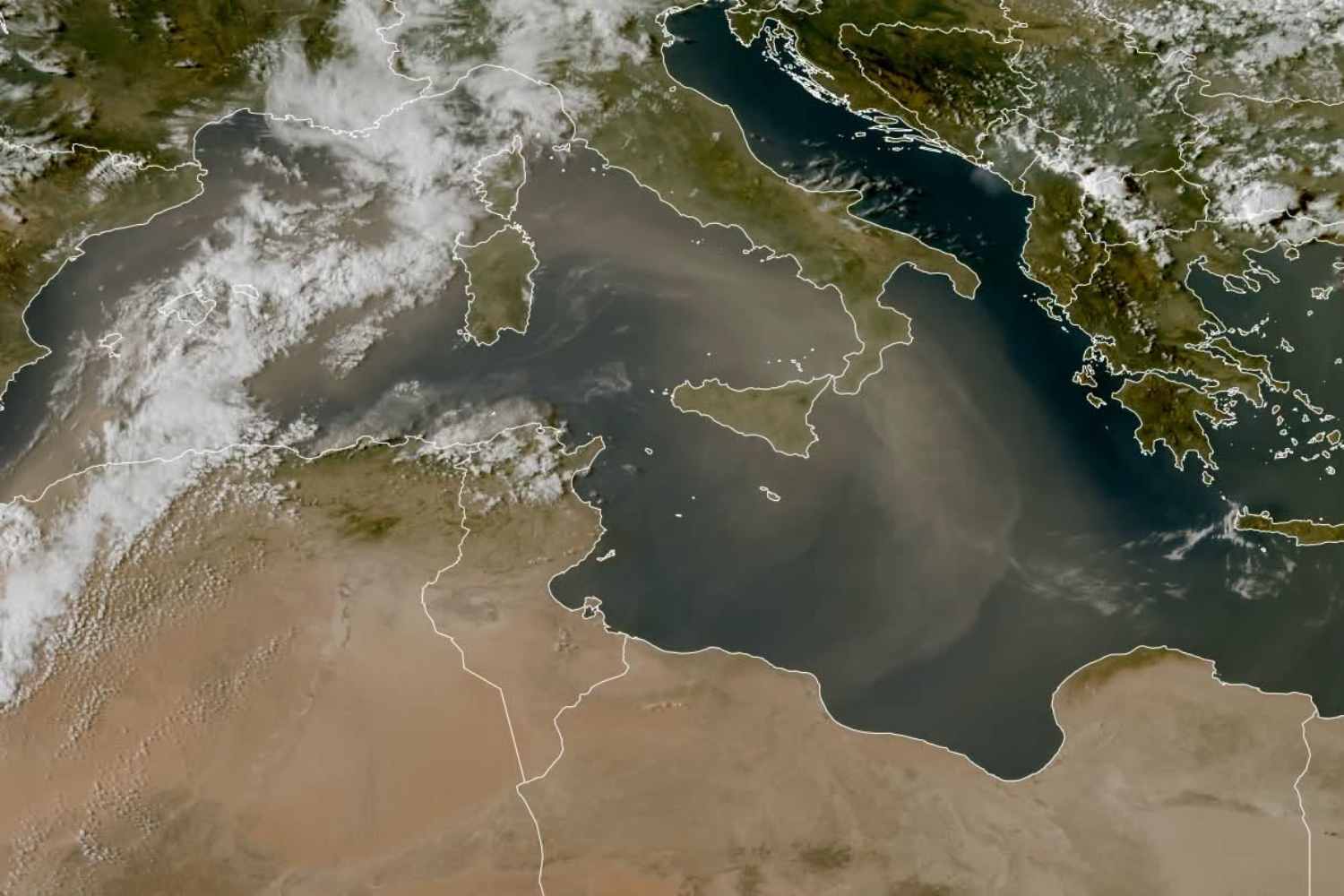
A surreal, milky and opalescent atmosphere has enveloped the Italian skies, transforming the landscape of Central-Southern Italy, Sicily and Sardinia into an almost ghostly scenario. The simultaneous arrival of the fifth heat wave of the summer and an enormous cloud of Saharan dust is oppressing the country with temperatures that touch exceptional peaks between 40 and 44 degrees. The phenomenon, carefully monitored by the European satellites of the Copernicus program, is generated by a deep area of low pressure positioned to the west of Europe which, rotating counterclockwise, acts as a powerful suction engine for the scorching currents from the desert.
Health risks and the increase in PM10 and PM2.5 dust
The large quantity of suspended particles has caused the concentrations of atmospheric particulates to soar, with a strong increase in PM10 and PM2.5. As recalled by the World Health Organization directives, inhalation of these desert micro-dusts can cause eye and throat irritation, prolonged coughing and respiratory complications.
Maximum caution is directed towards vulnerable subjects, in particular those suffering from asthma and chronic bronchopneumopathies, as well as children and the elderly. To limit exposure in urban areas, experts recommend avoiding intense physical activity outdoors and constantly consulting the survey bulletins provided by environmental agencies.
The most affected regions: Sardinia, Sicily and Southern Italy above 40 degrees
The real epicenter of the great heat will be represented by the two Major Islands. In Sardinia and Sicily, maximum temperatures will easily exceed 40 degrees, with local peaks that on Friday and during the weekend could reach up to 43-44°C in the plains and inland valleys far from the sea.
Red flag conditions also in Calabria, Puglia and Basilicata, where the combination of extreme heat and high humidity levels will make the climate muggy and unbearable even during the night hours, when minimum temperatures will struggle to drop below 24-25 degrees (the now unfortunately famous “tropical nights”).
The climate in the Centre-North: trouble in inland areas and the first storms
In central regions such as Lazio, Tuscany, Umbria and Marche, the thermometer will rise sharply, reaching peaks of 37-38°C, in particular in urban areas and inland basins such as the Tiber valley and the province of Terni. In the North, while remaining on the edge of the hottest influence, a sultry and oppressive heat will be felt in the Po Valley, with values between 33 and 35 degrees.
However, the northern part of the Peninsula will be the first to see a change: already today the first heat storms will appear in the Alpine and pre-Alpine areas, a precursor to the cool Atlantic currents that will cross the Alps from Monday to undermine the African bubble and bring temperatures back towards the seasonal average.
A summer with a historic record according to Copernicus data
This new hot pulse is part of a global context of anomalous warming that is marking the 2026 summer season. Historical measurements processed by Copernicus confirm that the month of June was the second warmest ever recorded in Europe, with a thermal anomaly of +1.78 degrees compared to the 1991-2020 average. The data becomes even more dramatic when analyzing Western Europe, where the June-July two-month period set the absolute heat record from 1979 to today, recording a peak of +2.79 degrees above the seasonal averages. What seemed like a drop in temperature in the North in mid-August represented only a temporary return to the normal temperatures of the period.
The forecast for the weekend and rain with a wash-out effect
The grip of the heat and sand will continue to be felt at warning levels throughout the weekend, keeping the skies covered in a reddish patina. The weather turning point will only come at the beginning of next week, when the entry of fresh Atlantic currents will favor the dissolution of the African bubble. The gradual passage of unstable storms will give rise to the typical wash-out phenomenon: the raindrops will capture the Saharan dust causing it to fall to the ground, leaving the characteristic patina of sand on cars and surfaces but finally returning cleaner and more breathable air.
