
The air finally has a face. An x-ray that updates every sixty minutes, taken from 35,000 kilometers above our heads. Sentinel-4 is a tireless eye that never sleeps, never looks away, and records every breath of the European continent.
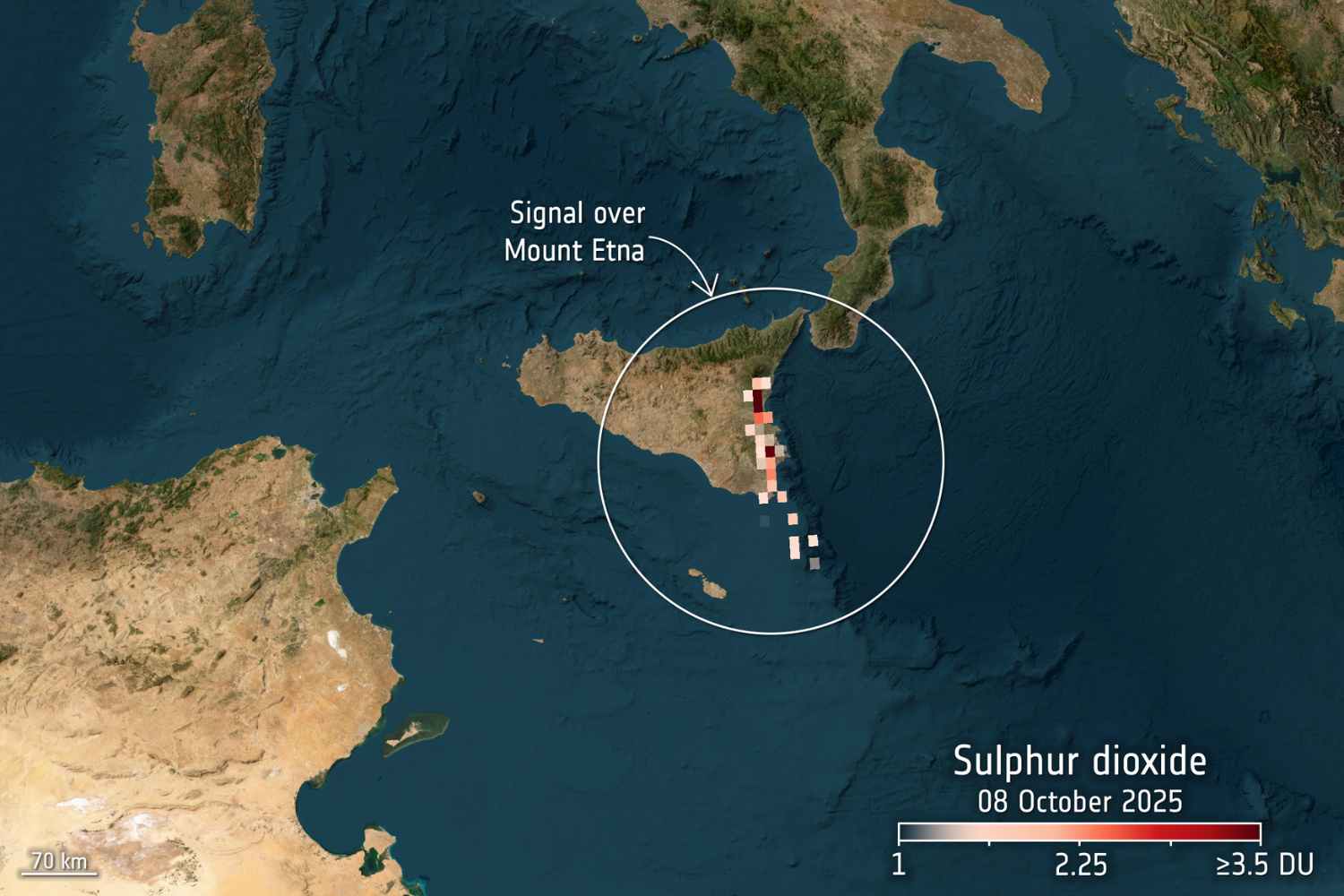
The first images arriving from geostationary orbit at the beginning of October have the visual impact of a map of environmental crime: red stripes along the Po Valleyspots concentrated on the Mediterranean coast, and a volcanic surprise – the plume of Etna which winds south-east like a snake of sulfur dioxide on the blue sea.
Updates every hour
Launched in July 2025, Sentinel-4 is not a satellite like the others. His spectrometer, mounted on the Meteosat Third Generation Sounderoccupies a fixed position in space – a front row seat to constantly observe the same portion of the Planet. The hourly readings represent a quantum leap compared to previous daily readings: the difference between a blurry photograph and a high definition film of the air passing through the lungs of Europe.
Its fixed position 35,000 kilometers from Earth allows it to constantly observe the same region, ensuring a continuous flow of air quality data, in stark contrast to previous daily readings.
The primary objective of the mission, part of the Copernicus programme, is measure key pollutants such as nitrogen dioxide (NO₂), ozone (O₃) e sulfur dioxide (SO₂), gases that pose a direct threat to human health in industrialized regions.
NO₂: urban corridors
On October 8, Sentinel-4 captured its first atmospheric data, focusing on nitrogen dioxide concentrations in Europe. The results confirmed already known scenarios, but with remarkable clarity: the most intense signals are concentrated along the Mediterranean coast and on the Po Valley.
These areas, densely populated urban-industrial centers, are characterized by high emissions resulting from vehicles and fossil fuels. Nitrogen dioxide, produced mainly by cars and power plants, contributes to the worsening of respiratory diseases such as asthma and chronic cardiovascular diseases.
The ESA scientist Ben Veihelmann called this real-time monitoring a “revolution” in the way we address air quality issues. Because NO₂ emissions fluctuate throughout the day, hourly Sentinel-4 updates are crucial to identifying times of greatest risk for exposed populations. The ESA Project Manager Didier Martin confirmed that the first results demonstrate the good functioning of the instruments and calibration chains.
The Plume of Etna
The mission is not limited to monitoring anthropogenic pollution. Among the first findings, the clear identification of the plume of sulfur dioxide (SO₂) coming from the Etna volcano in Sicily.
Although the eruption was small, Sentinel-4 distinctly recorded the gas as it was transported by winds southeastward, over the sea. Sulfur dioxide, also emitted by shipping routes and coal-fired plants, is highly toxic. The satellite demonstrated the ability to clearly distinguish the volcanic plume from background emissions, highlighting the importance of continuous coverage to monitor unpredictable events.
The observation confirms the versatility of the instrument: it can track both industrial and natural pollutants, significantly expanding the scope of orbital observation.
Ozone
Sentinel-4 also mapped levels of ozone (O₃), a dual nature pollutant. Essential in the stratosphere as UV filterat ground level ozone poses a direct threat to respiratory health.
Initial readings revealed strong regional variations: high concentrations were detected over the Balkans and Greece, while levels were significantly lower over the Baltic states. Second Earth.comthese readings match other satellite data from the same period, confirming Sentinel-4’s accuracy.
Next steps
As Sentinel-4 becomes fully operational, data will flow into the Copernicus Atmosphere Monitoring Service. This flow of information is not just a scientific exercise, but an operational tool intended to improve pollution forecasts and more effectively guide public health guidelines across Europe.
