
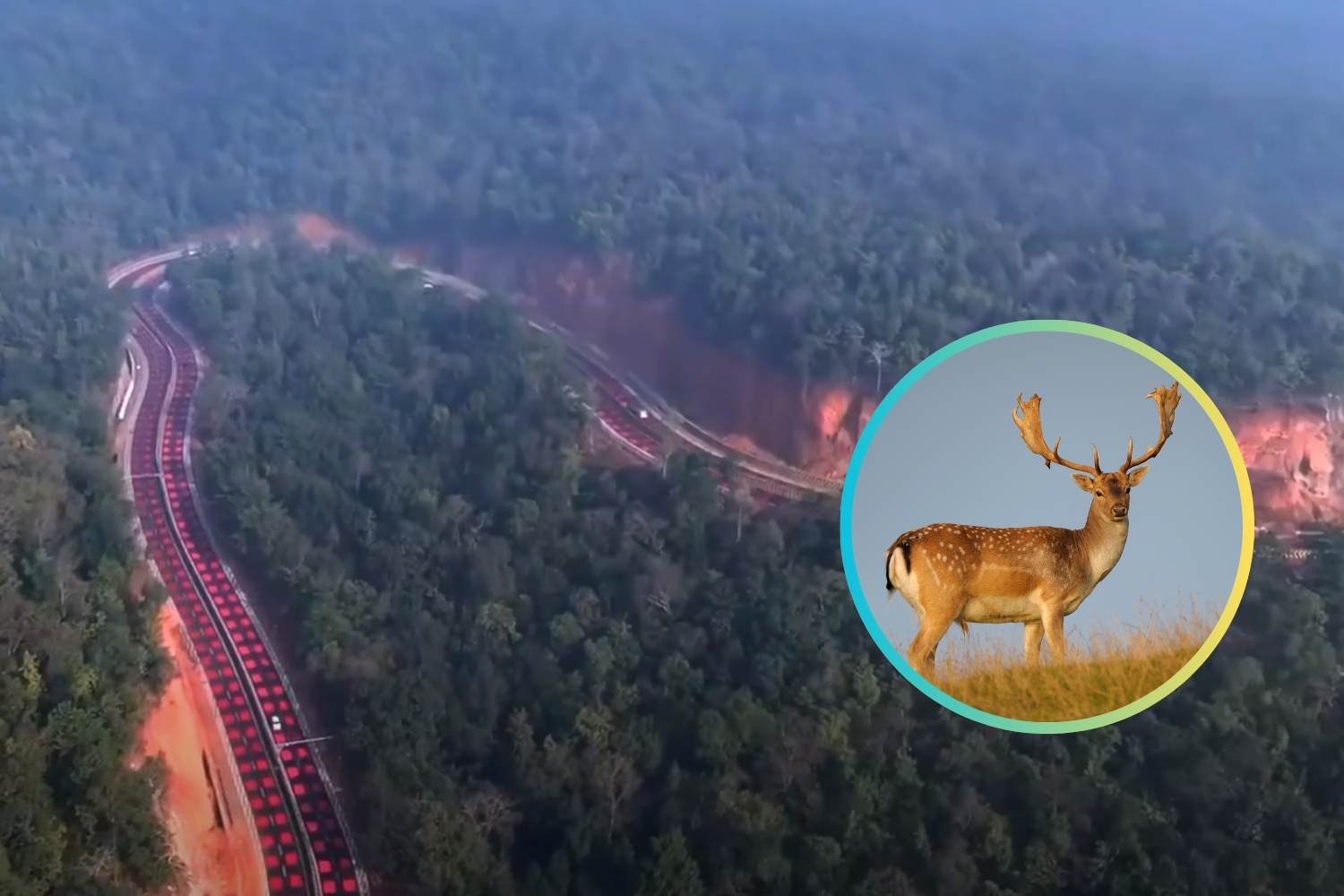
In the heart of Madhya Pradesh, along National Highway 45, India has inaugurated its first wildlife safe road, a project designed to reduce accidents between vehicles and wild animals in one of the most sensitive ecological corridors in the country.
The intervention concerns a segment of approximately 2 kilometers within a larger road project of 11.96 km which crosses areas close to the Veerangana Durgavati Tiger Reserve and the Nauradehi Wildlife Sanctuary. Here heavy traffic has coexisted for years with deer, wild boars and sambar. The National Highways Authority of India’s response was not just a warning sign, but a visible and concrete engineering solution.
The red surface that induces you to slow down
The heart of the intervention is a clearly visible red marking: a red thermoplastic layer, about 5 millimeters thick, hot applied on the entire roadway in the areas considered most critical. The bright color and light raised texture create an immediate signal. No barriers or invasive bumps, but a clearly visible suggestion inviting you to reduce speed.
The idea takes inspiration from solutions adopted on international arteries such as Sheikh Zayed Road in Dubai, but here it takes on a specific environmental function. Red indicates entry into a sensitive wildlife corridor, where the driver’s attention becomes part of the protection system.
Underpasses, fences and continuous control
Safety doesn’t stop at paint. Along the affected stretch, 25 underpasses dedicated to fauna have been built, designed to allow animals to cross the road without exposing themselves to traffic. To guide them towards these passages, fences approximately 2 and a half meters high are installed on the sides of the road to avoid random entry.
To complete the picture there are speed detection devices and cameras positioned at minor bridges, also used as crossing points. Monitoring is continuous and will serve to evaluate the effectiveness of the intervention over time.
The project is part of the Green Highways program promoted by NHAI, which aims to integrate infrastructure development and environmental protection. Consolidated data on the reduction of wildlife collisions are not yet available, but the first findings indicate a reduction in the average speed in the marked sections and a regular use of the underpasses.
In a country where roads cross active reserves and complex habitats, the “red road” represents a paradigm shift: the infrastructure does not eliminate the problem, but addresses it with targeted planning, transforming a critical point into an experiment that hopefully will soon be replicated beyond Indian borders.
You might also be interested in:
