
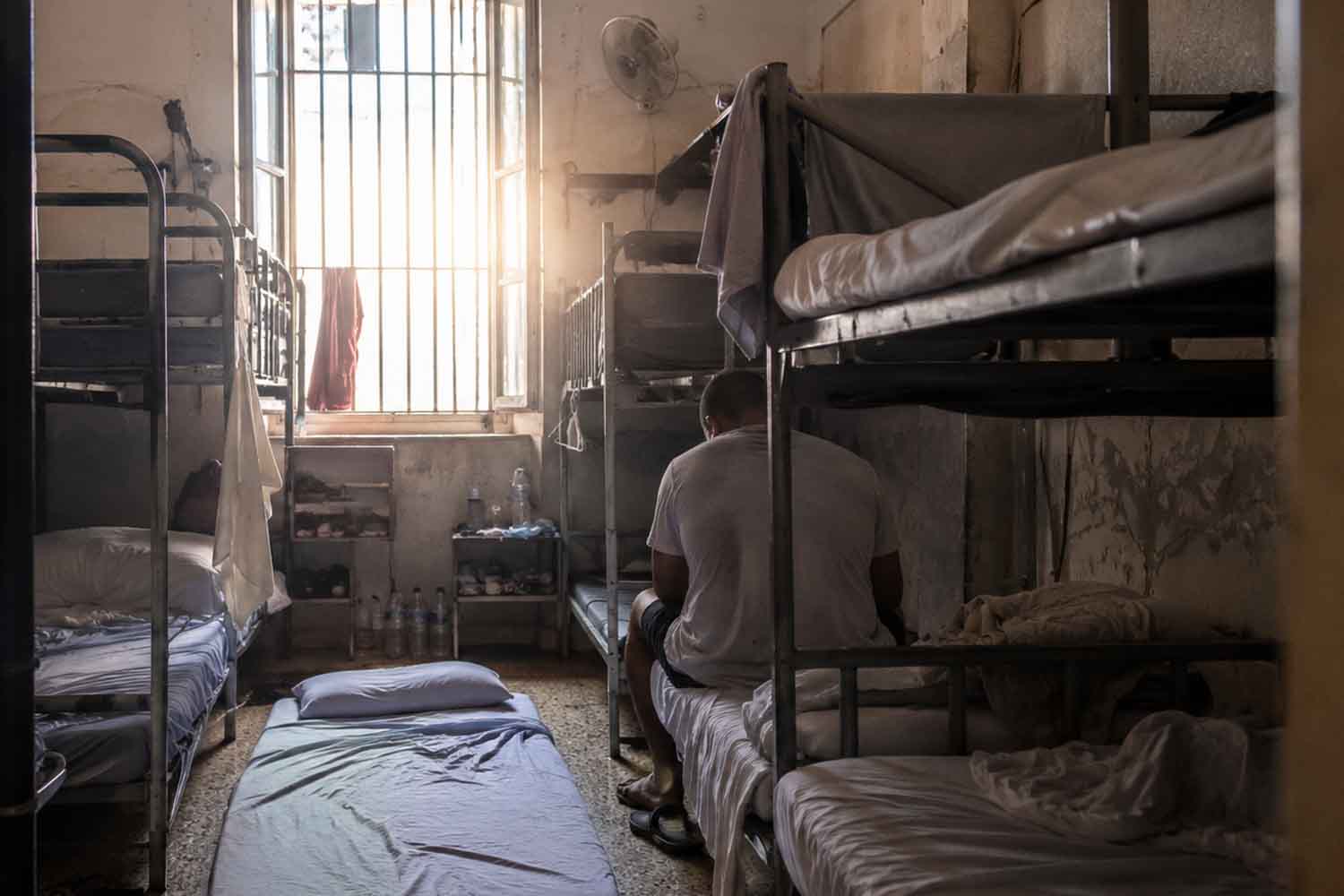
In Sassari, in the Bancali prison, the mattresses fell off the cots and ended up on the floor. The inmates sought refreshment where they could: a few centimeters lower. In Rome, in the Camerotti department of the Rebibbia women’s department, up to five women share rooms designed for three. On the top floors of San Vittore, in Milan, the heat is concentrated inside an institution with a real crowding rate of 223.6%. The mid-2026 report from the Antigone Association describes the heat in Italian prisons like this: bodies squeezed between grates and walls that retain the heat, even before 40°C.
As of July 28, 64,741 people were detained. The declared regulatory capacity amounted to 51,220 seats, but 4,877 were unavailable due to works, closed sections or other reasons. The usable places therefore drop to 46,343 and the average real overcrowding rate rises to 139.7%. Almost three people in the space intended for two. The heat comes in here, with little air and even less distance between one bed and another.
Mattresses on the floor and courtyards without shade
Over 60% of the inmate population lives in closed custody and spends a good part of the day in the overnight room. The four hours outdoors provided for by article 10 of the penitentiary system often fall in the hottest periods. Exposing yourself to the sun in the courtyard or staying in the overheated cell: the hour of summer air can be reduced to this choice.
In Naples, in the Poggioreale prison, some walks take place in spaces without shelter from the sun. In Uta prison, near Cagliari, the summer break suspended activities, a practice also reported elsewhere. In Padua many inmates remained lying on cots during the middle of the day; some reported increased use of medications to manage insomnia and discomfort. Matera has postponed the closing of the cells from 3pm to 4pm. An hour gained against an entire summer.
Then there are the fans. At Milano Opera they are missing in some departments and, where they are present, they may be too small for the rooms. In Rebibbia Femminile the administration declared that it had distributed one per cell, but during visits, rooms were found still without it. At Dozza in Bologna more than one hundred inmates had less than 15 euros in their accounts and could not buy one. In Poggioreale almost all the devices had been purchased directly by the inmates. Air, apparently, is one of the extras.
The heat also reaches juvenile institutions. In Palermo the fans are insufficient and the simultaneous closing of the internal grate and the armored door in the evening blocks the recirculation. The air remains on the other side, with an almost administrative precision.
For fresh water you need a key
On 23 April 2026, a circular from the Department of Penitentiary Administration ordered that refrigerated wells and large appliances be placed in common areas, such as former showers or laundries, outside the cells and corridors. A note dated April 27 clarified that minibars and minibars may instead be allowed in rooms. Communal refrigerators, however, require the intermediation of staff or working prisoners.
In Rebibbia Femminile the inmates must contact the worker in charge to reach the only refrigerator in the section. Drinking fresh water during the night therefore depends on who can open the place. At Milano Opera a refrigerator serves an entire department; in Matera the cells do not have them. Cooling a bottle becomes a procedure, with times, steps and related waiting.
Also in Opera, an electrical fault in the pump left the fourth floor of the second department without water. The Red Cross distributed 600 emergency bottles. In Bollate, some blocked windows and concrete courtyards without shade push temperatures even higher. In Ferrara just two communal showers serve more than fifty people in the medium security sections, while thick metal nets shield the windows.
Six prisons have more than double the number of inmates
The national average smooths out the worst: Lucca reaches 256.8%, San Vittore at 223.6%, Latina at 220.8% and Foggia at 219.9%. Lodi follows with 209.3% and Brescia Canton Mombello with 202.7%. In 25 institutions, crowding exceeds 180%; in 44% of the 72 prisons visited by Antigone there was at least one cell with less than three square meters per person.
In 2025, the supervisory judiciary accepted 6,539 complaints about inhuman or degrading conditions, 12% more than the previous year. The numbers refer to the Torreggiani ruling, with which in 2013 the European Court of Human Rights condemned Italy for overcrowding and detention conditions. Article 27 of the Constitution establishes that punishments cannot consist of treatments contrary to the sense of humanity. The thermometer does not allow exceptions.
The heat also takes its toll on mental health
In the facilities visited by Antigone, 9.3% of the people detained had a serious psychiatric diagnosis. 20.5% regularly took mood stabilizers, antipsychotics, or antidepressants; 46% used sedatives or hypnotics. For every hundred inmates, an average of 6.5 hours of psychiatric care and 16.6 hours of psychological support were available per week. The previous year they were 7.4 and 20.4 respectively.
Between January and August 2, 2026, at least 38 people took their own lives in prison. The report does not attribute these deaths directly to temperatures. However, he records days spent in crowded cells, stopped activities, insomnia, isolation and reduced psychological assistance. In the seven institutions with at least two suicides, overcrowding was high: San Vittore reached around 224%, Teramo 182%, Poggioreale and Viterbo 168%. Material conditions do not explain every gesture. They can make an already existing discomfort even worse.
The penal code expands, the cells remain the same
Responses to the heat begin with much less solemn interventions than a new decree: fresh water accessible even at night, adequate fans, working showers, windows that open, shaded courtyards and hours of air moved out of the hottest bands. We need maintenance, efficient systems, healthcare personnel and activities that don’t disappear with the start of summer. Before adding new cots, there are nearly five thousand existing seats that need to be brought back to usable condition.
In the first half of 2026, according to what was communicated during the control room of Palazzo Chigi, over 960 places would have been recovered or created through maintenance interventions. However, Antigone notes that those actually available have decreased by 424 units compared to July 2025: from 46,767 to 46,343. The plan promises around ten thousand places by 2027. Those usable, meanwhile, have fallen.
Concrete alone cannot absorb an ever-growing prison population. At the end of 2025, according to the XXII Antigone report, 24,348 prisoners had a remaining sentence of less than three years and could have accessed an alternative measure. In the same year, new intakes for probationary assignment to social services and home detention decreased. Investing in offices for external criminal enforcement, in the surveillance judiciary and in reintegration paths would reduce the pressure on the cells without waiting for years of construction.
A counter-trend measure arrived at the end of July with therapeutic home detention for some convicted drug or alcohol addicts. The effect will depend on places in facilities, local services and court decisions. A limited corrective, too small to become prison policy.
General legislative direction runs elsewhere. Since the beginning of the legislature, Antigone has had over 55 new crimes, more than 60 aggravating crimes and over 65 increased sanctions. According to the association, the increase in minimum and maximum sentences makes it increasingly difficult to resort to alternative measures. After the Security decree of 2025, another one arrived in 2026: law decree number 23, converted in April into law number 54. Security decrees upon Security decrees, while fans, refrigerators, psychologists and maintenance proceed at a decidedly less martial pace.
Security continues after conviction: it means preventing a sentence from becoming abandonment, treating mental distress, reducing recidivism and making the buildings in which the State locks people inhabitable. The penal code continues to expand. The cells, the air and the hours of psychologists, however, are increasingly narrower.
