
The summer that is about to end was hellish and it wasn’t just a perception: temperatures in Italy also broke the 2003 record. In particular, August was the hottest ever. Sultry days that seemed to never end, tropical nights, unlivable cities and temperatures well above seasonal averages. If the summer of 2026 seemed exceptionally hot to us, now the numbers also confirm it: it was the hottest ever recorded in Italy since 1950.
According to the analysis conducted by the Institute for Bioeconomy of the National Research Council (Cnr-Ibe) on ERA5-Land data from the European Center for Medium-Term Weather Forecasts (Ecmwf), between June and August 2026 the average temperature across the entire Italian territory was 24.3 °C, measured two meters above the ground. In the unforgettable summer of 2003, the average stopped at 23.6 °C. It means a difference of 0.7 °C on an average calculated not on a single city or on a few particularly hot days, but on the entire national territory, including mountainous areas.
2003 record broken
It might be easy to read these numbers as yet another weather record to add to the list. But the point is precisely another: heat records are becoming less and less exceptional and increasingly closer together. 2003 was experienced as an out-of-scale event, difficult to repeat. Twenty-three years later, that threshold has not only been reached, but significantly exceeded. And looking at 2026 month by month, an even more eloquent picture emerges. From January to August, in fact, every month was warmer than the same period in 2025. July and August 2026 were also, for the first time consecutively, the warmest of the entire series analyzed since 1950.
@CNR
Spring had already given a very clear signal, reaching an average temperature of 12.1 °C, on par with the previous record of 2024. Then in the summer months the situation became truly alarming.
August 2026 was off the charts
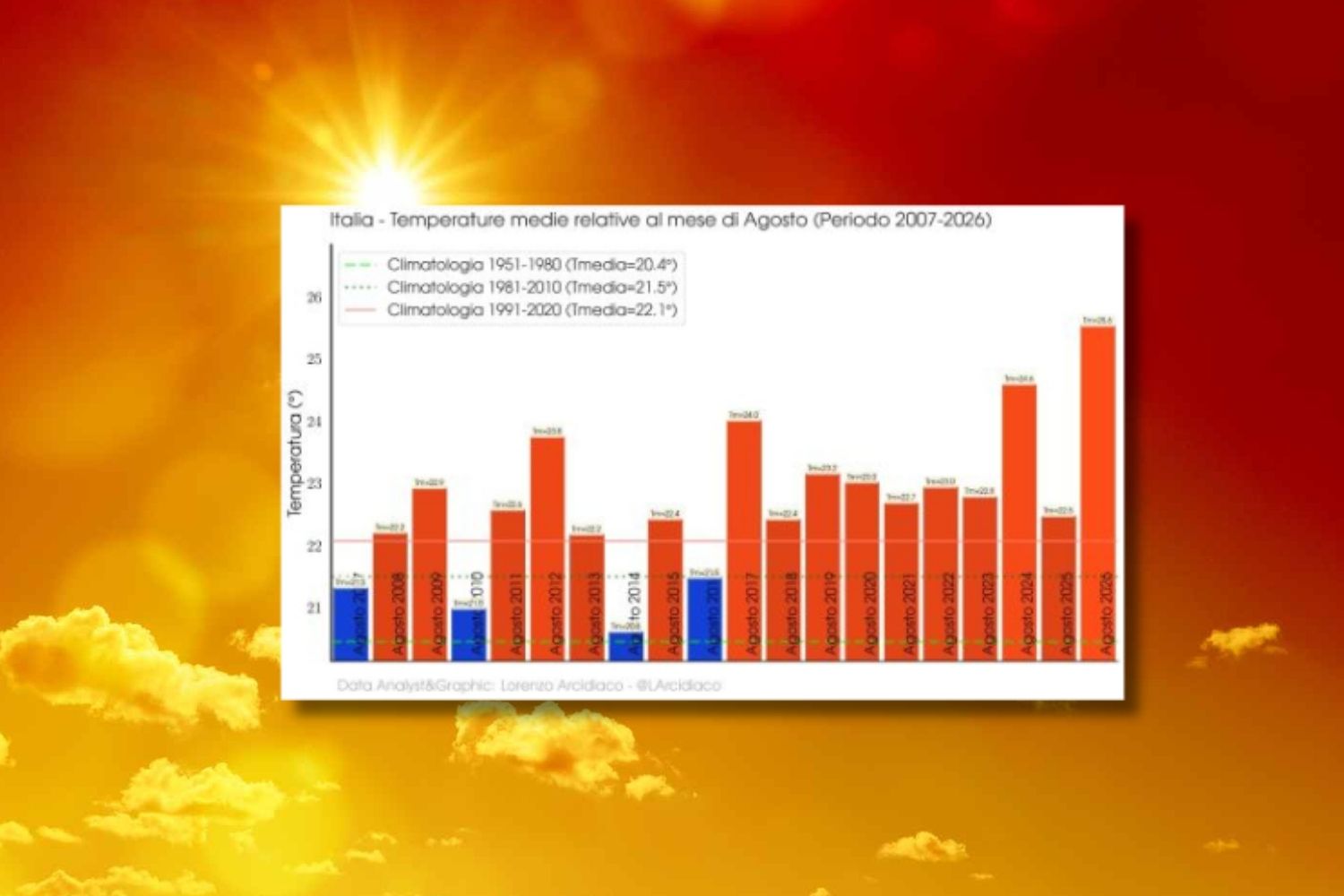
It is precisely the last month of the meteorological summer that shows how exceptional the heat experienced this year was. The national average temperature in August reached 25.6°C.
To understand what this number really means, just compare it with the climate averages of the past: it is 5.2 °C higher than the average for August between 1951 and 1980, equal to 20.4 °C, and 3.5 °C above the average for the period 1991-2020, equal to 22.1 °C. It is therefore not surprising that Lorenzo Arcidiaco of the Cnr-Ibe, author of the calculation, highlighted that 2026 seems destined to become the warmest year recorded in Italy since 1950.
Thermal anomalies are increasingly worrying
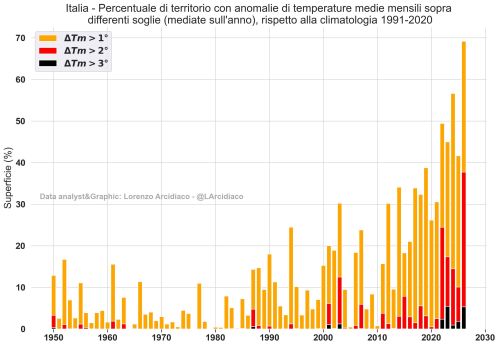
Furthermore, the increase in temperatures does not only concern some particularly exposed areas. Between January and August, approximately 70% of the national territory recorded thermal anomalies above 1 °C, while in approximately 40% of the country the anomaly exceeded 2 °C.
The surfaces exposed to thermal anomalies are very significant, with a concentration in the plain areas of the north-west and the Apennines – observes Cnr-Ibe researcher Lorenzo Arcidiaco – Mostly these are cultivated surfaces which, exposed to a higher temperature and in some areas to a period of drought, mean that the primary sector is the most affected. Confirmation comes from the processing of GSOD (Global Summary of the Day) and OGIMET data (based mainly on NOAA data) concerning Rome, Florence and Turin, which in the months of June, July and August 2026 were all three hit several times by heat waves, i.e. periods in which maximum temperatures exceeded the 90th percentile for at least six consecutive days.
@CNR
And here the heat quickly ceases to be just a meteorological issue: most of the surfaces involved, as underlined by the CNR, are represented by agricultural land. Temperatures persistently higher than normal, combined in some areas with drought conditions, increase crop stress, accelerate the evaporation of water from the soil and increase irrigation needs. It is no coincidence that the primary sector is among those most exposed to the consequences of these anomalies.
The agony of the Alpine glaciers as a wake-up call
To see one of the most tangible effects of galloping global warming, all you have to do is climb up. The summer of 2026 risks being remembered as one of the worst ever experienced by the Alpine glaciers, perhaps even more serious than 2022 and 2023. The alarm was raised by the Legambiente glacier caravan, which over the course of the summer crossed the Alpine arc observing seven symbolic glaciers: from Adamello to Grande Motte, from Miage and Planpincieux on Mont Blanc to the glaciers of Forni, Montasio and Upper Coolidge on Monviso.
The verdict that emerges from the observations is difficult to soften: all the glaciers monitored are retreating and all show signs of increasing instability. High temperatures, a freezing point that remained above 4,800-5,000 meters for a long time, limited snowfall and drought continued to consume the ice relentlessly, while over 70 extreme weather events hit the Alpine regions between January and the end of August. The mountains are becoming more fragile before our eyes: debris flows are increasing, moraines are deforming and entire portions of the glacier are giving way, as happened this summer on Monviso and Montasio.
Making the picture even more disturbing is the fact that the merger did not stop in August. Unusually high temperatures and freezing temperatures still at exceptional altitudes at the beginning of September, during the sixth heat wave of the year, continued to fuel an almost uninterrupted loss of ice. Where snow and ice dominated until a few years ago, new vegetation and pioneer species are starting to appear: not a simple change in landscape, but the visible sign of ecosystems that are rapidly changing their identity. The long-term numbers perhaps reflect the extent of the loss better than any image. From the mid-nineteenth century to 2015, the Alps lost approximately 57% of their glacial surface and 64% of their volume, while after 2000 the rate of decline of the glacier surface tripled. Furthermore, between 2000 and 2023, Central Europe – a region dominated by the Alps – lost around 39% of its glacial mass.
The problem, now, is no longer wondering whether the Alpine glaciers are disappearing, but how rapidly this transformation is taking place and what will remain of the mountains we know. The receding ice does not just take away part of the landscape: it changes water availability, destabilizes slopes, alters ecosystems and makes the future of the communities living downstream more uncertain. The summer of 2026, with its endless sequence of heat and melting, has revealed another piece of that future.
Sources: CNR/Legambiente
