
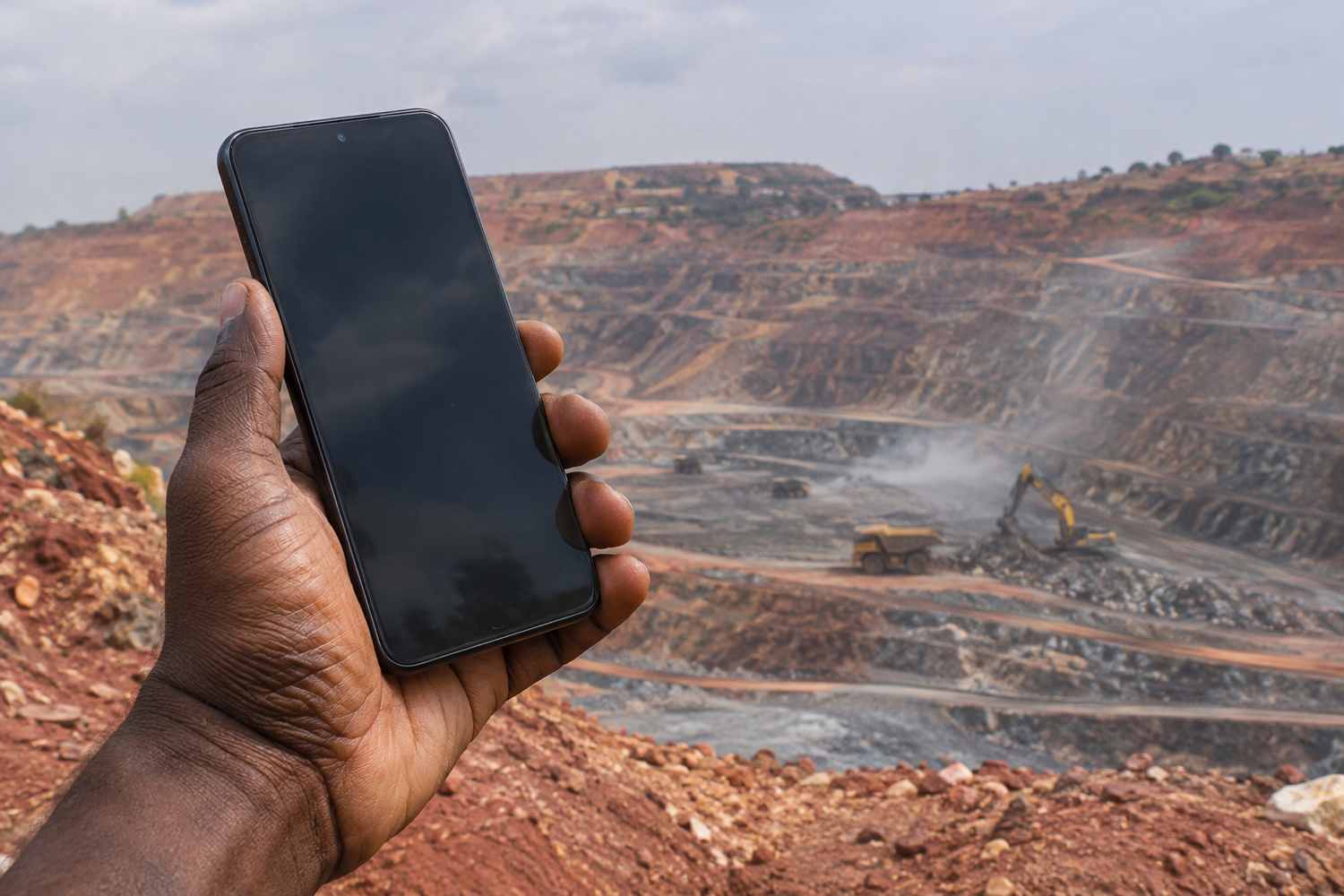
Marie bought the land in 2008, built her house and moved in in 2010. The mine came five years later. The mother of eight children is now one of 27 people, including eight children, who have taken one of the largest mining companies in the Democratic Republic of Congo to court, accusing it of contaminating the water, air and land on which they live. They are asking for a total of 6.3 million dollars in compensation and environmental cleanup.
We are in Kolwezi, in the southern province of Lualaba, one of the main world centers for copper and cobalt extraction. The first hearing was held at the city’s Commercial Court on November 3, 2026. The legal action, supported by the human rights organizations RAID and AFREWATCH, sees among those called into question the Compagnie Minière de Musonoie Global (COMMUS), the Congolese State and the National Environment Agency (ACE).
The mine is 67% controlled by the Chinese giant Zijin Mining, which declares an annual production capacity of more than 120 thousand tonnes of copper and 2 thousand tonnes of cobalt. The latter is one of the metals that allow many of our smartphones to work for hours without being connected to an electrical outlet.
A school less than 500 meters from the mining waste
Marie (not her real name) told the organizations supporting the cause about her experience:
When COMMUS arrived, we already lived here.
Before the arrival of the mine, explains the woman, fishing was done in the stream, vegetables grew spontaneously on the banks and the water was used for cooking and washing. Today, according to his testimony, the fish have disappeared and washing with that water causes skin problems.
A short distance away is the Galaxy School, attended by around 1,500 students aged between 4 and 17. There is less than 500 meters between the school and a large accumulation of mining waste attributable to COMMUS.
During a survey campaign conducted in October 2025, researchers recorded a daily PM2.5 concentration of 44 micrograms per cubic meter, almost three times the value recommended by the World Health Organization. For PM10 it reaches 105 micrograms, more than double the value indicated by the WHO.
Environmental investigations published in June 2026 by RAID, AFREWATCH and Source International also found high concentrations of copper and cobalt in respirable dust collected at the school. One of the pollution peaks was recorded in the late afternoon, when students are still in class or on their way home. And then there’s the water. In a well in the community of Pierre Muteba II, near a mine waste basin, Source International detected concentrations of manganese up to 14 times the limit indicated by the WHO.
Testimonies collected in the region’s mining communities speak of persistent coughs, nosebleeds, skin irritations and reproductive problems. Environmental analyzes document exposure to conditions of severe pollution; an independent epidemiological study that ascertains the link with the pathologies reported by the inhabitants is still missing.
The Congolese state must supervise the mine of which it is a shareholder
Of the $6.3 million requested, about $1.3 million is for damages residents say they have suffered, including medical expenses and economic losses. The other 5 million are intended for environmental restoration. Residents are also calling for clean water, the publication of pollution monitoring data and an independent health investigation.
The case calls into question article 285 bis of the Congolese Mining Code, introduced with the 2018 reform, which provides for a particular form of liability for damage caused by extractive activities. To escape this liability, the company must demonstrate that the damage has an origin unrelated to its activities.
There is also a peculiarity in the corporate structure. As Zijin Mining itself confirms, in 2024 the group sold a 5% stake in the mine directly to the Congolese government. Among the subjects accused of having insufficiently supervised, there is therefore also one of the shareholders of the business to be supervised.
COMMUS denies the charges. In a response to the organizations dating back to July 2026, the company declared that it complies with Congolese environmental legislation, illustrated the measures adopted to contain dust and manage wastewater and recalled the existence of other possible sources of contamination, including previous mining activities and the geological characteristics of the territory. The responsibilities will have to be established in court.
How much Congo is in the batteries of our smartphones
According to estimates from the United States Geological Survey, in 2025 the Democratic Republic of Congo produced approximately 230 thousand tons of cobalt out of the 310 thousand estimated worldwide. Almost three quarters of the entire production. Cobalt is used in several types of rechargeable lithium-ion batteries, contributing to their stability and performance. We find it in smartphones, laptops and many electric cars.
When we talk about Congolese cobalt, we often think of images of children employed in artisanal mines. In Kolwezi, however, we are talking about a large industrial activity controlled by a multinational. Children, in this case, are among those asking for compensation for the consequences of what they breathe and drink while living near the mine.
The automotive industry is already reducing its dependence on this metal. According to the International Energy Agency’s Global EV Outlook 2026, cobalt-free lithium iron phosphate (LFP) batteries accounted for more than 55% of electric vehicle batteries deployed globally in 2025.
The possibility of using different materials already exists. However, the need to control the conditions in which all other raw materials are extracted remains. Including copper, which comes out of the same Kolwezi mine.
Before changing your smartphone, let’s try changing the battery
A battery that no longer lasts in the evening, a cracked screen, a slightly better camera in the model just released. It takes relatively little to retire a smartphone, perhaps perfectly functional in all its other components. Every device replaced prematurely brings with it a waste of materials that someone had to extract, process and transport from one part of the world to another. Extending the life of electronic devices also means reducing the demand for new raw materials.
From 20 June 2025, European regulations on the eco-design of smartphones and tablets require batteries capable of retaining at least 80% of their initial capacity after 800 charging cycles and the availability of the main spare parts for at least seven years from the end of the model’s marketing.
A repairability index also appears on the energy label, from class A to E. Information to take into consideration at the time of purchase, perhaps together with the number of megapixels of the camera. Replacing a battery rather than the entire phone, preferring a refurbished one when you need to buy a new one and correctly returning unusable devices to WEEE collection centers are ways to limit waste and recover materials that have already been extracted.
Europe has taken another two years to control battery supply chains
The responsibility for the conditions in which the raw materials are extracted, naturally, cannot be placed on those who buy a smartphone. Companies must be able to account for the origin of the materials used, the environmental and social risks identified among their suppliers and the measures adopted to prevent them. A sustainability statement on packaging is of rather limited use if this information is missing.
On this front, Europe has also decided to take it with a certain calm. The verification obligations of battery supply chains, also covering the supply of cobalt, lithium, nickel and natural graphite, were supposed to apply in August 2025. With EU Regulation 2025/1561, the deadline was postponed by two years to allow interested companies and control bodies to prepare.
The new deadline is set for 18 August 2027. In the meantime, among the requests presented by the 27 inhabitants of Kolwezi before the court, there is one that is technologically much less ambitious than a latest generation battery: being able to drink clean water.
