
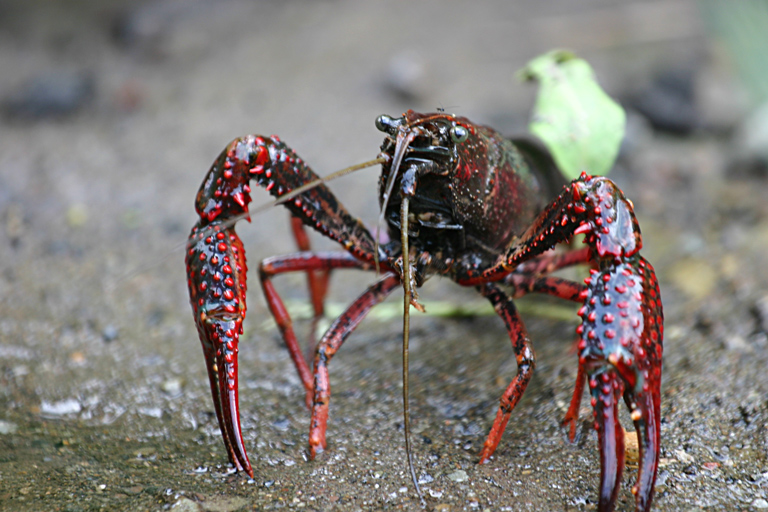
It is not a simple seasonal change that accompanies the first autumn storms in the peninsula’s water basins. When rainfall swells the small tributaries of the middle and lower Garda or floods the wetlands of the capital, the phase of maximum biological aggressiveness of the Louisiana red crayfish is activated (Procambarus clarkii). The freshwater crustacean, native to the areas of the Gulf of Mexico and introduced to Italy in the second half of the twentieth century for commercial farming, is completing the occupation of minor hydraulic networks with serious consequences for the local ecological balance.
@Wikimedia
The colonizing dynamic exploits the humidity of the soil. In the bodies of water and along the ditches, the competition between males equipped with powerful claws and the protection of the eggs by the females in the dens precede transhumances out of the water, useful for conquering any adjoining reservoir, pond or canal.
Massacre of fry and eroded banks
The damage caused by this omnivorous and opportunistic crustacean goes far beyond its simple numerical presence. Its diet eliminates submerged vegetation and sweeps away larvae, eggs, small fish and invertebrates. The disappearance of underwater flora makes the waters cloudy and eliminates the natural refuge of amphibians, insects and fish. The phenomenon has been documented in the field by the WWF Bergamo Brescia in the waterways of Garda, where the association highlights a clear before and after. As stated by the WWF in the Dolomites: “At that point, once upon a time, there was a flock of fish. Today only them remain.”
The threat does not stop at aquatic biodiversity but directly attacks territorial infrastructures. The underground tunnels dug by the species to overcome adverse seasons undermine the compactness of the banks. As underlined again by the WWF in the Dolomites, “the tunnels dug for wintering damage the banks, weaken the embankments and put the water management systems at risk”. A physical destabilization that complicates the maintenance of canals and the management of hydraulic safety.
Our freshwater crayfish at risk
It is primarily the native animal that pays the price of this siege (Austropotamobius pallipes), now reduced to a minimum on national soil. The interaction between the two species leads to a double impact, competitive and health-related. Conservation biologist Francesco Petretti, interviewed by RomaToday regarding the recent sightings in the Parco degli Acquedotti in Rome, defined the alien species as “a competitor that takes away resources from our population of European crayfish”.
Added to this is a pathogenic factor. The North American crayfish is in fact a healthy carrier of theAphanomyces astacithe causative agent of the so-called crayfish plague. It is, Petretti explained to RomaToday, “a mycosis of which this species is a healthy carrier and has devastating effects for native shrimp”. The infection is capable of eradicating entire local populations that are already threatened.
A national and continental emergency
The problem does not only concern the Northern territories. The appearance of the crustacean within the Appia Antica natural park in Rome confirms the inclusion of the Procambarus clarkii in the list of invasive invertebrates of EU importance drawn up as part of the Life ASAP project, like the Asian hornet, the coypu and the American pond turtle.
European legislation strictly prohibits the breeding, sale, transport and release of these specimens into the wild. Containment interventions require promptness: WWF Bergamo Brescia has started a continuous monitoring network on the Garda wetlands to track the spread of the crustacean and support the authorities’ counter-measures. Finally, the environmentalist association recalls that the restoration of a compromised marsh ecosystem is an extremely complex operation and that the only viable path lies in blocking the spread before the alterations become definitive.
