
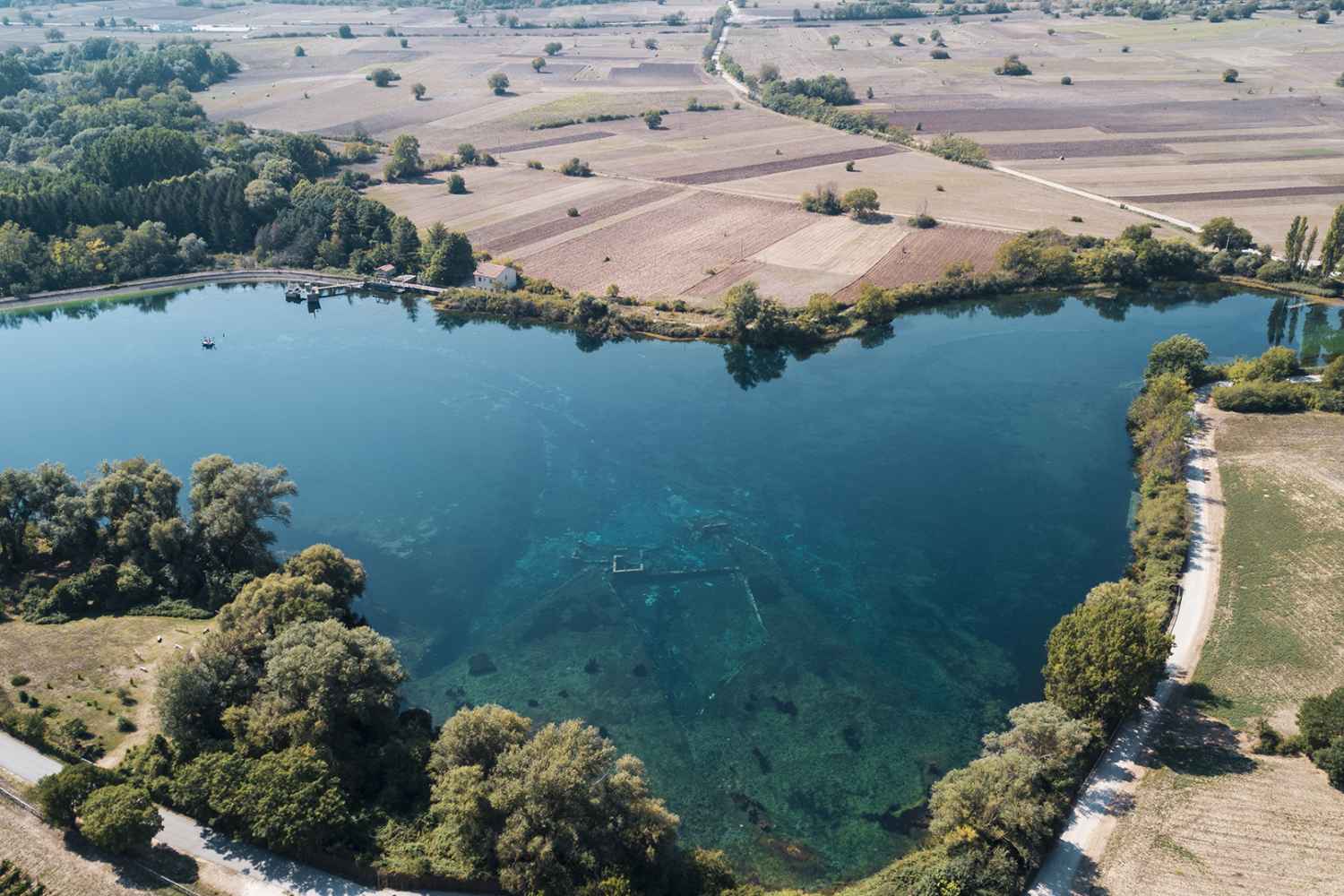
At 340 meters above sea level, on the slopes of Mount Scarafano, the water is so clear that it is possible to see the bottom even at eight meters deep. Down there, among the trout and small freshwater prawns, are the ruins of two mills that once ground the grain of the Verlengia family, a historic Abruzzo family. We are in the heart of Abruzzo, more precisely in Capestrano, in the province of L’Aquila, where the protagonist of this story is Lake Capodacqua. We are talking about an artificial reservoir, built in 1965 by blocking the upper course of the Tirino near the source, a case that determined the current situation: when the water filled the valley, it submerged everything there was, namely a mill of approximately 400 square meters, a paint factory and a stretch of cobbled road with a small bridge. Hence the nickname by which the lake is now known even overseas, the little Atlantis of Abruzzo.
A lake that you can’t (almost) touch
If you are planning a trip to the Tirino Valley, hoping for a refreshing dip, you will be disappointed, because the lake falls within the territory of the Gran Sasso and Monti della Laga National Park, and the status of a protected area excludes both bathing and snorkeling. The only activity permitted is scuba diving accompanied by an authorized guide, a choice that minimizes disturbance to the avian fauna, in particular the migratory birds that winter here.
View this post on Instagram
Another often hidden detail concerns the private property status of the lake, therefore diving can only be organized on weekends, upon reservation, and requires a licence, so the classic “baptism of the sea” is not possible for those who have never worn a tank. The water temperature, between 10 and 11 degrees all year round, still requires a dry or semi-dry suit, even in the height of summer.
What you see underwater
Visibility, according to the diving centers operating in the area, can reach 70 metres, an exceptional figure for a freshwater basin, made possible by the continuous supply of fresh springs which do not allow the lake vegetation to proliferate. It is precisely this transparency that has won over specialized magazines such as Scuba Diving Magazine, which has included it among the 50 best dive sites in the world.
View this post on Instagram
Of the two submerged mills, the first still retains the blades that powered the millstones, although it is in precarious conditions. The second, more imposing, offers more complex environments and structures to explore, even if the earthquake of 6 April 2009 damaged part of it, including an arch which today appears partially collapsed.
The valley around
The lake is just one piece of the Tirino Valley, the river that originates from three sources (Capodacqua, the underground lake of Capestrano and the Presciano source) and which is often cited among the cleanest waterways in Europe. The Park Authority organizes guided excursions along its course on foot, by canoe and by mountain bike, meeting at the Valle del Tirino Tourist and Training Center in Capestrano. Precisely in Capestrano, in 1934, the statue of the Warrior was found, one of the most famous finds of pre-Roman Italian archaeology.
The Piccolomini castle still dominates the village, with the ancient city gates, Porta Parete and Porta del Lago, which open onto alleys and stairways.
By pointing the camera towards the lake, from the outside, without tanks or wetsuits, it will still be possible to find a setting that is truly worth the stop, between cultivated fields, rows and the profile of the Gran Sasso as a backdrop. The rest (the mills, the submerged roads, the bridge swallowed by the water) will remain a secret accessible only to the most expert divers.
