
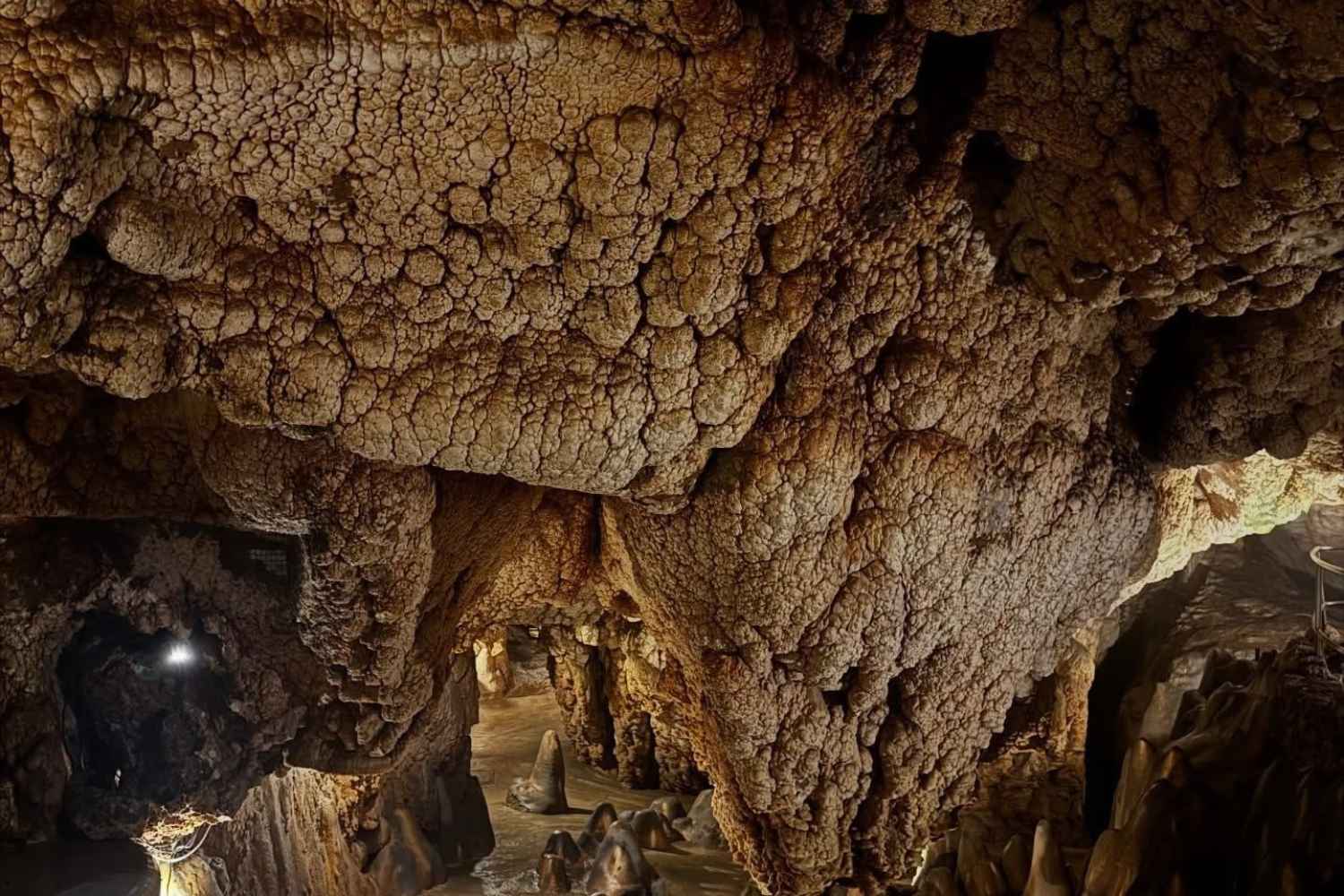
Imagine descending into the depths of the earth and finding yourself in an environment where the temperature is pleasantly warm all year round, steam rises naturally from underground water and the walls are covered in stalactites and stalagmites. It’s not a scene from a movie or an exotic destination on the other side of the world. This place really exists and is located in Italy, in the heart of Tuscany.
In Monsummano Terme, in the province of Pistoia, lies what is presented as the largest natural thermal cave in Europe. It is called Grotta Giusti, it extends for over 200 meters underground and houses a small lake of hot water that reaches 36 degrees.
A natural environment so particular that even Giuseppe Verdi, after visiting it in the nineteenth century, defined it as the “eighth wonder of the world”. And to think that its discovery occurred almost by chance, during some work in a quarry.
View this post on Instagram
Where the largest thermal cave in Europe is located and why it is so special
Grotta Giusti is located on the hills of Valdinievole, a few kilometers from Montecatini Terme, in an area of Tuscany known for centuries for its thermal springs.
What makes it different from classic spas is above all its natural origin. We are not talking about an artificial swimming pool or a wellness center built to reproduce the environment of a cave, but about a real underground cavity, modeled over very long geological times.
Inside there are corridors, natural rooms, rock walls and limestone formations. But the most surprising feature is the microclimate: the air temperature varies between 28 and 34°C, while the humidity and steam create the conditions of a completely natural Turkish bath.
At the bottom there is also an underground lake, called Limbo, whose water maintains a constant temperature of around 36°C.
It is precisely the combination of heat, thermal water and the shape of the rock that makes this place so particular. A sort of natural sauna hidden under a Tuscan hill, where the earth itself produces the heat and steam.
The accidental discovery of 1849: it all started in a quarry
The history of Grotta Giusti begins in 1849, when some workers were working in a quarry on the Monsummano hill. During the excavations they came across an opening in the ground, intrigued, they decided to explore it, lowering themselves into the cavity until they discovered an underground world that had remained hidden until then.
Before their eyes appeared large natural rooms, stalactites, stalagmites and above all a body of hot water from which steam was continuously released.
The discovery quickly attracted the attention of the Giusti family, owners of the land, who understood the thermal potential of the cave. Thus began the first activities related to steam baths, which within a few years transformed the place into a destination frequented by illustrious people. Among these there was Giuseppe Garibaldi, who stayed there to undergo spa treatments in 1867, and later the composer Giuseppe Verdi. A hotel was also built in 1880 to welcome visitors, starting a spa tradition that continues today.
A journey between Paradise, Purgatory and Hell: the three rooms of the cave
One of the most curious aspects of Grotta Giusti is the name of its rooms, which seem to come directly from Dante’s Divine Comedy. The cavity is in fact divided into three main environments called Paradise, Purgatory and Hell, to which is added Limbo, where the underground lake is located.
These are not just suggestive names: as you proceed towards the deeper areas, the heat and humidity progressively increase. Paradise is the initial part, where temperatures are milder. Crossing Purgatory, the climate gradually becomes hotter and more humid, until reaching Hell, where it reaches around 34°C.
Here natural steam envelops the rooms and creates the conditions for the traditional thermal bath, while stalactites and rock formations make the underground landscape particularly spectacular. An unusual experience, especially if you consider that all this happens without the need to artificially heat the environment: the heat comes directly from the thermal waters present underground.
View this post on Instagram
How to visit Grotta Giusti: prices, reservations and useful advice
The good news is that today Grotta Giusti can be visited through organized spa experiences, without necessarily having to stay in the hotel located above the cavity. The structure offers a natural steam bath lasting 50 minutes, during which you can experience the thermal heat directly inside the cave. The treatment has an indicative cost of 50 euros per person, with advance booking required.
For those who want to spend an entire day at the spa, packages are also available that include access to the outdoor thermal pool, hydromassages and other wellness programs. Prices vary based on the services chosen: for example, the Acqua & Relax package, which includes a swimming pool and steam bath in the cave, was offered at 82 euros.
It is important to know that access to the cave is not free or free, unlike some natural hot springs in Tuscany. This is why it is best to organize your visit in advance and consult the official website to check availability, updated rates and entry conditions. Anyone suffering from cardiovascular or respiratory diseases or conditions that may make prolonged exposure to humid heat risky should seek medical advice before booking.
The property is located in via Grotta Giusti 1411, in Monsummano Terme, and can be easily reached by car from the A11 Firenze-Mare motorway, exiting at Montecatini Terme. After all, the charm of this place goes far beyond simple thermal well-being. It is the possibility of entering a natural environment that has remained hidden for millennia, where water, heat and rock have created something that no artificial spa could reproduce in the same way.
And to think that, without the curiosity of some workers working in a quarry in the 19th century, perhaps today we wouldn’t even know about the existence of this extraordinary underground wonder.
