
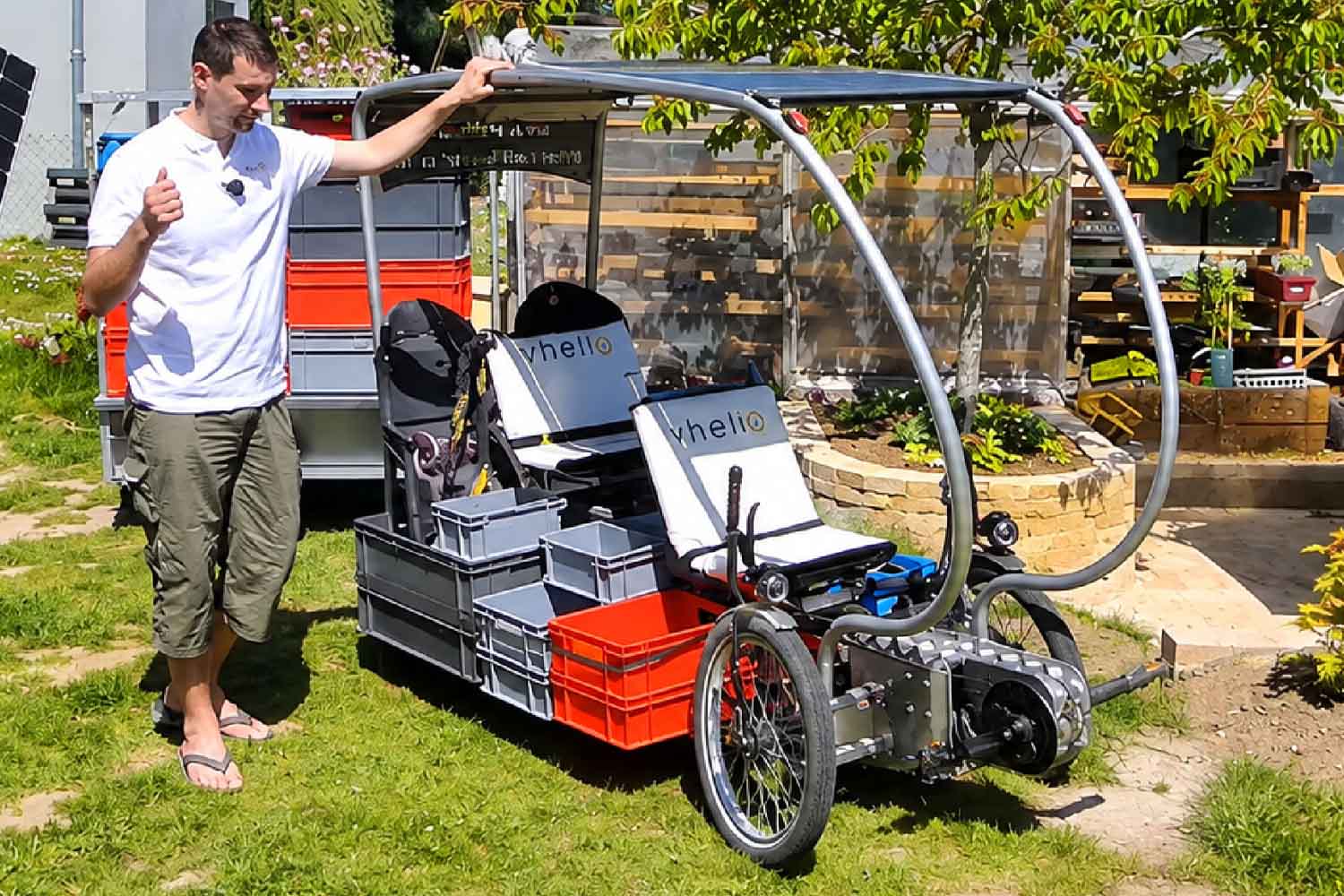
In 2027 an electric tricycle just over two meters long should arrive directly at home in a kit. Two days of assembly, then we ride. It is the new standard Vhélio, the evolution of the open source project born in France to combine cargo bike loading capacity, reclining position and electric assistance. The Vélo Solaire Pour Tous association presents it as a vehicle that can be ordered online, delivered to your home and simple enough to assemble to be compared to a large construction game.
Calling it a small solar car gives a good idea of the proportions, but the technical one a little less. The Vhélio remains a three-wheeled pedal-assisted cycle: 250 W motor, pedals, 20-inch wheels and an open cockpit that is more reminiscent of a chaise longue with a luggage rack than a city car. The pre-series version weighs 77 kilos and measures 2.10 meters in length, 90 centimeters in width and 1.05 meters in height, excluding the possible solar structure.
Two adults, a child and a total of 200 kilos
The configuration announced for the series model accommodates two adults plus a child, with a total transport capacity of 200 kilos which also includes the driver and passengers. The two main seats slide on guides and can be adjusted for people from 1.50 to 2.10 meters tall.
The electrical part changes a lot compared to the Vhélio that is already circulating today. The pre-series features a 250 W and 80 Nm Virvolt motor and a 700 Wh lithium ion battery, for which the association declares approximately 50 kilometers per charge. It is possible to install a second one. Then there are hydraulic brakes with 203 mm discs and parking brake, Shimano Nexus 8 gearbox and steel frame. These are still provisional data: the technical data sheet expressly specifies that the document is not contractual.
The result is something that takes up much less space than a car, allows you to transport people and shopping and, thanks to the three wheels, eliminates even the small detail of having to maintain balance. For some it is quite important: the association indicates among the potential users also those who do not know how to ride a bicycle or have mobility difficulties, as explained in the presentation of the Vhélio project.
The solar panel will be there, but it is not yet the same as the current model
Here it is necessary to carefully separate two vehicles that have very similar names. The Vhéliotech, already available today for DIY, weighs 85 kilos, can carry two adults and two children and uses a 522 Wh battery with approximately 25 kilometers declared per charge. It can mount a 220W flexible photovoltaic panel: according to the data reported in the official documentation, one hour of full sun can add approximately 8 kilometers of autonomy.
Those 8 kilometers per hour of sunshine therefore concern the current Vhéliotech, not the future standard Vhélio. For the latter, the structure intended for the photovoltaic panel still appears among the non-marketed accessories, together with the rain protection, the body, the lateral extensions, the tow ball and GPS localization. The future version may therefore become solar, however the pre-series technical data sheet does not yet assign a precise power or autonomy gain to the panel.
It’s a small distinction only on paper. The new model goes from 522 to 700 Wh per battery, promises double the declared autonomy and also changes frame material, dimensions, weight and transport capacity. Putting the numbers of the two versions together produces a Vhélio that, for now, only exists in slightly overenthusiastic descriptions.
From the garage to series production
The project was born in 2020 around Grégory Barrier, who after a broken wrist began looking for an alternative means of transport to both the traditional bicycle and the car. The Vélo Solaire Pour Tous association was born from the first prototypes, which continued to develop the vehicle with a collaborative and open source logic.
The Vhéliotech was released in open source in 2022: plans, 3D modeling, assembly guide, parts list and suppliers are freely available. The association reports that there are now more than one hundred in circulation. The problem is that building it means buying the components individually and facing a decidedly more demanding assembly than that promised for the 2027 model.
The move to the series also serves to make the project much easier to market. The current Vhéliotech in fact belongs to the world of self-construction, while the new vehicle is developed to be sold with CE marking and in compliance with the European standards dedicated to cargo cycles. The commercial model will also continue to be open source, at least according to the commitments published by the association.
One rather concrete fact is still missing: the price. The association has not published it for the standard Vhélio and is collecting expressions of interest from private individuals, businesses, associations and administrations in view of the 2027 launch, through the official website of the new model. The kit may also resemble a giant LEGO. Before understanding how many we will really see on the cycle paths, the least playful piece of the box is missing: the tag.
