
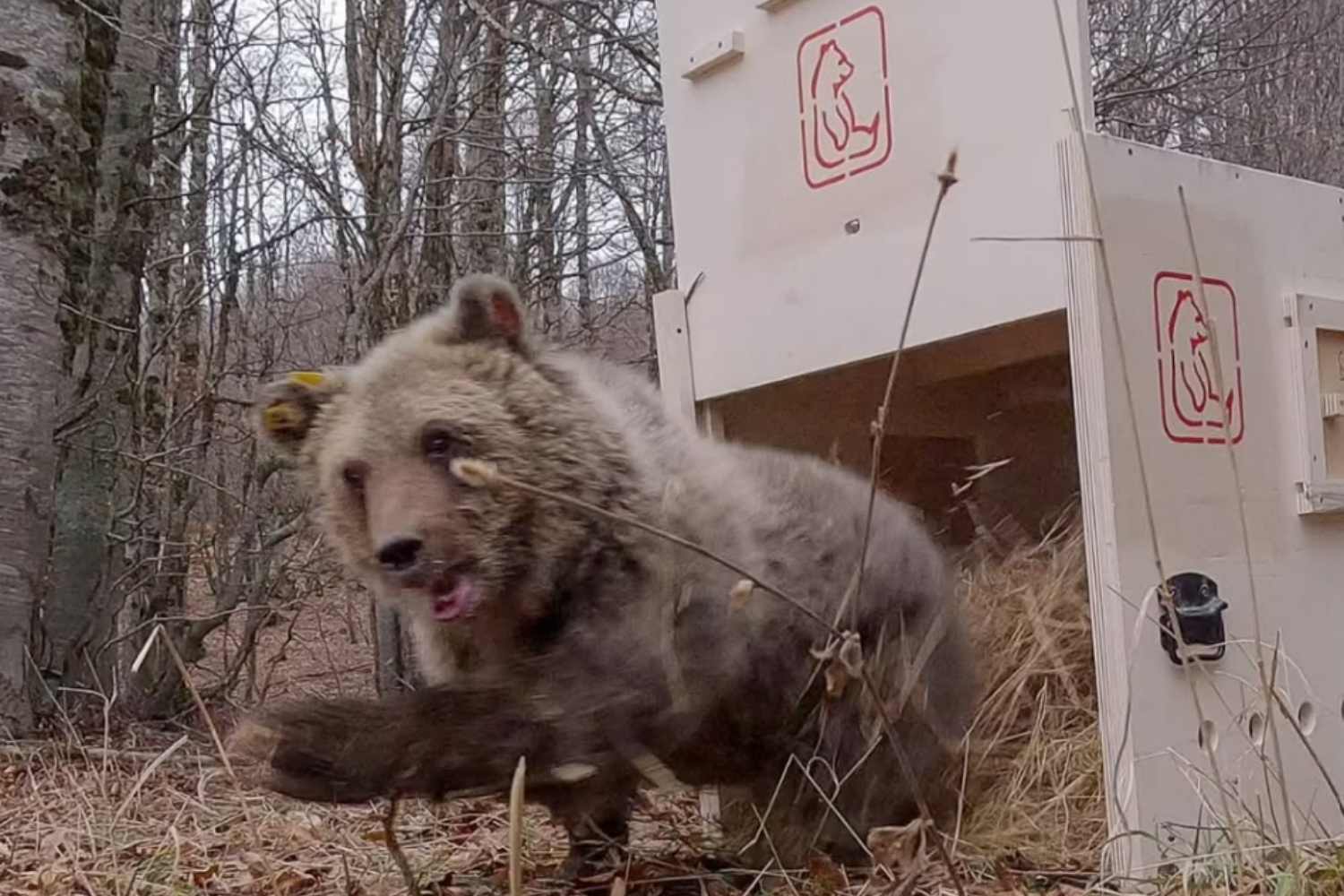
The Marsican bear Nina has returned to the woods of Abruzzo, after being orphaned last May. The release operation was carefully planned by the Abruzzo, Lazio and Molise National Park, with the aim of guaranteeing maximum safety and promoting the young bear’s adaptation to wild life. Nina will face her hibernation in the wild for the first time, a crucial moment for her development and the survival of the species.
In the days before her return to freedom, the staff of the Scientific and Veterinary Service and the Surveillance Service followed Nina carefully. The cub underwent a complete health examination, according to the guidelines for the release of Marsican brown bears, thus ensuring that she was in optimal condition to face the natural environment. The gradual reduction in feeding and the increase in time spent in the den signaled the approach of the slowed metabolism typical of hibernation.
The choice of site and time of release
The choice of the place to release Nina followed accurate scientific criteria. The selected area is located in the heart of the Park, characterized by natural wintering areas, low human density and distance from population centers. The experts considered the weight and behavior of the young bear, deeming her 38 kg adequate to face the winter in complete safety.
Nina will not be left alone: a GSM radio collar will allow remote monitoring during the winter months. The director of the Park, Luciano Sammarone, underlines that the most delicate phase now begins, that of observing without interfering, hoping that the little bear can live free and contribute to the survival of the species.
Not all releases into the wild are successful, but the Park team did everything possible to ensure Nina had a safe path back into the wild. Her return represents an important step for the conservation of the species, with the hope that Nina can grow free and autonomous, far from the risks of human interaction. The Marsican bear population, extremely rare and endemic to the central Apennines, in fact numbers just between 50 and 60 specimens, making each individual fundamental.
View this post on Instagram
You might also be interested in:
