
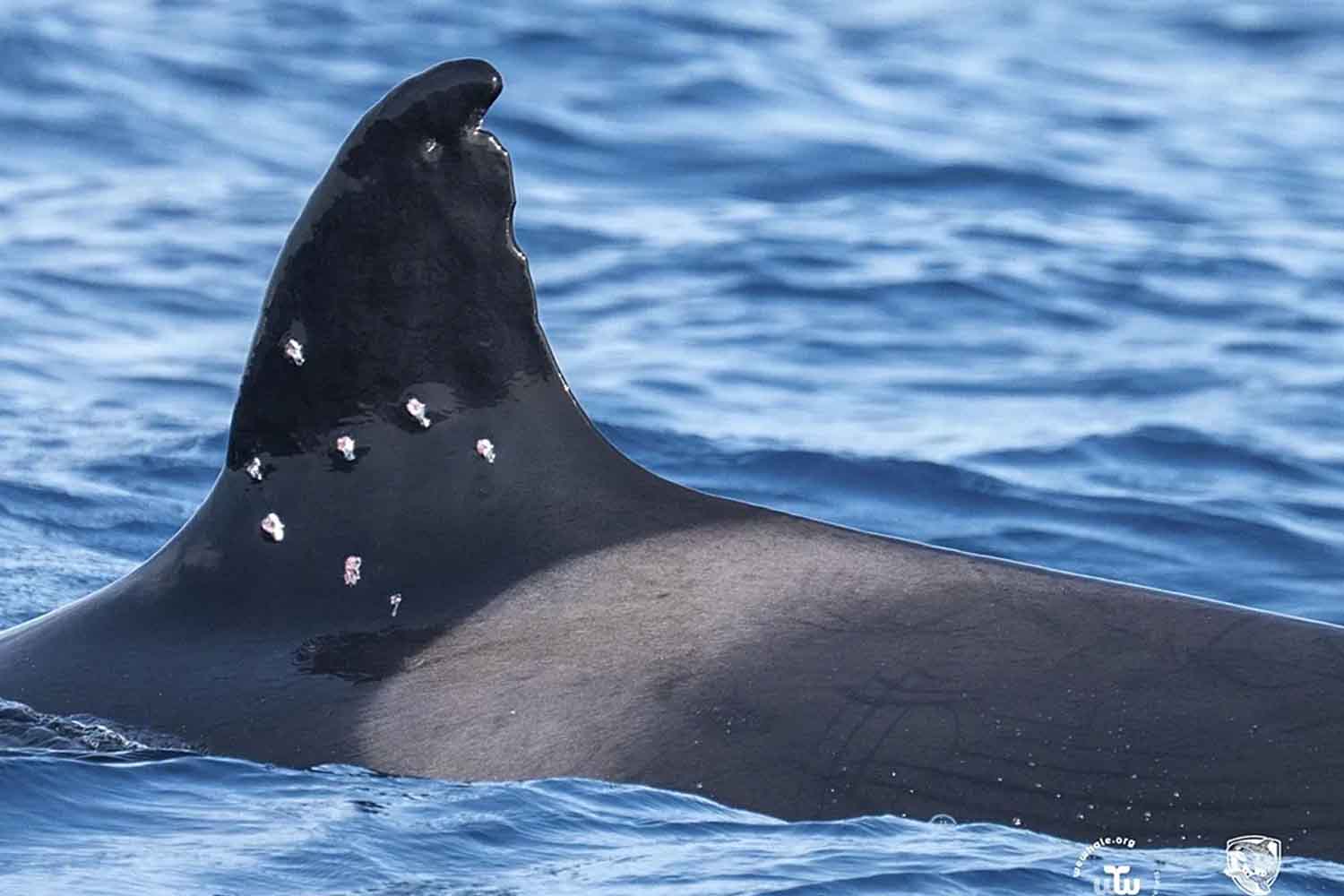
A few weeks ago those wounds weren’t there. Now several circular marks have appeared on the dorsal fin and back of Toñi, the longest-lived Iberian killer whale known, which have triggered a rather serious hypothesis: someone may have shot her. The Spanish Ministry for Ecological Transition opened an investigation after receiving images of the animal and officially speaks of signs compatible with shots from a rifle loaded with pellets or buckshot. Compatible, indeed. The origin of the injuries has not yet been ascertained.
Toñi was spotted in the Strait of Gibraltar and the organizations that have been following her for some time have counted up to a dozen new injuries. The Ministry was informed on 11 August by the WeWhale association, authorized to operate in the area, and the following day the General Directorate for Biodiversity, Forestry and Desertification started preliminary investigations. If the facts are clarified and any perpetrators identified, the investigation could turn into a sanctioning proceeding.
The wounds suggest a rifle shot, evidence is still lacking
The most disturbing detail lies in the arrangement of the signs. The Orca Atlántica Working Group hypothesized that some injuries may be compatible with lead buckshot of approximately 9 millimeters, ammunition also used in hunting cartridges. A lexical difference that matters here: speaking generically of “pellets” makes one think of tiny projectiles, while the hypothesis put forward concerns decidedly larger spheres, what in Italian we would more correctly call buckshot.
However, there are those who are keeping their foot on the brake, and it is a necessary brake. CIRCE, which has been studying the cetaceans of the Strait for decades, has launched a specific investigation into Toñi’s injuries and wants to compare the new photographs with its own historical archive, as well as directly observing the animal again, its behavior, movements and general conditions. Before attributing the wounds to a gunshot, therefore, better images and a more complete examination are needed.
View this post on Instagram
The Spanish Ministry uses the same caution: in the official communication it does not say that Toñi was hit by a firearm, it says that she shows signs compatible with this possibility. It’s a less spectacular distinction than a hole in the fin, but journalistically quite important.
Toñi is the “grandmother” of the Iberian killer whales
In the photographic catalog of the Orca Atlántica Working Group, Toñi is listed as the longest-lived specimen of the Iberian population known. The photographs serve precisely this: the shape of the fin, the notches, the scars and other signs allow researchers to recognize individuals over the years and follow the movements of the different groups. The Foto-ID catalog published in 2023 was built by analyzing approximately 21 thousand images.
This photographic memory makes the appearance of a new lesion particularly evident. And there is also a much less reassuring precedent. The same Orca Ibérica archive recalls that in 2002, in Burela, Galicia, a female arrived near the port in very serious conditions: according to the reconstruction reported by the group, she had been hit by a firearm in the face, had lost the ability to orient herself acoustically and died.
The population of the Strait of Gibraltar and the Gulf of Cadiz is now classified as vulnerable in the Spanish Catalog of Threatened Species. There is also a specific conservation plan, approved in 2017, which regulates activities in the areas frequented by orcas.
Interactions with the boats began in 2020
The suspicion of possible retaliation comes in a story that has made several headlines in recent years. Since the summer of 2020, some Iberian killer whales have begun to repeatedly interact with boats, especially with the rudders of sailing ships. The phenomenon is real, the damage to the boats as well; on the origin of the behavior, however, there is not yet a single and proven explanation. And above all, not all Iberian killer whales participate in these interactions: the GTOA catalog distinguishes the individuals observed interacting with the boats from other members of the population.
The response envisaged by the Spanish authorities is decidedly less creative than a possible hunting weapon. Royal Decree 1727/2007 on the protection of cetaceans establishes distances and rules of behavior, prohibiting actions that may disturb or damage the animals. The most recent indications from the Ministry also recommend avoiding the areas of the Strait and the Gulf of Cadiz indicated in the risk maps in the months with greater presence and, during an interaction, heading towards shallower waters without implementing deterrent systems capable of harming cetaceans.
The protections are substantial even on paper. According to MITECO, violations of the protection legislation can lead to fines of up to two million euros and, in applicable cases, criminal liability. If the gunshot hypothesis were confirmed, therefore, we would not be faced with a particularly aggressive form of “boat defense”, but rather with the possible deliberate wounding of an animal belonging to a protected population.
For now, the most solid data remains what the photographs have recorded: Toñi has new lesions on his fin that are suspicious enough to have pushed the Spanish Government to open an investigation. CIRCE is looking for more images and new encounters with the orca to understand what happened to her. The rifle is still a hypothesis. The signs, unfortunately, are already there.
