
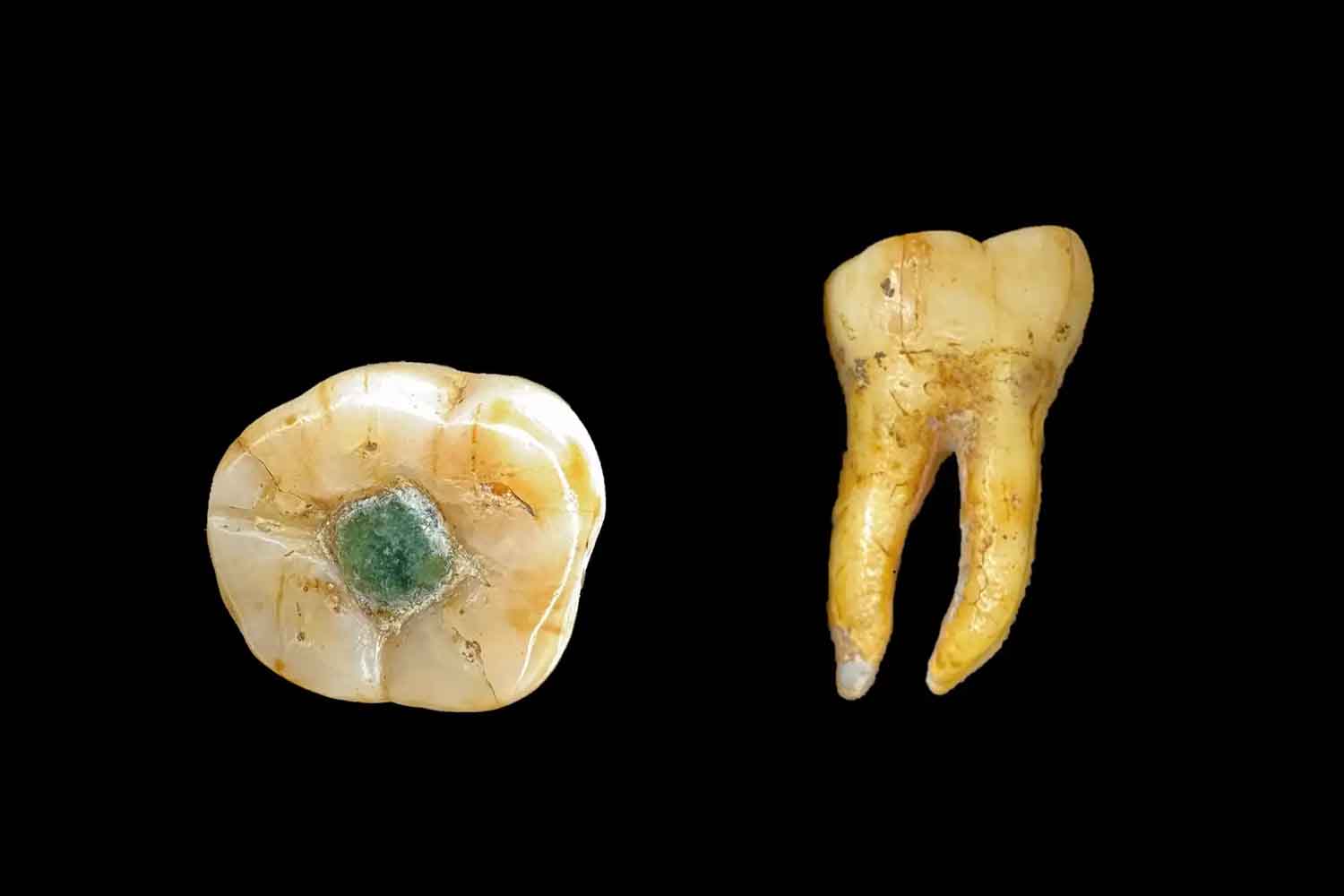
A green stone in the most hidden point of the mouth tells much more than an ornament. On the front teeth it would have made sense: you could see yourself talking, smiling, showing yourself to others. On a molar, however, the jadeite remains inside, working in the darkness of chewing, away from eyes. And it is precisely this detail that makes the Mayan find so interesting that in recent days it has begun to circulate widely online: a back tooth with a small stone set on the surface used for chewing.
The case comes from a study published in 2026 on Journal of Archaeological Science: Reports and concerns a first lower left molar preserved in the osteological collection of the Popol Vuh Museum, in Guatemala. The tooth has a precisely modeled cavity in the center, inside which is fixed a green insert identified as jadeiteor very similar material. The find belongs to the pre-Hispanic Mayan world and is placed, prudently, in a horizon of approximately 1,400-1,500 years ago, even if its exact archaeological provenance remains difficult to reconstruct because it is an isolated element, without the jaw and the rest of the skeleton.
From ritual smiles to the possibility of a concrete treatment performed on a living person
The strongest part of the discovery lies in the radiography, or rather in the cone beam tomography, a technique now also used in dentistry because it allows you to read the inside of the tooth without destroying it. The pictures showed dystrophic calcifications in the pulp chamberconcentrated just below the worked area to accommodate the stone. In simple terms: the pulp of the tooth, i.e. the internal living tissue, would have reacted to the mechanical stress of the intervention. This indicates that the setting was performed when the person was alive, with a tooth still biologically reactive.
The data matters a lot. Mayan dental modifications have been known for a long time: incisors and canines were filed, drilled, decorated with jade, turquoise, hematite, pyrite and other stones. They were complex interventions, linked to identity, status, perhaps to social or ritual passages. The mouth, in many Mesoamerican cultures, had a very high symbolic value. However, most of these changes concerned the visible teeth. Here we are in front of a molar, an area that no one shows during a normal conversation. The jadeite is where you chew, flush with the surface of the tooth, without protruding enough to interfere with the bite.
For this reason the aesthetic hypothesis loses strength. The study remains cautious and is good: the tooth alone leaves many open questions. Gender, social position, precise place of origin and duration of the insert in the mouth during life remain out of reach. However, the position of the setting suggests a very real possibility: the stone could have been used to close a cavity, perhaps after removing tissue damaged by decay or a local problem. A kind of ancient filling, made with precious materials and with a hand that is anything but improvised.
Resins, essential oils and sealants
Already in 2022, another analysis had shifted attention from the “jewel” teeth to the less conspicuous part of the operation: the sealant. To hold the stones in place, Mayan dental artisans used cements capable of resisting saliva, chewing, time and even centuries of post-mortem decomposition. The analyzes conducted on samples from Mayan sites of the classical period, between Guatemala, Belize and Honduras, had identified organic components such as plant resins, essential oils, botanical preparations and bitumen. Some of these substances have potential properties antibacterial and anti-inflammatory.
This changes the way you look at those settings quite a bit. The stone remained visible and attracted the eye, of course. But around the stone there was a precise material technology: small and deep cavities, knowledge of dentin, attention to avoiding the pulp, sealants capable of protecting the tooth from fractures, pain and infections. Previous research has already observed low rates of secondary caries around many inserts, which is difficult to dismiss as simple luck.
In the case of the jadeite molar, the idea of a medical function becomes even more concrete. The Mayan populations had a diet heavily based on corn, and this could promote wear, tooth decay and dental infections. However, working on a back tooth required a practical reason: that tooth was used for chewing, it was in an area that was difficult to reach and offered very little aesthetic gain. The choice to work it, drill it and seal it with a green stone speaks of an already highly developed skill.
Caution is needed, because a single finding is enough to open a trail, without closing it. The cavity may have erased traces of a previous cavity, or the sealant may have made some marks invisible on x-ray images. There also remains the hypothesis of an individual choice, perhaps symbolic, eccentrically personal, linked to reasons that escape us today. However, the tooth does not behave like an ornament to be displayed. It’s in the wrong place for vanity and in the right place for annoyance.
The most interesting thing aboutMayan dentistry it is precisely this: technical refinement comes from small, almost grumpy details. A stone fitted flush. A calcified pulp chamber. A vegetable sealant that holds. A cavity excavated without piercing the internal living tissue. Nothing but a lazy idea of a past made up only of superstition and approximate remedies. Here there were trained hands, suitable instruments, materials chosen with intelligence and an anatomical attention that we recognize today because radiology puts it before our eyes. The rest will come, perhaps, from other teeth. For now this molar remains: small, green, stubborn. Hidden at the back of the mouth, where aesthetics are of little use and pain rules.
