
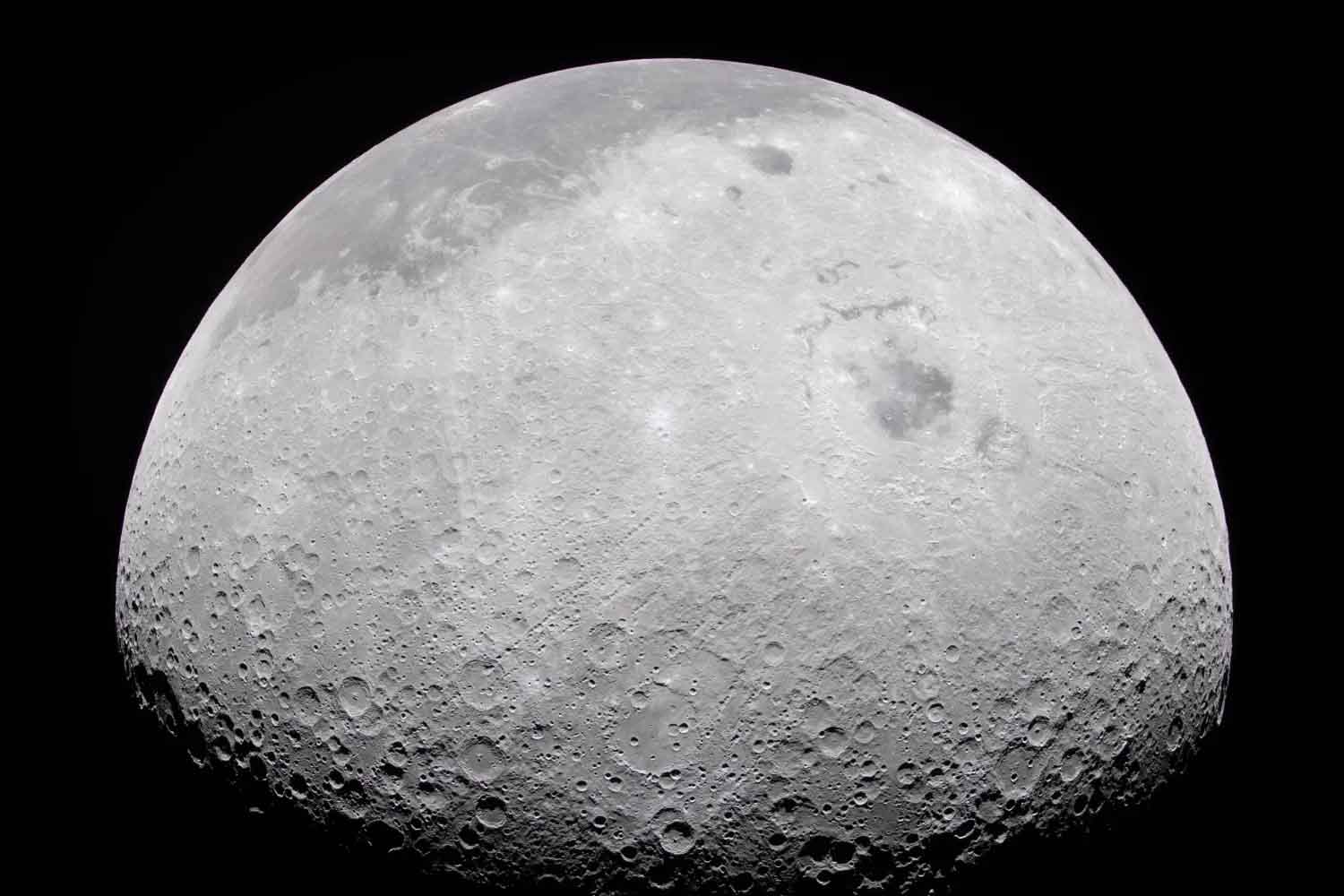
Eighteen meters in diameter, less than three meters deep and a sort of fan of light and dark dust all around. From August 5, 2026, it will be on the Moon a brand new crater unintentionally built by SpaceX: the now unused upper stage of a Falcon 9 excavated it. Six days later, NASA managed to point the Lunar Reconnaissance Orbiter’s camera right there and photograph the result.
The rocket had done its job long ago. He had left January 15, 2025 from the Kennedy Space Center, carrying Firefly Aerospace’s Blue Ghost 1 lander to the Moon for NASA’s commercial CLPS program. After the cargo was released, the upper stage remained in space; according to NASA, solar activity and gravitational forces modified its trajectory until the inevitable encounter with the lunar surface.
A crater 18 meters wide and a very easy target to miss
The impact was expected. Already on August 4, NASA announced that the stage now had a 100% chance of hitting the Moon, in the area between the Einstein and Bell craters. No risk to Earth and not even a particularly huge event in lunar terms: the agency estimated that a meteoroid with comparable energy hits the natural satellite, on average, about once every six days. This time, however, the origin and trajectory of the object were known. It was a rather convenient opportunity to prepare the cameras. Convenient up to a point.
The Lunar Reconnaissance Orbiter passes by at approx 96 kilometers above the surface traveling at about 1.6 kilometers per second. To frame the small crater, the engineers had to tilt the probe and wait for the lunar rotation to bring the right point under its trajectory. It took six days.
©NASA
And it was enough to miss the timing of the shot by ten seconds to find yourself with the target moved by approximately 16 kilometers relative to the center of the image. On August 11 and 12 LRO did it, using its Narrow-Angle Camera, capable of distinguishing details less than a meter wide.
The images allowed us to measure a crater of approximately 18 meters in diameter and less than 3 meters deep. The most detailed analysis published by the Lunar Reconnaissance Orbiter Camera team also indicates that the booster hit the ground at an angle of approximately 31 degrees from horizontal.
The light and dark stripes tell what’s beneath the surface
Around the hole we see a distribution of debris that is anything but uniform. On the southern side a characteristic V-shaped pattern appears, compatible with a low-inclination impact. The interesting thing, however, is above all the color.
The darker stripes come from the surface layer of the lunar regoliththe dusty, fragmented material that covers the Moon. For enormously long times that part of the land was hit by the solar wind, by galactic cosmic rays and by micrometeorites, processes that progressively changed its appearance. According to the LROC team, during impact the Falcon 9 lifted this material off the front Approximately 50 centimetres of depth.
Much brighter areas appear near the edge of the crater. They are less altered materials coming from deeper layers, brought to light by the impact. A piece of rocket that arrived where it was definitely not expected ended up also making a small geological excavation, without an auger and with much less delicacy.
The shape of the impact also offers an interesting comparison with natural ones. An empty rocket has a rather strange mass distribution: large, now lightweight tanks and a much heavier engine concentrated at one end. The orientation with which it reaches the ground can therefore modify both the shape of the crater and the way in which the debris is scattered. In the case of Falcon 9, the result resembles in some respects that produced by a natural body arriving with an inclined trajectory.
First Danuri, then LRO: the rocket also became a test for planetary defense
Even before the NASA images, independent astronomers entered the hunt for the impact point and reconstructed the trajectory using public data. The Center for Near Earth Object Studies of the Jet Propulsion Laboratory, normally busy calculating the orbits of potentially dangerous asteroids and comets, then refined the prediction by exploiting the event to test the tools used in planetary defense.
The predicted coordinates were sent to the South Korean team of Danurithe Korea Pathfinder Lunar Orbiter. Its LUTI camera spotted the new crater a few hours after the impact: the real spot was just distant about a kilometre from the CNEOS forecast. The coordinates obtained by Danuri then returned to NASA and helped LRO plan subsequent shots. A kind of orbital relay to find a hole the size of a small swimming pool.
The episode also leaves a less photographic question. NASA states that controlled impacts of spent stages on the Moon are a technically accepted mode of disposal on certain missions; this, however, was not planned. With the increase in commercial missions in space between Earth and the Moon, knowing the trajectories of abandoned objects and predicting their fate becomes less and less an exercise for enthusiasts.
This time the debris ended up on the far side of the Moon, opened an 18-meter crater and gave scientists a few centimeters of subsurface to observe. At least he had the courtesy to arrive with an appointment.
