
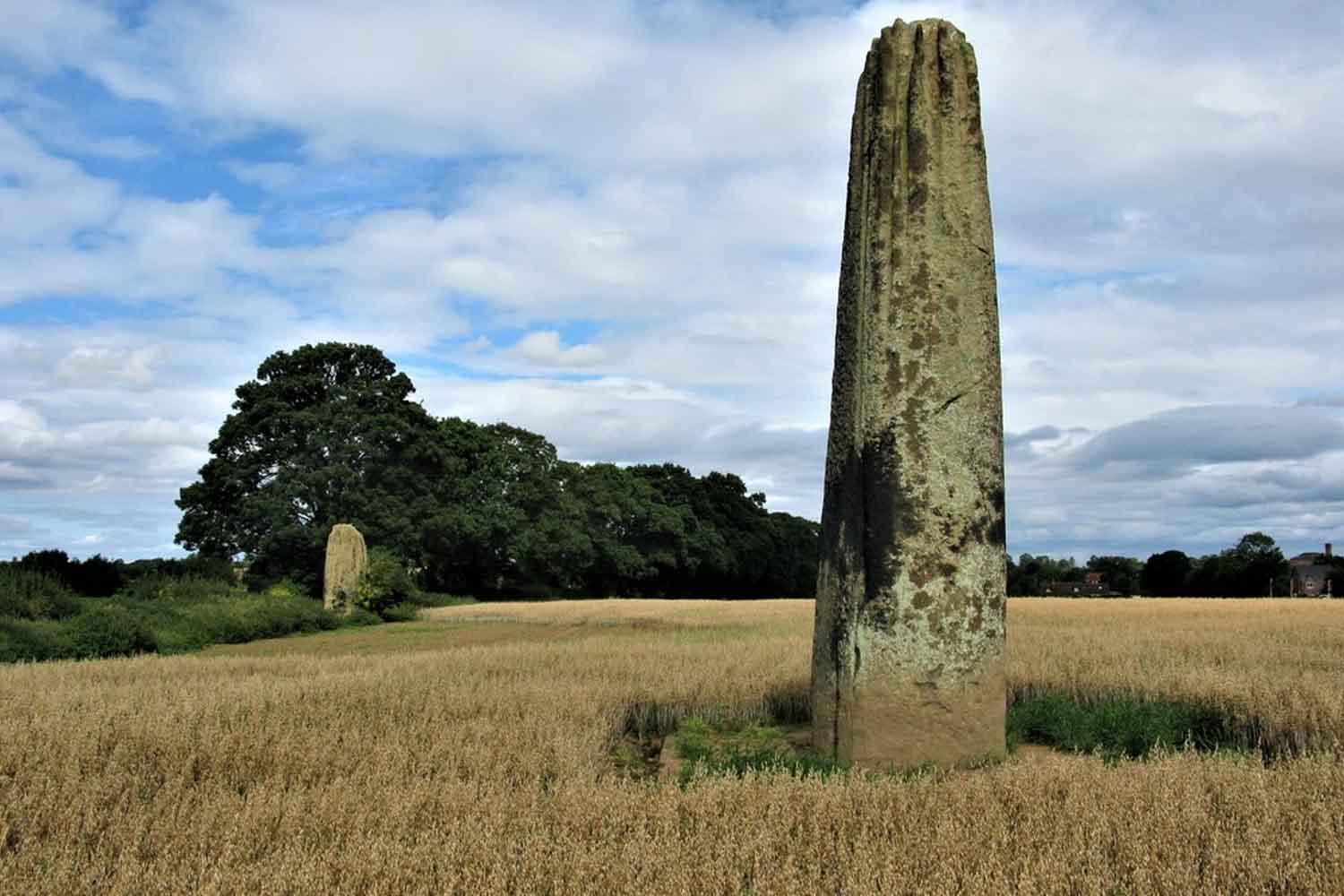
They pressed the municipality adhesive tape against three stones almost seven meters high, waiting for something infinitely smaller to remain on the glue: grains of zircon and apatite. This is how a group of researchers managed to follow the journey backwards Devil’s Arrowsthe gigantic menhirs that have stood on the outskirts of Boroughbridge, North Yorkshire, for around four thousand years. The answer leads to Brimham Rocks, 18 kilometers further west. Those stones weighing over 25 tons were not already there and a glacier had not left them there: someone went to get them and managed to carry them to their destination.
This is shown by the study published on Proceedings of the Royal Society A by Anthony Clarke, Jim Leary and Chris Kirkland. The stones would have been transported and erected between the late Neolithic and the early Bronze Age, perhaps around 2000 BC. As for how, for now, there is no information: we know where they left from, not what they traveled nor how many people it took to move something that weighs more or less as much as four adult African elephants.
They had stones closer. They went to get them much further away
The Devil’s Arrows are made of coarse sandstone Millstone Grit. Suitable outcrops are already found at approx 5 kilometers from the monument; Furthermore, for decades, one of the main candidates was Plumpton Rocks, about 13 kilometers away. Brimham Rocks is even further away and sits in a rugged landscape of large rock formations shaped by erosion. If the goal had been to simply find a boulder to stand on, there were far less strenuous options.
The researchers were able to distinguish them thanks to their kind of geological identity card. In fact, isotope ratios and different crystallization ages remain in the tiny minerals trapped in the rock. Analyzing mainly zircons with the uranium-lead technique, the team obtained a set of characteristic ages and compared it with samples from possible places of origin.
The Devil’s Arrows and Brimham Rocks share a very similar signature. Plumpton Rocks, however, is not. Reconstructing ice movements in the region also makes incompatible the idea that huge blocks from Brimham were gently delivered to Boroughbridge by an ice sheet. Intentional transportation by prehistoric communities thus becomes the explanation supported by all the analyses.
And the duct tape? It served precisely to avoid the most obvious problem: to study a protected prehistoric monument you cannot arrive with a chisel and hammer. The adhesive allowed enough grains to be taken from the surface for analysis without removing portions of the stones. An almost banal technique in its gesture, much less in what it allows you to see.
Three menhirs remained standing and one piece disappeared and was there for all to see
Today there are three Devil’s Arrows, distributed along an alignment of approximately 174 meters. The tallest reaches almost seven meters and, together with the others, forms the tallest alignment of prehistoric stones still standing in Great Britain. However, historical sources tell of a larger monument: in the past there may have been at least five stones, perhaps more.
One of them, then, hadn’t really disappeared. In the 16th century the antiquarian John Leland described a fourth stone still standing; a few decades later it was no longer there. A document from 1687 says that part of a fallen monolith was broken off and used to build the nearby Peg Bridge. In the nineteenth century JR Walbran put forward another hypothesis: a piece of the lost Devil’s Arrow would have ended up in Aldborough Battle Crossa monument approximately 5.5 meters high.
The same mineral signature used to track down Brimham Rocks proved Walbran right: the Battle Cross was carved from one of the stones of the ancient alignment. A Neolithic monolith survived because someone, many centuries later, gave it another job.
Why drag 25 tons for 18 kilometers?
Geology only goes so far. He can say that those blocks came from Brimham Rocks and that communities of the time discarded nearby stone springs. He can’t explain yet because that very place was worth such an effort.
According to Anthony Clarke and Jim Leary, the choice suggests that Brimham Rocks had a particular meaning in the landscape experienced by those communities: cultural, symbolic or perhaps spiritual. It is an interpretation supported by the deliberate selection of a distant source and the very recognizable characteristics of the place, not a belief that we can reconstruct in detail today.
On the other hand, the Devil’s Arrows were not three isolated stones in the middle of the countryside. To the west of the monument there is a vast collection of prehistoric remains between the Swale and Ure rivers, with seven late Neolithic henges. According to the researchers, the alignment may have marked the southern entrance to this great monumental landscape.
Now the group wants to dig around both the Devil’s Arrows and Brimham Rocks. It will be used to try to understand when the blocks were extracted, how they were moved and how people without cranes and engines managed to make tens of tons of rock travel at least 18 kilometers and then put them back upright.
The name will remain the “Devil’s Arrows”, as will the local legend according to which it was he who launched them towards Boroughbridge and missed the target. However, we now have some more certainty about who did the heavy lifting. And to find out, after four thousand years, a piece of adhesive tape was also needed.
