
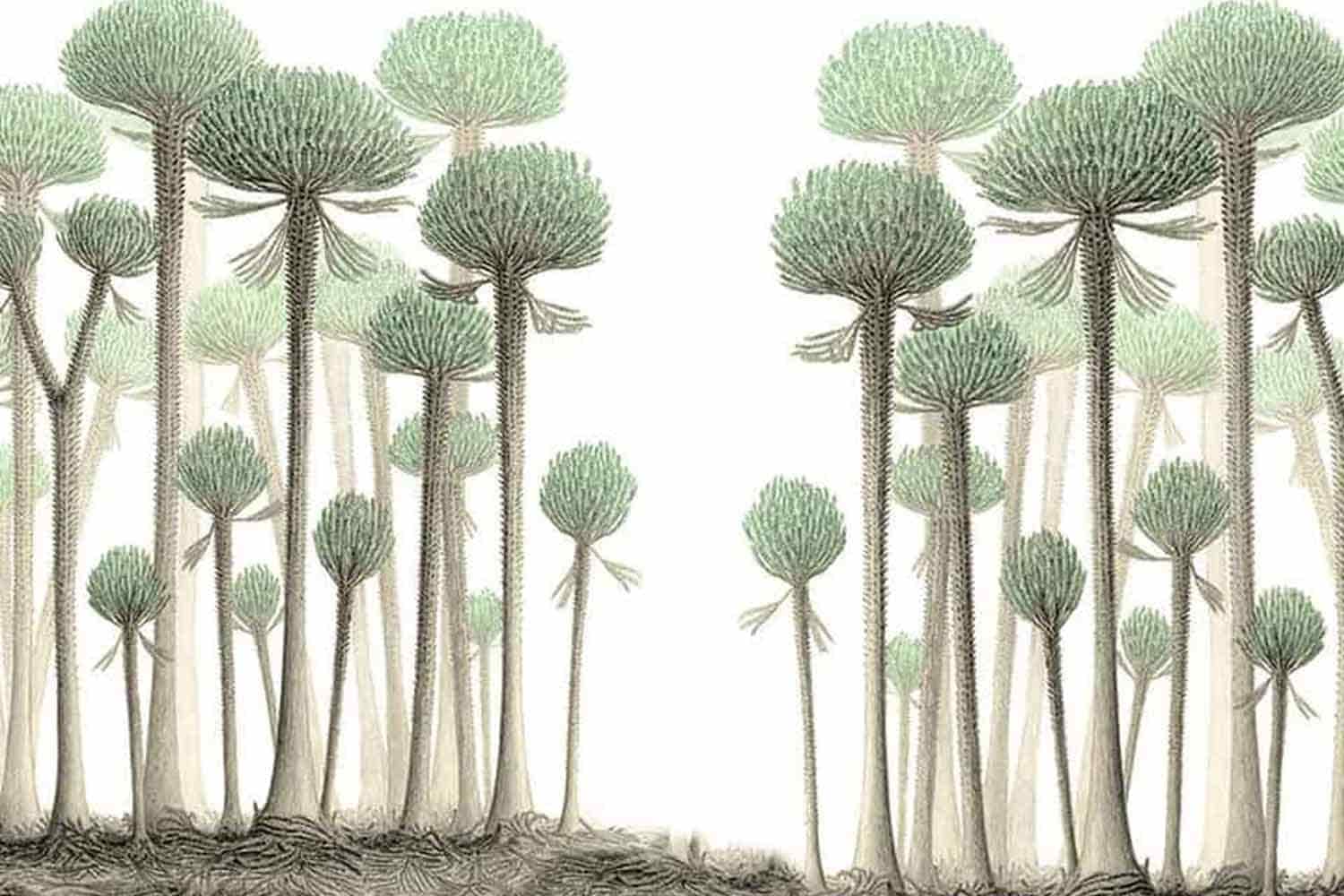
On the cliffs of south-west England, between Devon and Somerset, there is a preserved forest that dates back to around 390 million years ago. It is the oldest known fossil forest in the world and had little in common with those we see today. The trees were just a few meters tall, had thin trunks and crowns made up of hundreds of small twigs. No leaves, no lawns and not even the classic undergrowth. Yet, those strange plants were already helping to transform the planet, modifying the terrain and the path of rivers.
The discovery, documented in a study published in Journal of the Geological Societyis the work of a group of researchers from the Universities of Cambridge and Cardiff. Scientists have identified the remains of ancient trunks, traces of roots and imprints left by vegetation in the Hangman Sandstone geological formation, near Minehead. A sort of photograph imprinted in the rock, detailed enough to allow us to understand how these trees grew and, above all, what was happening around them.
How was the oldest forest in the world
The trees belonged to a group of now extinct plants, the cladoxylopsidsmainly represented by gender Calamophyton. Looking at them from afar they would have reminded us of small palm trees, even if they had no direct relation to modern ones. They reached a height of between two and four meters and had a hollow trunk in the center, supported by a crown of woody bundles. Instead of leaves they had very thin branches, distributed around the upper part of the plant.
Then there was a rather particular characteristic: as they grew, these trees continually lost their lower branches. The ground was thus covered with plant material which, by decomposing, contributed to creating new habitats for small terrestrial invertebrates. As researchers from Cardiff University explain, it was a very different environment from current forests, also because the herbaceous plants that today cover meadows and clearings would have appeared much later.
At the time, moreover, the Earth’s geography was completely different. The region that today forms the south-west coast of England lay much further south and was close to territories destined to become part of Belgium and Germany. The landscape was predominantly semi-arid, crossed by small streams and plains subject to periodic flooding. Precisely in this apparently unfavorable environment, trees began to occupy increasingly larger spaces, giving rise to plant communities capable of modifying their surroundings.
Those strange trees were already changing the course of the rivers
One of the most surprising aspects of the discovery is found in the rocks of Porlock Weir, where researchers have identified traces of an ancient river channel approximately 15 meters and up to 75 centimeters deep. Along its margin, six cavities associated with the bases of trees have remained imprinted, some still connected to the marks left by fallen trunks. Particular erosion marks appear around these structures, produced by the water that flowed around the plants.
These details have allowed scientists to reconstruct part of the relationship between vegetation and waterways. When the river encountered a trunk, the current was diverted, digging up the land in some places and encouraging the accumulation of sediment in others. The roots, meanwhile, helped to retain sand and mud, making the banks more stable. A process that we normally observe today in landscapes crossed by rivers, but which 390 million years ago represented an important transformation.
The rocks also preserve the ripples left by the water, some of which are deviated precisely by the presence of the ancient trees. The researchers were able to recognize different phases in the history of that small environment: the formation of the canal, the growth of vegetation along the banks, the passage of floods and, subsequently, the fall of the trunks. A sequence of events that time has preserved well enough to be reconstructed hundreds of millions of years later.
According to Neil Davies, geologist at the University of Cambridge and first author of the study, these fossils testify to a fundamental phase in Earth’s history, when the spread of trees began to change the behavior of river systems. Plants had begun to colonize land long before, but the appearance of forests made possible a more intense interaction between roots, water and sediments. In essence, trees began to participate in the construction of the landscape.
The English forest is older than the one discovered in New York
Before the English discovery, the record for the oldest known fossil forest belonged to a site near Cairo, New York, dating back to around 386 million years ago. The American discovery, described in 2019 in the journal Current Biology, had already shown how articulated the first tree communities were. In that forest coexisted primitive plants similar to those in England and others with characteristics much closer to modern trees.
Among these were the Archaeopteristrees with real leaves, woody trunks and decidedly more developed root systems. Some root systems identified in Cairo reached an extension of about eleven meters. Quite a leap from the relatively small roots of the Calamophytonwho had colonized the English territory a few million years earlier. The difference tells how quickly the forests diversified during the Devonian, even if the available fossils allow us to reconstruct only part of this evolution.
The comparison is also interesting for another reason. Christopher Berry, paleobotanist at Cardiff University and co-author of the English research, had also participated in the study of the American forest. When he saw photographs of British fossils, he immediately recognized those plants, which he had been studying for about thirty years. The biggest surprise, as he said, was finding them so close to home, after having spent a good part of his career looking for evidence of the oldest forests in different parts of the world.
How the first forests helped transform the Earth
The appearance of forests had consequences that went far beyond the shape of rivers. With the spread of trees, the soil began to develop more complex structures, while roots and plant material contributed to the alteration of rocks and the accumulation of organic substances. As the Natural History Museum in London explains, these changes favored the formation of new terrestrial habitats, offering resources and shelter to organisms that until then had lived in much simpler environments.
Invertebrates had already colonized the land, but vegetation offered them new possibilities. The fallen branches and decomposing organic matter fed detritivorous organisms, while the soils became progressively more complex. Over millions of years, the development of increasingly extensive forests also had consequences on the carbon cycle: through photosynthesis, plants absorbed carbon dioxide from the atmosphere and some of the carbon could remain trapped in sediments.
The spread of large forests thus contributed to the climatic and geological transformations that characterized the Devonian and subsequent periods. Trees grew progressively taller, developed deep roots and articulated crowns, while terrestrial ecosystems began to take on increasingly familiar characteristics. The English forest represents one of the oldest testimonies of this path, when plants just a few meters high were enough to influence the surrounding environment.
There is also a curious detail in the history of the discovery. For years, this part of the British coast had been considered relatively poor in significant plant fossils. Instead, the researchers found traces of trees growing in their original position, along with signs of the waterways that ran through them. An exceptional testimony, hidden in rocks that geologists have already known for some time. And which today tells how, long before the great modern forests, leafless trees just a few meters high had already begun to change the Earth.
