
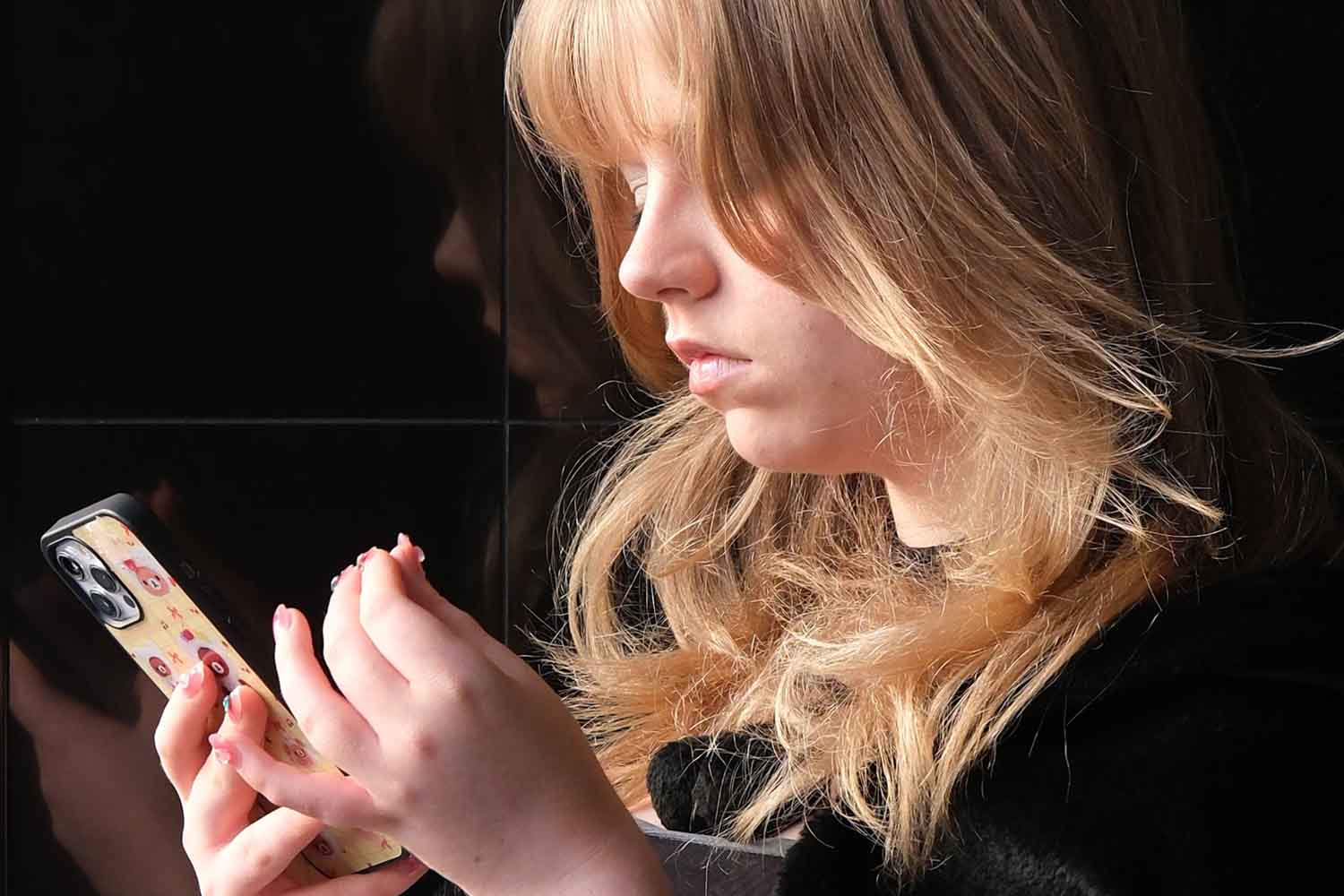
Scrolling through a feed without liking, without commenting, without writing anything. Just look. It is one of the most common activities we do on social media and also one of the easiest to confuse with rest: according to the new survey Eurispes on digital technologies and mental health, 53.6% of those interviewed also use technology to relax. Yet the 79.8% scroll through feeds and content without interactingwhile 78.3% look at other people’s profiles and activities while remaining silent. About three in ten people do this often.
That’s what it’s called passive scrolling: we observe someone’s trip, the house they just bought, the perfect body, the promotion, the dinner, the apparently very happy couple. We are perhaps on the sofa in our pajamas with the washing machine that has just decided to die. The comparison starts with a certain ease.
The survey, published by Eurispes on 1 September 2026, photographs precisely this less evident area of our relationship with screens: the one in which the phone is opened to distract or relax and ends up turning into a long exposure to the lives selected by others. The data describes associations and experiences reported by the interviewees; . Furthermore, the sample size and survey method are not specified in the summary document. The signal that emerges, however, especially among younger people, is difficult to ignore.
Active and passive scrolling are two very different experiences
Posting a photo, texting a friend, commenting on a post, or joining a conversation requires action. In the Eurispes survey, 69.2% publish original content at least sometimes, 63.4% comment on that of others and 79% use private or group messaging.
The passive scrolling it works differently. You consume what comes on the screen without really entering into the relationship. And this method is almost as widespread as participatory ones.
Between the ages of 18 and 24 it reaches impressive proportions: the 96.5% scroll through content without interacting and 98.8% observe other people’s profiles or activities without intervening. At the same time, 97.7% publish content and use private chats. The kids, therefore, participate a lot and observe a lot. They are immersed in the flow from both sides.
Eurispes identifies precisely in this prolonged exposure to the representations of other people’s lives a favorable terrain for social comparison, the perception of inadequacy and the loss of track of time. Passive scrolling, taken alone, does not equate to pathological behavior; it becomes more critical when it takes the form of an automatic, repetitive gesture and continuously looking for the next stimulus.
Among young people, almost one in two feels inferior to the lives they see on social media
Here the numbers stop telling only how much we use Instagram, TikTok or other social networks and start saying something about how we feel while we use them.
Among the users considered as a whole, comparison with the lives of others is felt more intensely by 19.9%. In the range between 18 and 24 year olds, however, 45.1% say they feel inferior compared to the life shown by others.
And that feeling comes along with other signs. 74.4% of very young people lose track of time on social media, 67% get nervous when they can’t connect, 59.7% feel the need to do so continuously and 58.5% feel they are wasting time. 46.3% end up feeling out of touch with the real world.
There is also the other side: 53.7% of 18-24 year olds say they feel less alone thanks to social media and 65.8% are freer to express themselves. The same platform can therefore offer company, personal expression and, a few screens later, very fresh material to feel behind everyone else.
The issue becomes even more delicate because for young people, social media often serves to manage emotions. 70.9% of 18-24 year olds consider it important to use technology to distract themselves from problems, 56.9% give weight to the approval received online and 91.9% declare they have used social media at least sometimes to relieve negative emotions.
We therefore open the phone even when we are vulnerable. And waiting for us we find a flow of people who, by definition, publish a selection of their day. Nobody puts on Instagram forty-seven minutes spent looking for a password or a photo of the registered letter from the Revenue Agency.
The comparison continues even when we are the ones publishing
Digital social anxiety isn’t just about the beholder. The 60.4% of users report at least some degree of concern about what others will think of the content published, while 55% fear negative evaluations. 63.6% check the likes received with a certain frequency and about half modify the posts for fear of reactions or feel discomfort when interactions are few.
The mechanism can thus close on itself. We look at others, we compare ourselves, we publish something of our own, we check how it is received and we look again.
The way in which the platforms are built also contributes to making it particularly effective. According to the Eurispes document, Infinite feeds, notifications, personalized recommendations and approval metrics they promote involvement and permanence. 71.7% of those interviewed recognize that the platforms show content consistent with their interests; among 18-24 year olds the percentage reaches 91.9%. 60.5% of younger people also believe that these systems can influence opinions or moods.
There is one piece of data that clearly illustrates how much automation has become a daily basis: 51.3% of those interviewed check notifications as soon as they wake up and the same percentage looks for updates during the day even when the phone signaled nothing. Among 18-24 year olds the figure rises to 86% and 80.3% respectively.
Reducing automatic scrolling seems to work, when we really try
The majority, however, know their own behavior much less well than they imagine. Only 11.2% regularly monitor the time spent online through phone functions or dedicated applications. 52.9% only have a rough estimate and 35.9% could not quantify it.
Strategies to curb automatism remain uncommon: just 12.7% declare they have adopted at least one, while 30.4% admit they have not done so even though they think they should.
Among those who try, the most common solutions are to turn off notifications and set timers or application limits. This is followed by meals and family moments without devices, periods of digital detox and set times away from the screen. And something seems to be moving: 36.3% say they have achieved their goals, another 44.4% at least partially.
Perhaps the most useful signal comes from here. Passive scrolling may seem like one of the most harmless gestures of the day: the thumb goes up, the video changes, five minutes pass and very often become twenty. In the meantime we have seen bodies, journeys, careers, loves and lives carefully cut out to fit on a screen. The phone was supposed to help you relax. Sometimes we just keep scrolling.
