
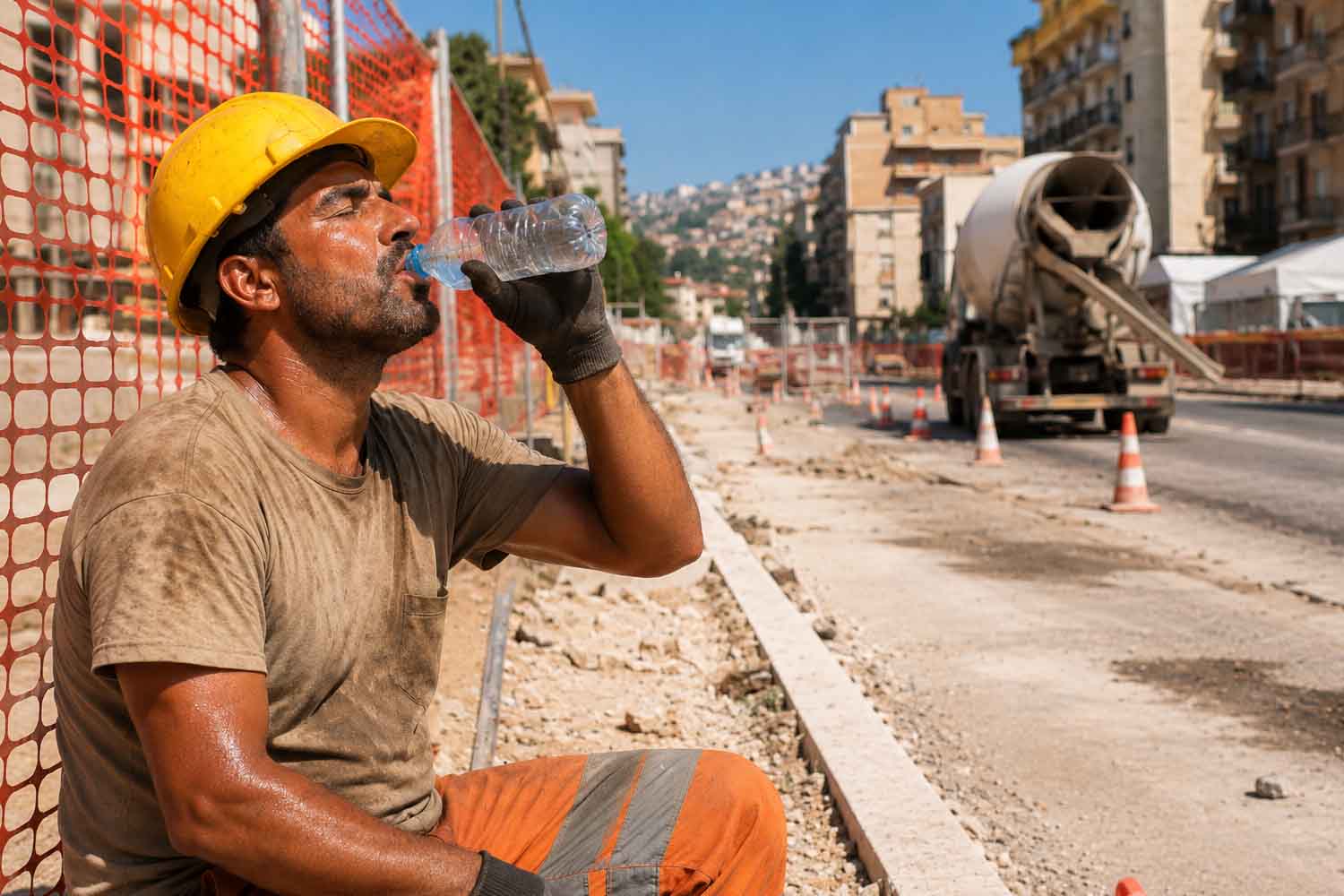
In the large cupboard of omnibus decrees, where Intercity, PNRR, mini-parcels, tourism, public accounting and a few bolts left at the bottom end up, this time the heat has also entered. With his good file, the sweaty shirt and the look of someone who is tired of being treated like an elevator pitch.
In the statement of the Council of Ministers n. 179, within the legislative decree on infrastructure and implementation of the PNRR, the Government reintroduces rules already seen in previous years: some economic operators will be able to suspend or reduce their work activity, with access to the redundancy fund in derogation, in the event of exceptional heat waves.
The formula is dry, almost bureaucratically tanned. Inside there is a simple reckoning: the extreme heat now stops the work. It enters construction sites, fields, yards, quarries, the timetables of those who work outdoors and the pockets of those who risk losing hours. First the shift is cancelled, then the cover arrives, then everything is called an emergency and we move on to the next file. The heat is treated as a production failure, a kind of machine downtime with the sun instead of the screwdriver.
The heat on the payslip
The redundancy fund for excess heat already has its own perimeter. INPS has clarified that it can be recognised, in general, with temperatures above 35°C, also considering the perceived temperature. When an ordinance provides for the suspension or reduction of activities, companies can request salary integration with the reason linked to the stop decided by the public authority.
So far, the good piece is there. Stopping a construction site during an extreme heat wave is a measure of decency even before safety. Covering your income avoids the oldest blackmail in the world: health or salary, you choose, possibly quickly as there is a need to close the delivery.
The problem comes in the transition from sheet to powder. Who checks that that work stops? Who enters the construction site at two in the afternoon? Who looks inside the subcontracting, in the logistics yards, among the riders, in the containers, in the warehouses without good air, in the factories where summer remains glued to the walls? The heat doesn’t just find exposed bodies. Find hierarchies, deliveries, team leaders, tight contracts, fear of wasting hours, attentive companies and companies with the climatic delicacy of a hairdryer turned on in the face.
The Ministry of Health updates heat wave bulletins for 27 cities, with 24, 48 and 72 hour forecasts. From 22 June the number 1500 has also been active, also designed for those who work exposed to the sun. The alert machine exists: bulletins, maps, useful numbers, directions. The Italian problem is rarely the lack of paper. We always find paper. Sometimes even laminated.
Ordinances in the sun
The construction unions have already put the most uncomfortable step on the table. Fillea CGIL reported that the regional ordinances against the heat are still few and that, in several cases, they are disregarded. In the Lecce area, for example, activities still in progress during the time slots in which work should have stopped were reported, with a request for intervention from the inspection bodies.
The ordinance says stop. The thermometer says stop. The body says stop. The shipyard sometimes replies “not long now”. Immortal formula: it’s almost time to finish the casting, to close the load, to pause, to civilization.
According to Fillea, injuries related to thermal stress estimated by INAIL would be around 4 thousand per year, within a phenomenon that is difficult to measure and in all likelihood wider. The union asks for structural legislation, because the extreme summer is not faced every time as if it were a theatrical bolt that treacherously fell on the country.
Even in Lombardy the matter shows all its cracks. The CGIL Lombardia has defined the 2026 heat ordinance as a positive step: from 10 June to 23 September, on high risk days, work will stop from 12.30 to 16.00 for outdoor construction sites, agriculture, horticulture and quarries. Then comes the bill left out of the cart: outdoor logistics, riders, yards, containers, semi-trailers, closed environments without adequate air conditioning. A large, comfortable gray area, perfect for responsible parking with the four indicators turned on.
Water, shade and the rest of civilization
The Worklimate project, developed by INAIL and CNR, provides maps and tools to assess the risk of heat in the workplace. The indications, at the highest levels, are elementary: change timetables, favor less hot periods, increase breaks in shaded or air-conditioned areas, guarantee water, reduce the intensity of physical activity.
The heat cannot become a climatic deduction on the pay slip. If the summer changes, shifts, contracts and controls must change, not the pay slip of those who work outdoors. Water, shade, breaks and risk assessment are the minimum wage for survival, transformed every summer into a negotiation with the timetable, this word that manages to make even haste seem noble.
The redundancy fund for extreme heat is needed. Without economic coverage, stopping becomes a luxury for a few and a rip-off for everyone else. However, an answer centered only on the production stoppage remains lame. It’s like those homes where you put the bucket under the leak and it’s called home maintenance. The bucket helps, but the ceiling continues to drip.
Prevention means moving shifts before they end, writing contracts that take into account climatic conditions, extending protection to those who deliver, load, unload, drive, clean, cook, assemble, systematise, cross the city while everyone else checks the weather app with the air conditioning at 22 degrees.
The drawer decree
The Infrastructure decree contains a bit of everything: Intercity, extensions for road works, compensatory works for the Turin-Lyon line, tax on non-EU mini-parcels postponed, tourism, PNRR, public accounting, strategic plants. There is even a technical passage on the radioactive waste from the “RTS – 1 G. Galilei” nuclear reactor of the Navy, entrusted to Sogin for treatment, conditioning and disposal. The usual institutional drawer where you open to look for trains and you also find waste, tourism and an Ikea Allen key from 2014.
Inside that drawer, however, the heat weighs more than anything. Because it doesn’t stay put in the text. He goes out, crosses the road, climbs onto the scaffolding, enters the field, enters the warehouses, the yards, the vans, the shifts, the pay slips. Politics recognizes this when it remits the redundancy fund for the extreme heat. Paycheck notices now. The body had already sent a registered letter, certified e-mail and reminder.
You might also be interested in:
