
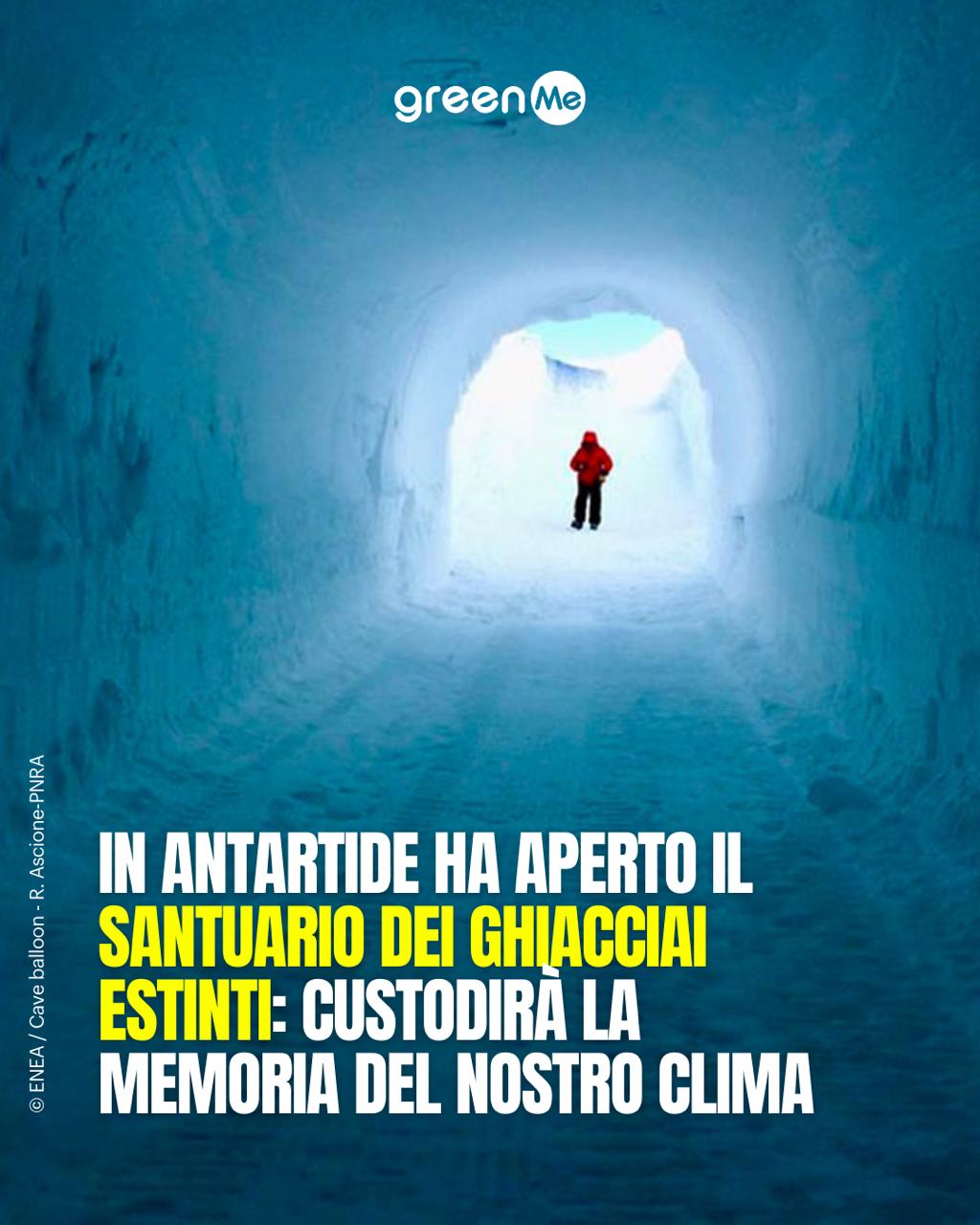
Is called Ice Memory Sanctuary and it will be a mega archive capable of storing thousands of samples arriving from melting glaciers across the globe.
Not far from the Italian-French Concordia base and born from a joint initiative of the Ice Memory Foundation with universities and scientific institutions between Italy, France and Switzerland, the sanctuary of extinct glaciers will be a bit like a time box, with the very specific aim of handing down as much knowledge as possible to future generations.
Since 2000, mountain glaciers have lost between 2% and 39% of their ice, depending on the region, and about 5% globally, according to the Ice Memory Foundation, raising concerns about the permanent loss of valuable climate records.
View this post on Instagram
How the sanctuary works
The pieces of ice will be placed in an archive cave 35 meters long, 5 meters high and 5 meters wide, and dug entirely into the snow layers at a depth of 9 meters. The temperature will be maintained at minus 52 degrees Celsius, guaranteed by the Antarctic Treaty System (#ATCM46), without the use of energy and without the risk of melting or loss of samples.
Ice cores contain air bubbles, dust, pollutants, isotopes and other particles that have been trapped for hundreds or thousands of years.
This “priceless legacy for future generations” will allow future scientists to reconstruct past climates, atmospheric changes, temperature cycles, concentrations of CO2 and other gases, and even historical volcanic events and fires.
We are the last generation that can act – declares Anne-Catherine Ohlmann, director of the Ice Memory Foundation, among the promoters of the project together with other institutions, including CNR and Ca’ Foscari University of Venice – it is a responsibility that we all share. Saving these ice archives is not just a scientific responsibility: it is a legacy for humanity.
In this way, nature itself will preserve these climate archives for future science. Hoping that, in the meantime, things will change.
