
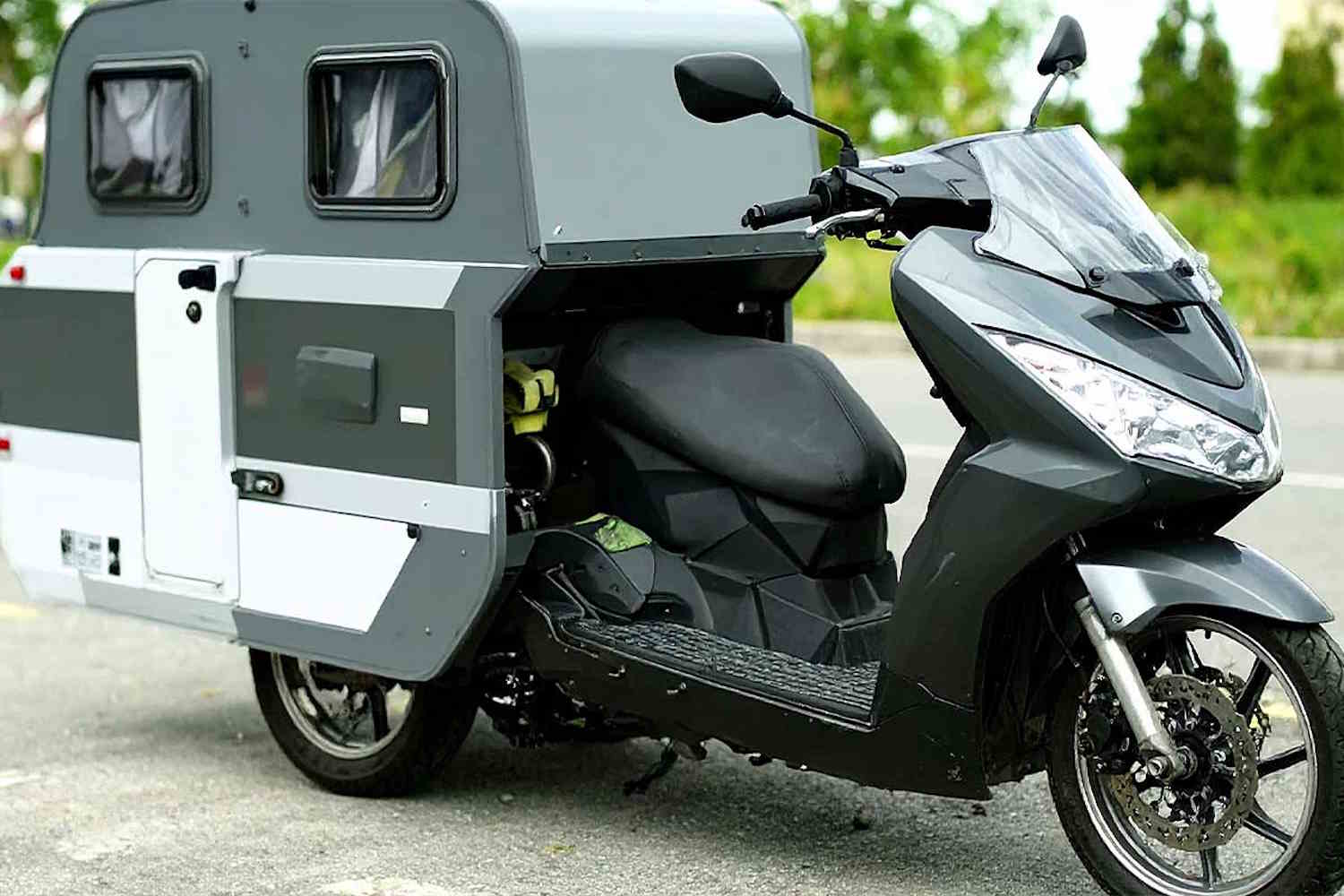
A small Chinese company based in Guangdong has developed a curious prototype: a camping cabin integrated onto a scooter, transforming it into a hybrid means of transport between motorbike and camper. The project is still patent pending and could be launched on the market in the coming months. The stated objective is to reduce the costs of the outdoor experience and, at the same time, offer temporary shelter for homeless people.
The invention was born in a context in which traditional campers are increasingly less accessible: in France, second Le Monde du Camping-Carthe average price exceeded 69,500 euros in the 2023-2024 season, making camping a luxury for a few.
The cabin is welded to the scooter frame
To present its solution, the company used a 150 cm³ Honda PCX scooter, modified with the addition of a rear cabin. Unlike more powerful mini-caravans that can be towed by motorbikes, this cab is attached directly to the chassis. Visually, it resembles a large box with an access door at the back.
No technical details were provided, but from the photos released it seems clear that the interior is too compact to accommodate an adult in a lying position. The most probable hypothesis is that it is an extendable or foldable structure, capable of offering sufficient space for a night’s rest only once opened. The company, however, has not yet clarified either the opening system or the materials used.
While the concept represents an economical alternative to campers, it raises several technical and safety concerns. The Honda PCX’s engine provides only 15 horsepower, which may not be enough to support the additional weight of the cab, especially on uphill journeys or when fully loaded.
In addition to the issue of power, the size of the cabin could alter the stability of the vehicle, making it vulnerable in case of side winds or sharp turns. This risks compromising the handling of the scooter and increasing the dangers in urban areas.
To date, no information has been released on any safety devices, nor on the method of attaching the cab to the chassis. Nor are any alternative versions or accessories planned for daily use known.
The company also offers the vehicle as a temporary shelter for homeless people
In addition to targeting urban camping enthusiasts, the Chinese company indicates that this cabin scooter could also serve as an emergency shelter for people living on the streets or sleeping in cars. A statement which, although not supported by studies or real tests, fits into the global debate on the housing crisis.
According to the Foundation for Logement des Défavorisés, in 2022 there were around 895,000 homeless people in Europe, a figure comparable to the population of cities such as Turin or Marseille. A year later, in 2023, FEANTSA (European Federation of National Associations for the Homeless) published a report estimating over 1.2 million homeless people on the continent.
In this scenario, a compact, economical and (in theory) habitable vehicle could represent a micro-solution to answer part of the problem. However, it remains to be understood how useful this type of product can be, considering its small size, the lack of thermal insulation and the absence of toilets.
Don’t want to miss our news?
You might also be interested in:
