
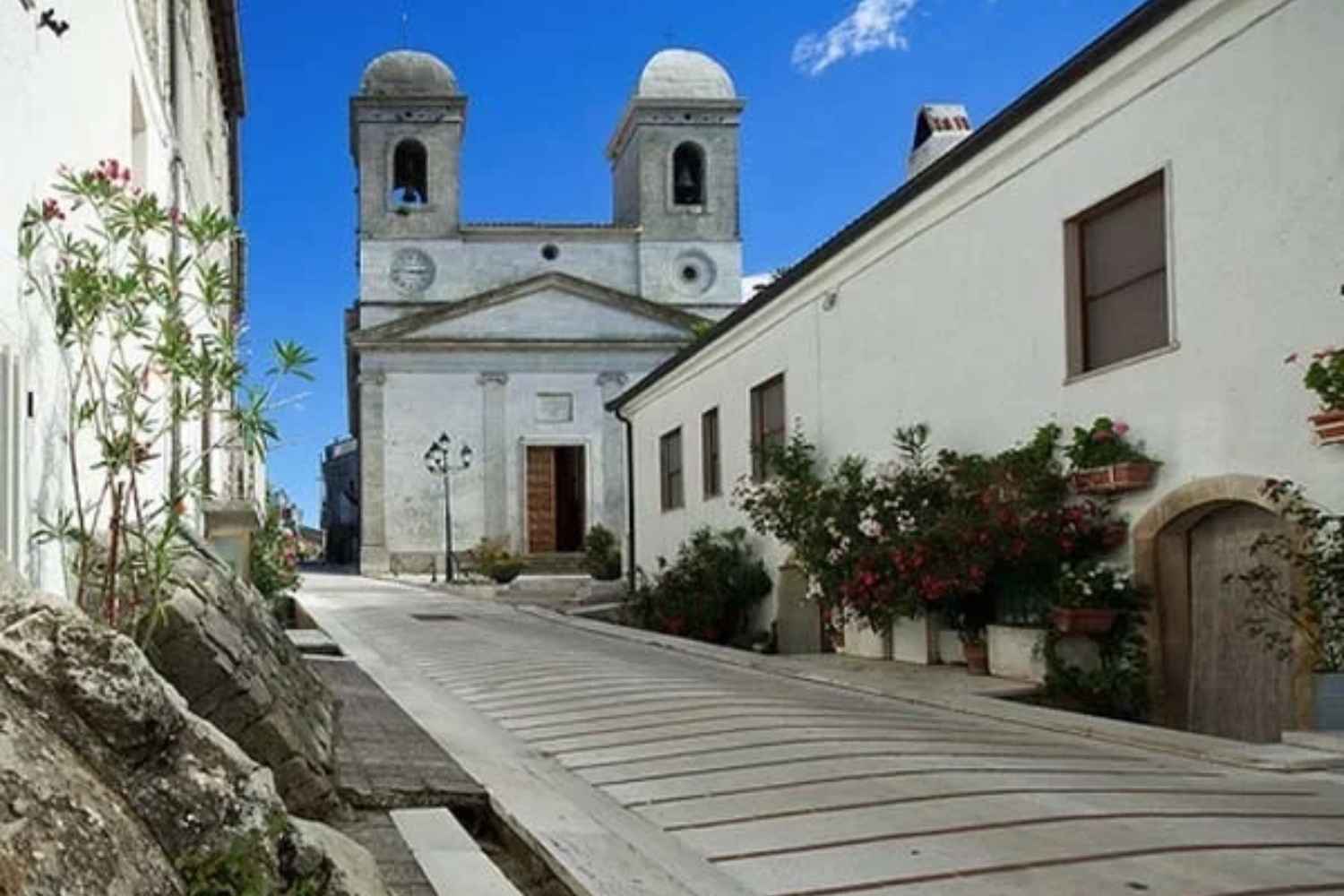
According to data released by the Municipality in 2026, there are 144 inhabitants of Celle di San Vito, a small town in the province of Foggia which holds a record: it is the least populous municipality in Puglia. It stands on the Dauni Mountains, in the hinterland overlooking Campania, in an area of the region far from the large tourist centers and coastal towns.
A language that arrived in the Middle Ages together with a group of soldiers following the Angevins is still spoken here. It is called Franco-Provençal and, after about seven centuries, it continues to be used in the daily life of the country, especially by the older generations.
Celle di San Vito shares this peculiarity with nearby Faeto. The two municipalities constitute the only Franco-Provençal linguistic island in Southern Italy, a community that has maintained a dialect of Gallo-Romance origin over time, despite living hundreds of kilometers from the territories in which this language is historically widespread.
Today the community is trying to recover even the words that risk disappearing. The operators of the Linguistic Help Desk meet the inhabitants, listen to their stories and note down terms that often survive only in the memory of those who grew up speaking Franco-Provençal.
How the Franco-Provençal arrived in the Dauni Mountains
To reconstruct the origins of Celle di San Vito we need to go back to the second half of the thirteenth century, when Charles I of Anjou, sovereign of the Kingdom of Sicily, sent a military contingent to the Crepacore area, a fortified center of the Capitanata, to counter the Saracen presence in the Lucera area.
According to the historical reconstruction reported by Treccani, the soldiers came from territories in the Gallo-Romance area and subsequently obtained the possibility of settling in the area with their families.
During the fourteenth century, following new tensions and incursions, a part of the community moved towards the territory of present-day Faeto. Other families settled near a religious building belonging to the monks of San Nicola. The name Celle di San Vito derives from the monastic cells.
The origin of these communities has long been debated by scholars. Among the hypotheses put forward in the past, that of a Waldensian settlement also appears, but the explanation linked to the Angevin military presence is generally considered the most accredited.
The language preserved by the descendants of those first inhabitants provided further clues as to where they came from. The linguistic analyzes cited by Treccani identify affinities with varieties spoken in an area of present-day France between Lyon, Vienne and Grenoble.
Franco-Provençal, in fact, belongs to the group of Gallo-Romance languages and is historically also present in the Aosta Valley, in some areas of Piedmont, in French-speaking Switzerland and in eastern France. Its presence in two small towns in Puglia therefore constitutes a particular case in Italian linguistic geography.
A language that changes from one generation to the next
In Celle di San Vito the Franco-Provençal is also called Cellese. The village itself is known in the local language as Celle de Sant Uite or Screwas reported on the institutional website of the Municipality.
The local speech retains linguistic characteristics that distinguish it from both Italian and the dialects of southern Italy. Among these is the use of the particle pa to construct negative sentences, placed after the verb. This is a typical structure of the Franco-Provençal varieties.
Personal pronouns also have particular forms, such as gigge míngewhich means “I eat”, e I’ll give you a damn«you eat». Scholars have also identified specific characteristics in the pronunciation of vowels and in the formation of possessive adjectives.
The survival of this language, however, presents some difficulties. The sociolinguistic research reported by Treccani highlights important differences between generations: the elderly maintain a more direct relationship with traditional speech, while among young people Italian and mixed linguistic forms often prevail.
The daily use of Franco-Provençal has thus progressively narrowed, while maintaining a strong cultural value for the community. The language is recognized among the historical linguistic minorities protected by national law 482 of 1999 and by the Apulian regional legislation.
A dictionary built by listening to the inhabitants
In October 2026, a new phase of the work of collecting Franco-Provençal words was started. The operators of the Celle di San Vito linguistic help desk are meeting the inhabitants, especially the older ones, to recover words, proverbs and lullabies that risk falling out of common use.
The material will be included in a new edition of the local Franco-Provençal dictionary, whose publication is scheduled for 2027. A first edition was published in 2022; the new volume will be expanded with terms recovered through the testimonies of the inhabitants and with an in-depth study of the pronunciation. Lina Giraldi, a retired teacher originally from the town, also collaborates in the drafting.
The work proceeds through meetings and conversations. Sometimes it is enough to listen to an expression used by an elderly person to identify a word absent from previous collections. The operators of the Linguistic Desk told ANSA that the research allows them to recover almost forgotten terms linked to the life and habits of the twentieth century.
In the meantime, the country has also started to use social media to make itself known. In summer 2026 the Municipality launched the project We are the Cells of San Vitoa series of videos in which the residents themselves talk about life in the village: from the owner of the grocery store to the president of the football team, up to the children who go to school every day in a nearby municipality.
The videos, made as part of a cultural valorization project financed by the PNRR, were published on the Municipality’s official YouTube channel. According to what ANSA reported in August 2026, the videos had already totaled around 1.2 million views in just over a month.
The Linguistic Help Desk also proposed teaching some Franco-Provençal expressions to tourists visiting the country. An activity that adds to the work on the dictionary and cultural initiatives dedicated to the local language.
In Celle di San Vito the collection of testimonies continues house by house, while the working group prepares the new vocabulary expected for next year.
