
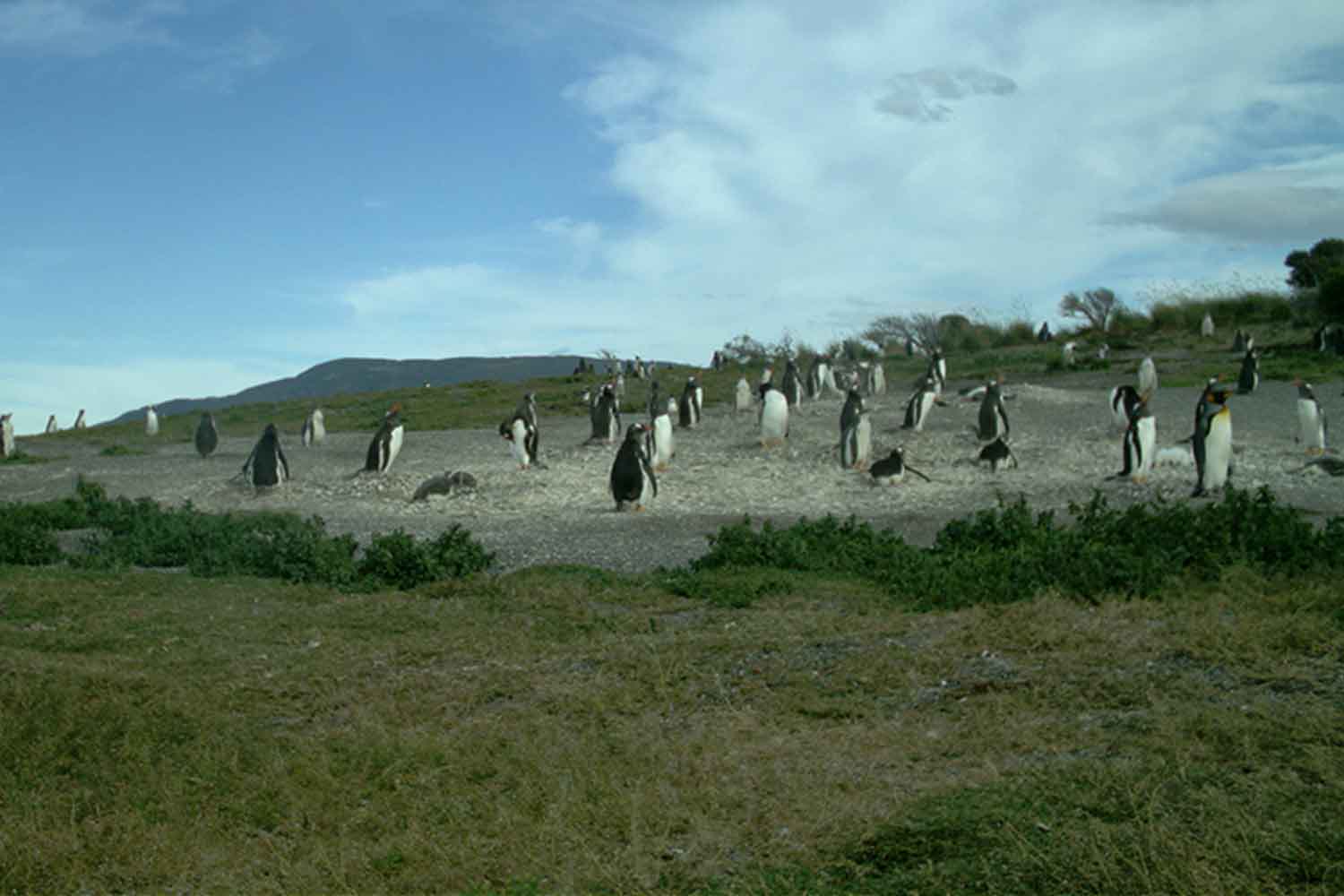
They arrive from the Beagle Channel and, within a few moments, the shore of Isla Martillo is filled with penguins. They are gentoo penguins (Pygoscelis papua), recognizable almost without the need for a manual: red-orange beak, legs of the same color and that showy white band that passes over the head connecting the eyes. The scene seems specially prepared for a postcard from the end of the world. Here, however, it is everyday life.
Isla Martillo is located in the Argentine sector of the Beagle Channel, in Tierra del Fuego, about 90 kilometers from Ushuaia. Magellanic penguins and a much smaller colony of papua coexist on the island. During the breeding season, between spring and southern summer, it is one of the best-known places in the area to observe these animals. In fact, Ushuaia’s tourist board refers to it as the “pingüinera” of Tierra del Fuego.
View this post on Instagram
The gentoo penguins of Isla Martillo have a peculiarity
Their Magellan neighbors spend part of the year away from the island. Papuans have much more sedentary habits. A study published in Wilson Journal of Ornithologybased on photographs taken for an entire year by a camera trap, showed that adults continue to frequent the colony even outside the reproductive period and usually make daily trips to the sea.
Those collective appearances on the beach can therefore be the return from the pantry. Another research conducted in Martillo, with small GPS devices applied to the animals, observed that the Papuans studied carried out feeding trips that were on average shorter than those of the Magellanic penguins: around 10 hours and 20 kilometres, concentrating in the waters close to the colony and generally less than 80 meters deep.
The papua is the third largest penguin in existence and lives mainly between the Antarctic Peninsula and the sub-Antarctic islands. The small community of Martillo has reached much further north than the bulk of the species. And it is a decidedly particular community: studies indicate it as the only known breeding site of the Gentoo penguin in mainland South America, therefore excluding the Falkland/Malvina Islands. The colony has been followed by scientists since the 1990s.
From a few pairs to 61 nests
It was tiny at first. In 2006-2007, a maximum of 12 nests were recorded. Since then, Isla Martillo has become a kind of natural laboratory to understand how a colony located on the northern edges of its range can grow and adapt.
The most recent data comes from a study published in PLOS One. An automatic camera followed the colony between 2013 and 2024, allowing researchers to count its nests and chicks without having to continually enter the area. Between 2013 and 2023, the number of visible nests grew by an average of 12.2% per year; in 2023, 61 were counted, together with 58 chicks that survived until the phase observed by scholars. The maximum number of nests photographed was used as an estimate of breeding pairs.
Sixty-one nests remain very little next to the enormous sub-Antarctic colonies. For Isla Martillo, however, they tell of a presence that in thirty years has gone from being almost a zoological curiosity to a small, stable and growing population.
The problem comes when it’s too hot for a penguin
The latest study of the colony also revealed something less photogenic. Papuan chicks tolerate exceptionally hot days poorly. Starting from around 18°C, scientists observed more behaviors related to thermoregulation, such as breathing with an open beak; above 20 °C many chicks moved towards the beach or under the bushes looking for cooler areas.
In January 2015, during an episode in which recorded temperatures reached 24°C, approximately 20% of the chicks present died: five were observed dying in the space of just 45 minutes. It is a single event, therefore not a universal threshold beyond which every penguin dies. However, it shows how narrow the margin can become for animals built for a completely different climate.
Martillo’s Papuans seem to have already moved their calendar. Between 2013 and 2023, the phase in which young people finish their period on land was brought forward by approximately 23 days, with an average advance of two days per year. According to the authors, leaving the colony earlier allowed the hatchlings to avoid up to 27 hours of exposure to temperatures above 20°C. It’s an interesting answer, accompanied by a rather concrete caution: if very hot days become more frequent, bringing forward the season may not be enough.
View this post on Instagram
So the line of penguins returning to the beach of Isla Martillo tells something more than a spectacular scene. By 2023, the colony had reached 61 nests and, in the same decade, its young had brought forward the time when they left the mainland by almost a month. The shore remained there. Their calendar has already moved.
