
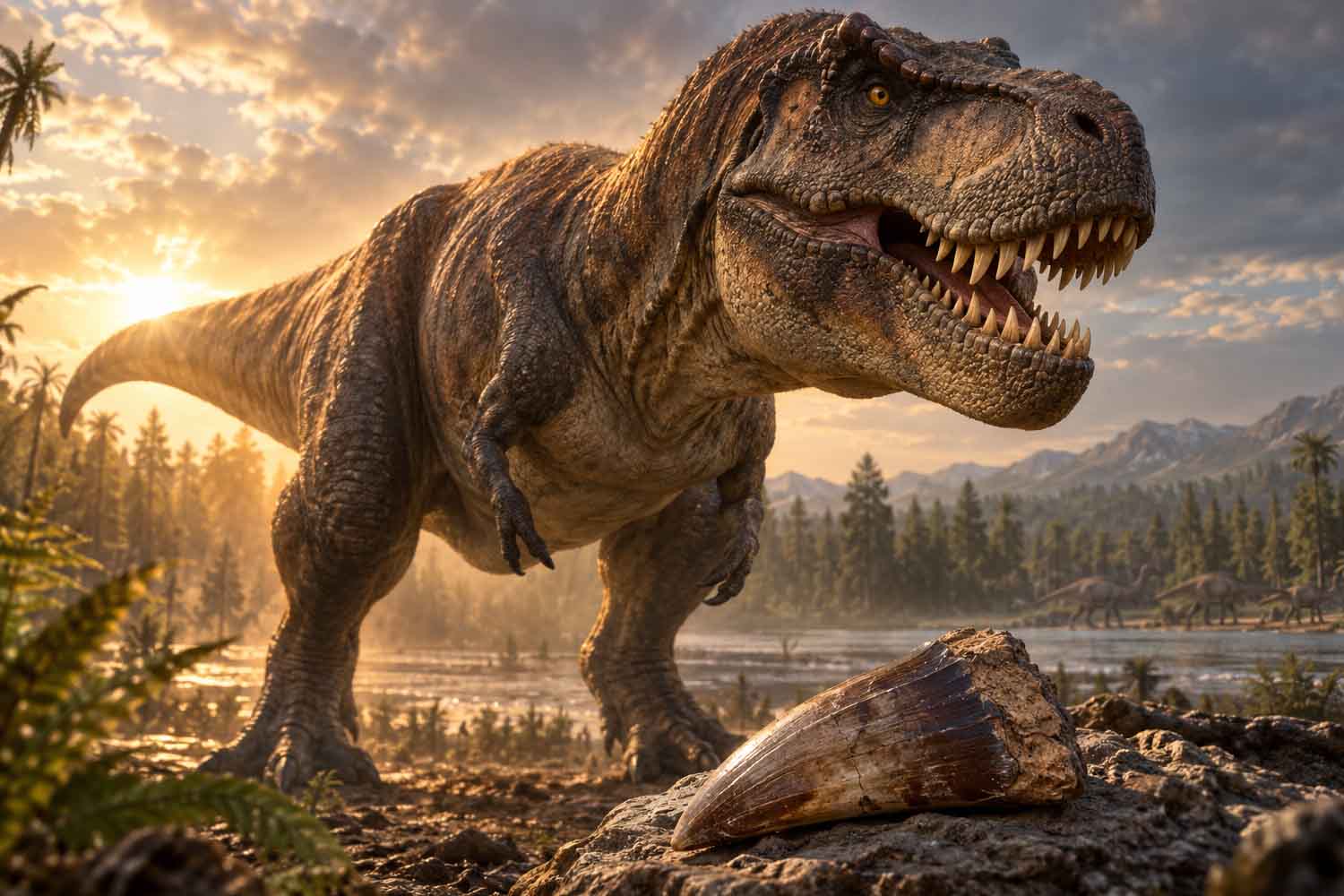
They remained buried for around 66 million years and inside the enamel they still retained a rather intimate measure of their owner: the body temperature of T. rex. By analyzing three fossil teeth from the Hell Creek Formation in Montana, an international team of researchers obtained an average estimate of 36.3 ± 2.5 °C. Closer to that of a large mammal than to that of the ectothermic reptiles with which it shared the territory. The study was published on Science Advances.
The number finally adds some concrete degree to a discussion that has accompanied dinosaurs for decades. The evidence in favor of a physiology capable of producing and retaining a lot of heat was already numerous; until now, however, a direct estimate of body temperature has been lacking Tyrannosaurus rex. And to get it you didn’t need to find a Cretaceous thermometer. A few milligrams of tooth were enough.
How do you take the temperature of a T. rex that died 66 million years ago
Two of the analyzed teeth come from “Thomas,” one of the T. rex skeletons preserved at the Natural History Museum of Los Angeles County. For years such an analysis would have required sacrificing too much fossil material: however, the group from the University of California, Los Angeles (UCLA) has refined the technique to the point of reducing the 90% the amount of sample needed. Enough to convince the museum to grant tiny portions of enamel.
The principle is that of clumped isotope paleothermometry. In the enamel some rare isotopes of carbon and oxygen tend to bind together with frequencies that change based on the temperature at which the mineral was formed. More precisely, those bonds are more frequent at low temperatures and less frequent at high temperatures. Dental enamel, very resistant to chemical alterations, can therefore function as a kind of geochemical thermometer remained dark for millions of years, but still readable.
The three teeth of T. rex returned an average temperature of 36.3 °C overall. To understand whether that chemical signature depended on the animal or on the transformations undergone by the fossils in the soil, the group also analyzed crocodilian teeth from the same geological formation. Their reconstructed temperature was around 30°Csignificantly lower. If the soil had rewritten the thermometer, the results should have been much more similar.
Warmer than the environment and the crocodilians that lived next to him
The comparison continues with the climate. Paleoclimatic reconstructions indicate that T. rex maintained a temperature higher than that of the surrounding environment, while the simulations carried out by the authors show that an animal with those characteristics could have occupied a very large part of late Cretaceous North America, including colder regions and at high latitudes.
And it’s a detail that fits well with an old paleontological oddity: remains of tyrannosaurs have also been found in Alaska. During the Cretaceous the planet was much warmer than today, of course, but winters at high latitudes remained prohibitive for many animals strictly dependent on external heat. According to the models used in the study, a body temperature around 36°C would have allowed the large predator to go much further north, potentially from Mexico to the North American Arctic.
The result therefore strengthens the hypothesis of a Endothermic T. rexcapable of internally generating an important part of the heat necessary for its activity. Such an animal could have remained active without waiting for the sun to set its muscles in motion, with obvious consequences on hunting, movement and the amount of energy – and therefore food – needed to maintain a body weighing several tons.
However, there is a limit almost as big as the dinosaur. A high temperature, alone, . A gigantic animal sheds heat slowly, and its very mass can help keep it warm. Furthermore, we are talking about just three teeth and very few individuals: 36.3 °C is an estimate obtained from these fossils, not the value to be printed on the health card of every T. rex that has ever existed.
A number that changes the way we imagine the predator
The similarity to our temperature is probably the most immediate detail, but it doesn’t mean that a T. rex functioned like a human. The same researchers point out that many modern birds — the living descendants of dinosaurs — reach normally 40-43°Cwhile several ectothermic reptiles are around 28-30 °C. The tyrannosaurus’s approximately 36°C is in the middle and is comparable to that of some large mammals.
However, the discovery makes the image of the gigantic slow reptile, forced to wait for the sun to start the day, increasingly less convincing. Dinosaur physiology was much more varied than suggested by the old scholastic division between “cold-blooded” reptiles and “warm-blooded” mammals.
Sixty-six million years later, three teeth thus manage to restore something that normally disappears together with the animal: how warm he was while he was alive. For a T. rex it is already a notable invasion of privacy.
