
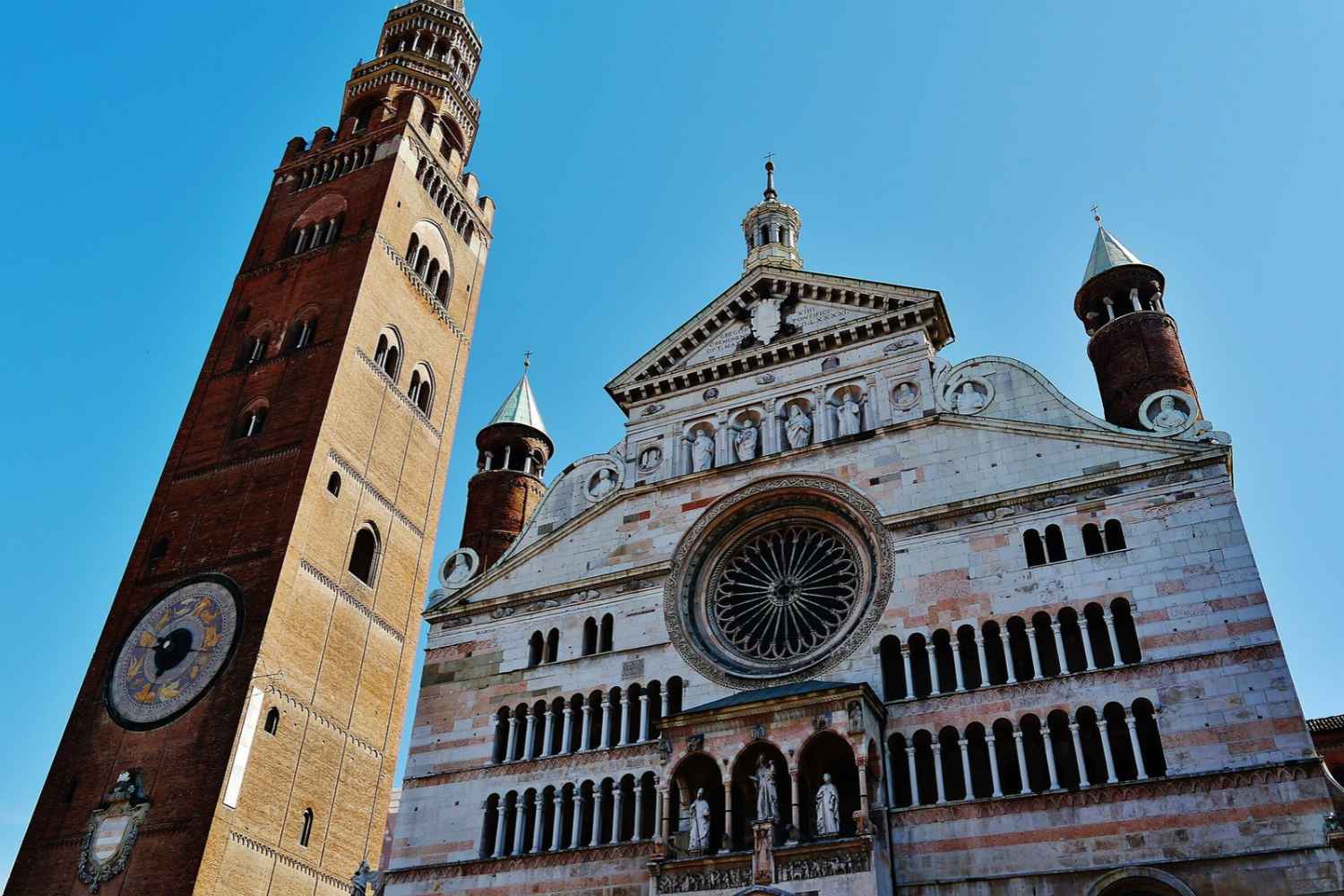
There are monuments that tell the story of a city and others that become its symbol. In Cremona, in the heart of Lombardy, you just need to look up to encounter a building that has dominated the roofs of the historic center for centuries. It is the Torrazzo, a gigantic brick tower that houses one of the most fascinating architectural records in Europe.
With its 112.54 meters of height, it is considered the tallest medieval brick bell tower in Europe. But the dimensions are not the only peculiarity of this monument: to reach the top you have to face 502 steps, while along the way you come across an ancient astronomical clock, centuries-old gears and even an experiment that demonstrates the rotation of the Earth.
A place that manages to bring together history, astronomy and engineering, transforming the visit into a real journey through time.
@wikipedia
The Torrazzo of Cremona: a record-breaking medieval tower
The Torrazzo stands in Piazza del Comune, next to the Cathedral of Santa Maria Assunta, and represents one of the most impressive examples of medieval Lombard architecture.
Its construction dates back mainly to the 13th century and developed through various phases, until the early 14th century. The result is a building that combines Romanesque and Gothic elements, with a massive square brick base topped by an octagonal structure, known as the Ghirlanda, which culminates in a slender spire.
One of the most surprising features, however, concerns the internal structure. The Torrazzo is in fact made up of two towers inserted one inside the other, separated by a cavity in which runs the long staircase that allows you to reach the upper part.
Even his height hides a curiosity. For a long time there was talk of 122,217 meters, a measurement also reported on a plaque at the base of the building. Subsequent measurements, confirmed by the Polytechnic of Milan, however, established that the actual height of the building is 112.54 metres.
The difference derives from the different reference point used for the calculation: the ancient measurement in fact considered a height approximately ten meters lower than the level of the square.
Despite this clarification, the Torrazzo retains its extraordinary primacy among medieval brick bell towers.
The astronomical clock showing the phases of the Moon and eclipses
What makes the Torrazzo even more special is the gigantic astronomical clock located on the façade of the tower.
Its dial, with a diameter of approximately 8.20 meters, is among the largest astronomical clocks in the world. It was created between 1583 and 1588 by the Cremonese artisans Francesco and Giovan Battista Divizioli, father and son.
This is not a simple clock that indicates the hours. Its complex mechanism, still functioning, represents various celestial phenomena and allows you to follow the apparent movement of the Sun and Moon, the lunar phases and astronomical configurations linked to eclipses.
Particularly fascinating is the so-called dragon hand, characterized by a head and a tail, used to represent the nodes of the lunar orbit, fundamental for understanding when eclipses can occur.
The original mechanism has been preserved over the centuries, while the dial has undergone several restoration interventions, including a repainting in 1970.
A mechanical masterpiece that demonstrates how, already in the Renaissance, the observation of the sky was closely linked to the measurement of time and the daily life of cities.
Inside the Torrazzo there is a museum dedicated to time
Since 2018, the tower has hosted the Torrazzo Vertical Museum, an exhibition itinerary that accompanies visitors to discover the history of astronomy and the instruments used by man to measure time.
The peculiarity of the museum is precisely its layout: instead of developing along a single floor, the rooms meet progressively as they go up.
In the Hall of the Measurement of Time the evolution of the instruments used over the centuries is retraced, from sundials to hourglasses up to the most sophisticated mechanical systems.
The Mechanism Room instead allows you to closely observe the gears of the astronomical clock, while the Quadrant Room explains its functioning and decorative aspects.
Finally, in the Astronomy Room, the itinerary focuses on the study of celestial bodies and the evolution of scientific knowledge.
Among the most interesting elements there is also an installation of Foucault’s Pendulum, the famous experiment that allows you to observe the effects of the earth’s rotation through the oscillation of a pendulum.
An experience that transforms an ancient bell tower into a place where architecture, science and dissemination meet.
The 502 steps that lead to one of the most beautiful views of Cremona
The visit to Torrazzo ends with perhaps the most exciting part: the climb up to the panoramic loggia.
To reach it you have to face 502 steps, distributed along the internal structure of the tower. A challenging climb, but which also allows you to closely observe the construction characteristics of the building.
Along the route you also come across the belfry, which houses seven eighteenth-century bells, each dedicated to a saint, including the patron saint of Cremona, Sant’Omobono.
Once you reach the top, your gaze can sweep over the city’s rooftops, the medieval squares and the surrounding countryside. On particularly clear days you can distinguish the course of the Po and, in the distance, even the Alps.
It is precisely from this perspective that we understand how Torrazzo has represented for centuries not only a religious, but also a geographical and identity point of reference for the inhabitants of Cremona.
How to visit the Torrazzo di Cremona: timetables and tickets
Il Torrazzo is located in Piazza del Comune, in the historic center of Cremona, next to the Cathedral.
The tower and the Vertical Museum can generally be visited every day, from 10.00 to 13.00 and from 14.30 to 18.00, with last entry 30 minutes before closing. In the months of January and February it will be closed on Mondays.
As for tickets, a cumulative ticket is available for 10 euros, which includes the Torrazzo Vertical Museum, the Baptistery and the Diocesan Museum. On Mondays there is a special 5 euro ticket for the visit to Torrazzo only.
Entrance is free for children under 14 accompanied by an adult, while discounted rates are available for groups and schools.
The climb takes place exclusively on foot, so it is important to consider the presence of the 502 steps before planning the visit. Times and fares may vary, so it is advisable to check them before departure.
The Torrazzo is much more than a record-breaking bell tower. It is testimony to an era in which building a tower also meant telling the story of the ambition and knowledge of a community. And today, more than seven centuries later, it continues to offer visitors something rare: the possibility of crossing history, one step at a time.
