
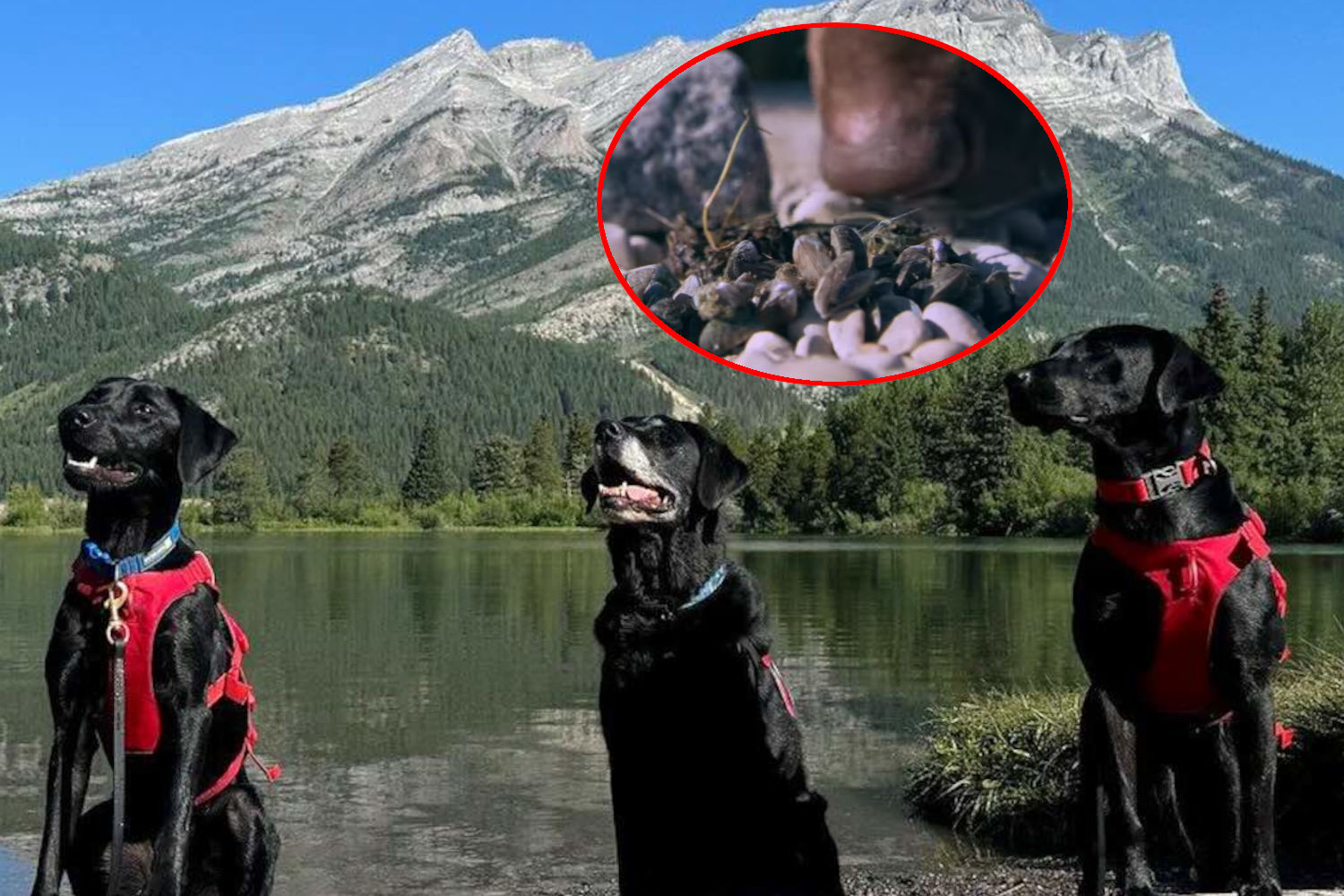
In the highway control stations and along the water basins of the Canadian province of Alberta, the efficiency of environmental protection relies on the nose of three four-legged allies: Hilo, Jane and Winnie. Made up of two black labradors and a black labrador cross, this conservation K9 unit works for local authorities to detect the presence of zebra and golden mussels.
These are filter-feeding molluscs originating from South-East Asia capable of devastating river and lake ecosystems, depriving the native fish species that populate the seabed of nourishment. Local legislation imposes the obligation to stop and inspect every vessel entering or leaving the provincial territory. In this context, the intervention of dogs is decisive in tracking down microscopic larvae, often invisible to the human eye and detectable to the touch only as a very slight roughness similar to sandpaper on the bodies of boats or on the structures of piers.
Concern about the proliferation of golden mussels in the State of California
The field management and organization of these patrols is headed by Cindy Sawchuk, manager of the provincial Aquatic Invasive Species and Conservation Dog Operations and Conservation Program. The expert underlined the complementarity of animal action compared to traditional procedures, highlighting how the help of dogs allows obtaining an extremely precise picture of the state of cleanliness of the vessels.
Sawchuk also expressed grave concern about the recent proliferation of golden mussels in the state of California, a phenomenon that risks becoming a vector of biological contagion through neighboring British Columbia. The physical conformation of these organisms allows them to nest and survive for a long time in dark and humid ravines, making their identification complex without specific olfactory training.
How the research occurs and the economic impact of the problem
The use of the K9 team also responds to a pressing economic need. In territories geographically similar to Alberta, the uncontrolled proliferation of these molluscs entails management and cleanup costs that can reach 75 million dollars per year, with the real risk that the infestation becomes completely irreversible.
In addition to checking boats at road checkpoints, handlers also use Hilo, Jane and Winnie to search river banks and lake shores. To ensure maximum effectiveness, the activity is structured in the form of a game: each correct report is rewarded with special toys, stimulating the release of dopamine and keeping the animals’ motivation very high during patrolling operations.
