
From nuraghi to ancient tombs carved into the rock, passing through traditional songs, popular festivals and natural landscapes: Sardinia holds various heritages and recognitions linked to UNESCO.
But how many are there exactly? The answer requires clarification. Not all, in fact, belong to the same category: some are registered in the World Heritage List, others are part of the Intangible Cultural Heritage, while the territory of Tepilora, Rio Posada and Montalbo is a UNESCO Biosphere Reserve.
Added to these is the particular case of the Historical and Environmental Geomining Park of Sardinia, historically linked to the development of the international network of geoparks.
Here are the main UNESCO heritage sites of Sardinia and what makes them so important.
On Nuraxi of Barumini
The first site in Sardinia to officially enter the UNESCO World Heritage List was Su Nuraxi di Barumini, registered in 1997.
Located in Marmilla, in central-southern Sardinia, it is considered the most important and complete example of Nuragic architecture on the island.
The complex is dominated by a large nuraghe formed by a central tower, originally more than 18 meters high, surrounded by four towers connected by massive walls. Over time, a real village of huts developed around the fortification.
What are nuraghi
Nuraghi are megalithic constructions characteristic exclusively of Sardinia, developed mainly during the Bronze Age.
They generally have the shape of truncated cone towers built with large blocks of stone and have internal spaces covered with the false dome technique.
The exact function of the nuraghi is still being studied, but these structures certainly had a central role in the social, political and territorial organization of the nuragic communities. Su Nuraxi represents one of the most extraordinary examples of this civilization and testifies to the evolution of prehistoric Sardinian society for many centuries.
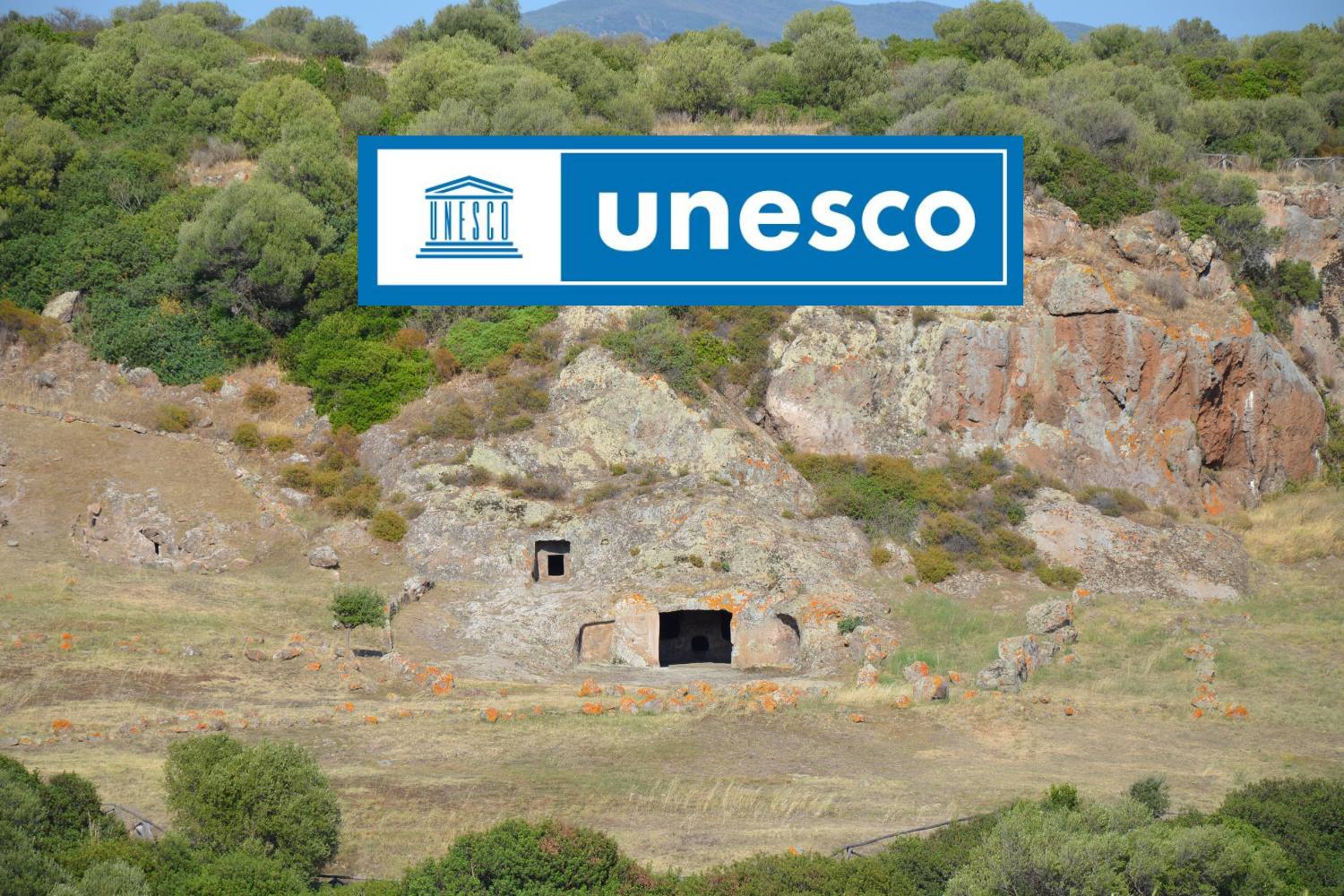
Le Domus de Janas, World Heritage Site since 2025
@Canva
The most recent UNESCO recognition achieved by Sardinia came in 2025, when the Funerary Tradition in the Prehistory of Sardinia – Le Domus de Janas was inscribed on the World Heritage List.
It is a serial asset made up of various archaeological sites distributed across the island, united by the presence of the characteristic tombs dug into the rock known in Sardinian as Domus de Janas, i.e. “houses of the fairies”.
Made mainly between the 5th and 3rd millennium BC, these burials allow us to learn about the religious beliefs, funerary rituals and even some aspects of the daily life of the prehistoric Sardinian communities.
In fact, many tombs reproduce elements of the homes of the living in their architecture and decorations, symbolically transforming the tomb into a sort of home intended for the deceased.
Thousands of Domus de Janas have been registered throughout Sardinia, but the UNESCO recognition concerns a selection of particularly representative complexes.
The locations involved include, among others, Alghero, Putifigari, Ossi, Porto Torres, Bonorva, Villaperuccio and Goni.
With the registration of 2025, Sardinia therefore possesses two assets properly registered in the UNESCO World Heritage List: Su Nuraxi di Barumini and the funerary tradition of the Domus de Janas.
The Canto a Tenor
Not all heritage sites recognized by UNESCO are monuments or physical places. Some traditions are protected as Intangible Cultural Heritage of Humanity.
Among the most important in Sardinia is the Canto a Tenore, a form of polyphonic singing deeply linked to the pastoral culture of the island.
It is traditionally performed by four men arranged in a circle and includes four different voices: boche, mesu boche, contra and bassu. It is above all the deeper voices, bassu and contra, that give the song the characteristic guttural timbre that makes it immediately recognisable.
The repertoire may include poems, texts related to pastoral life and songs intended to accompany the dance. The Canto a Tenore was proclaimed by UNESCO in 2005 among the Masterpieces of the Oral and Intangible Heritage of Humanity and, with the evolution of the UNESCO protection system, in 2008 it entered the Representative List of the Intangible Cultural Heritage of Humanity.
The Candlesticks of Sassari
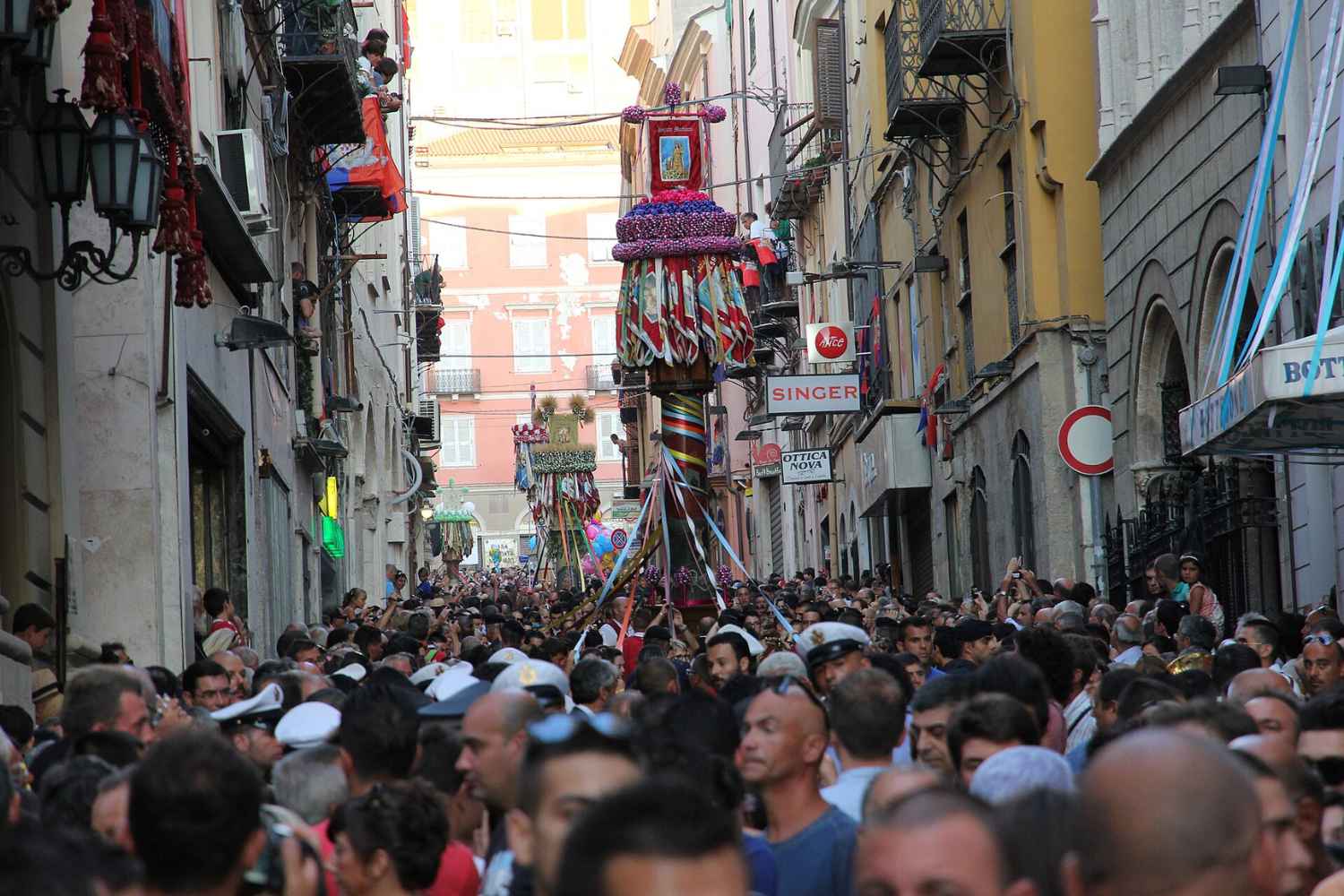
Another recognition concerns one of the most important and popular celebrations in Sardinia: the Faradda di li Candareri, also known as the Discesa dei Candelieri di Sassari.
Since 2013 it has been part of the UNESCO intangible cultural heritage within the collective recognition dedicated to the Festivals of large Italian shoulder machines.
The network includes several Italian celebrations characterized by the transportation of large votive structures in procession.
In Sassari the festival traditionally takes place on August 14th, on the eve of the Assumption of Mary.
The protagonists are the Gremi, the ancient city guilds of arts and crafts, which transport large ornate wooden columns, the Candelieri, along the streets of the centre. The procession is accompanied by music and the characteristic dance of the candles, which advance through the crowd up to the church of Santa Maria di Betlem.
More than a simple religious event, the Faradda represents a fundamental moment of the collective identity of Sassari, transmitted from generation to generation.
Tepilora, Rio Posada and Montalbo
In 2017 another territory of Sardinia obtained an important UNESCO recognition: Tepilora, Rio Posada and Montalbo entered the global network of Biosphere Reserves of the MAB, Man and the Biosphere programme.
The area is located in central-eastern Sardinia and includes over 140,000 hectares, extending from the inland mountain environments to the plains, waterways and coastal areas. The Reserve includes territories characterized by notable biodiversity and a still very strong relationship between local communities and the environment.
The purpose of Biosphere Reserves is not only to protect nature, but to experiment with forms of development in which biodiversity conservation, economic activities and human presence can coexist in a sustainable way. For nature lovers, the area offers woods, mountains, wetlands, rivers and numerous hiking routes.
The Historical and Environmental Geo-mining Park of Sardinia
A particular case is that of the Historical and Environmental Geomining Park of Sardinia, which protects a vast heritage linked to the mining and geological history of the island.
At the end of the 1990s, the project received important recognition among the international initiatives that would contribute to the development of geopark networks.
The territory includes ancient mines, mining villages, industrial plants, tunnels and landscapes shaped by centuries of extractive activity, especially in the Sulcis-Iglesiente-Guspinese areas, but also in other areas of Sardinia.
However, it is important not to confuse it with the two Sardinian sites registered in the World Heritage List. The relationship of the Geomining Park with UNESCO in fact belongs to the history of programs dedicated to geoparks and must be indicated separately from the current World Heritage Sites in the strict sense.
So how many UNESCO heritage sites are there in Sardinia?
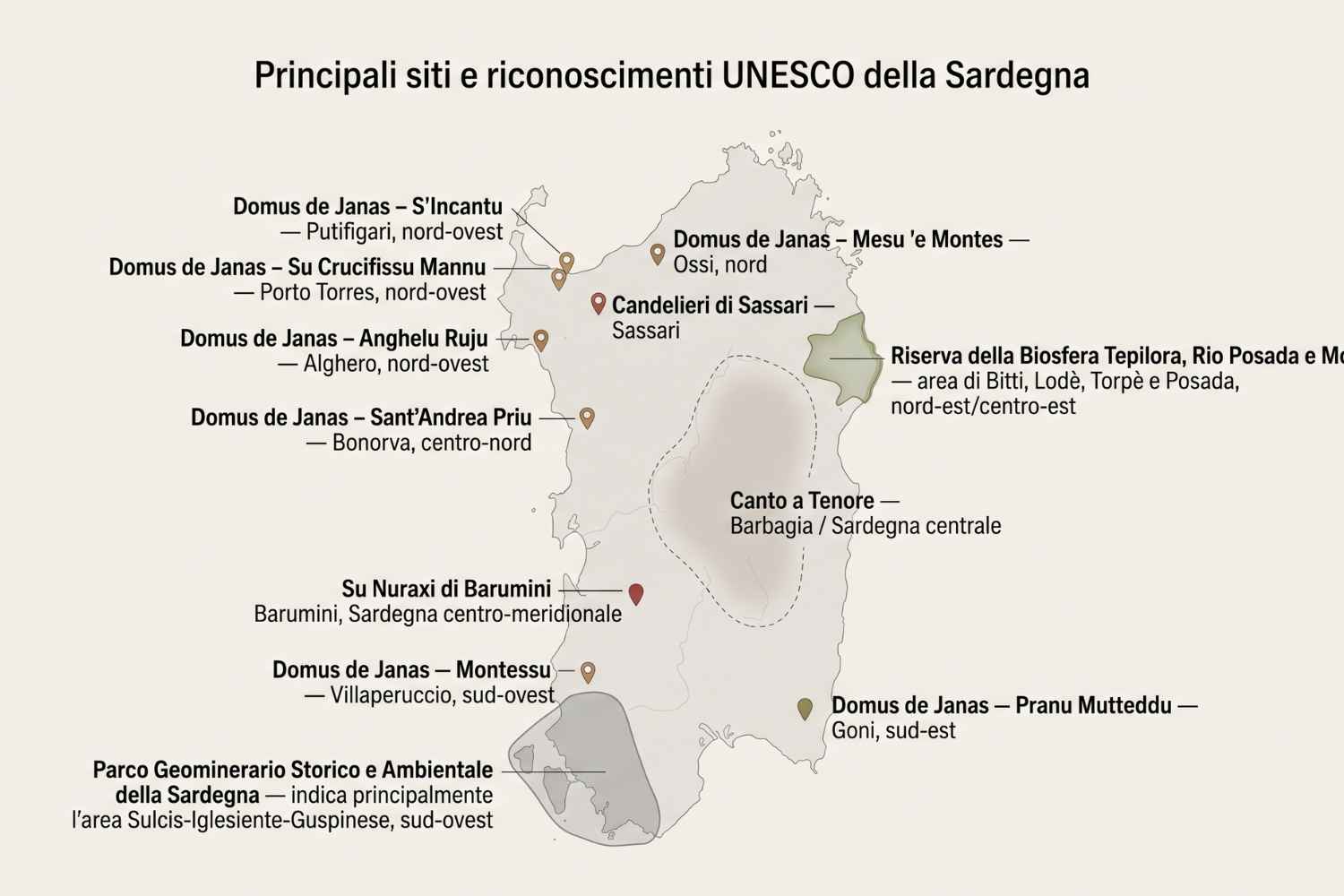
It depends on what is meant by the expression “UNESCO heritage”.
Strictly speaking, i.e. considering exclusively the World Heritage List, Sardinia today has two UNESCO sites:
Instead, broadening our gaze to the main UNESCO designations present on the island we also find:
The Historical and Environmental Geomining Park of Sardinia is frequently associated with these, due to its historical link with the UNESCO initiatives dedicated to the valorisation of the geological heritage.
A heritage that tells thousands of years of history
The particularity of Sardinia’s UNESCO recognitions lies above all in their variety. The Domus de Janas lead up to the Neolithic communities, Su Nuraxi tells of the extraordinary Nuragic civilization, while the Canto a Tenore and the Candelieri demonstrate how a heritage can still be alive and transmitted through voices, rites and traditions. Tepilora instead testifies to the value of a landscape in which nature and human activities continue to coexist.
