
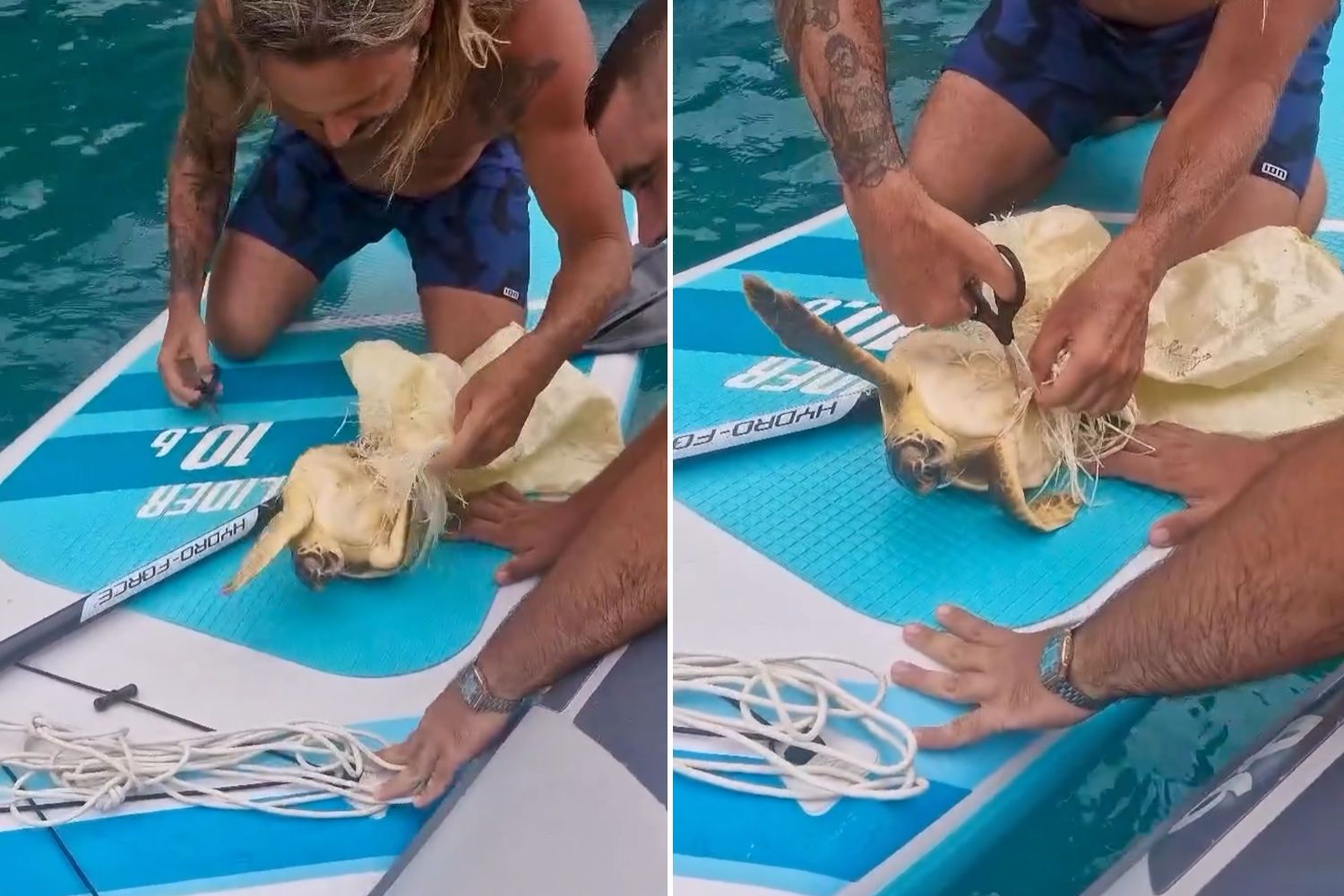
An apparently banal gesture, born from the simple desire not to leave yet another piece of waste in the water, was transformed into a rescue in the Sardinian sea. Lorenzo Castagna was paddling on his SUP board off the Sardinian beach of San Nicolò, in the Buggerru area, when he spotted a floating plastic casing about twenty meters away, near the suggestive sea stack known as the Eagle’s Nest. Determined to collect the rubbish to clean up the body of water, he approached it, discovering with surprise that the bag was hiding a defenseless victim: a sea turtle whose fins were tightly wrapped in threads of plastic material, making any movement impossible.
View this post on Instagram
From the SUP board to the dinghy scissors
Without wasting a moment, Castagna loaded the specimen onto his stand up paddle board to patiently begin untying the tightest knots. The situation was complex and required adequate tools to cut the synthetic fibers without risking causing further injuries to the animal’s skin.
Providential was the timely arrival of a group of boys on board a dinghy who, having noticed the scene, approached offering a pair of scissors essential to complete the operation. The coordinated intervention thus made it possible to quickly cut the intricate plastic mesh that completely blocked the turtle’s limbs.
The hidden obstacle and the return to the waves
During the final rescue phases, the occupants of the dinghy noticed a further decisive detail: a small crab attached to the turtle’s structure. This apparently harmless crustacean risked altering the weight and buoyancy of the reptile, hindering its ability to dive correctly to hunt or escape the dangers of the open sea. Having also delicately removed this second impediment, Castagna returned the animal to the waters of the Gulf of Lion. The turtle immediately started swimming again with surprising energy, quickly moving away towards the depth.
What to do if you come across an injured animal
The episode that occurred in Buggerru once again highlights the serious threat that plastic pollution represents every day for aquatic fauna, while at the same time indicating what practical actions to take in similar emergencies. If you come across an injured specimen, in difficulty breathing or unable to dive, it is essential to immediately alert the Coast Guard via the emergency number 1530 or call the sea turtle recovery center responsible for the area. While waiting for biologists or specialized personnel, the creature must be kept in a cool environment protected from direct sunlight, guaranteeing shade and tranquility.
