
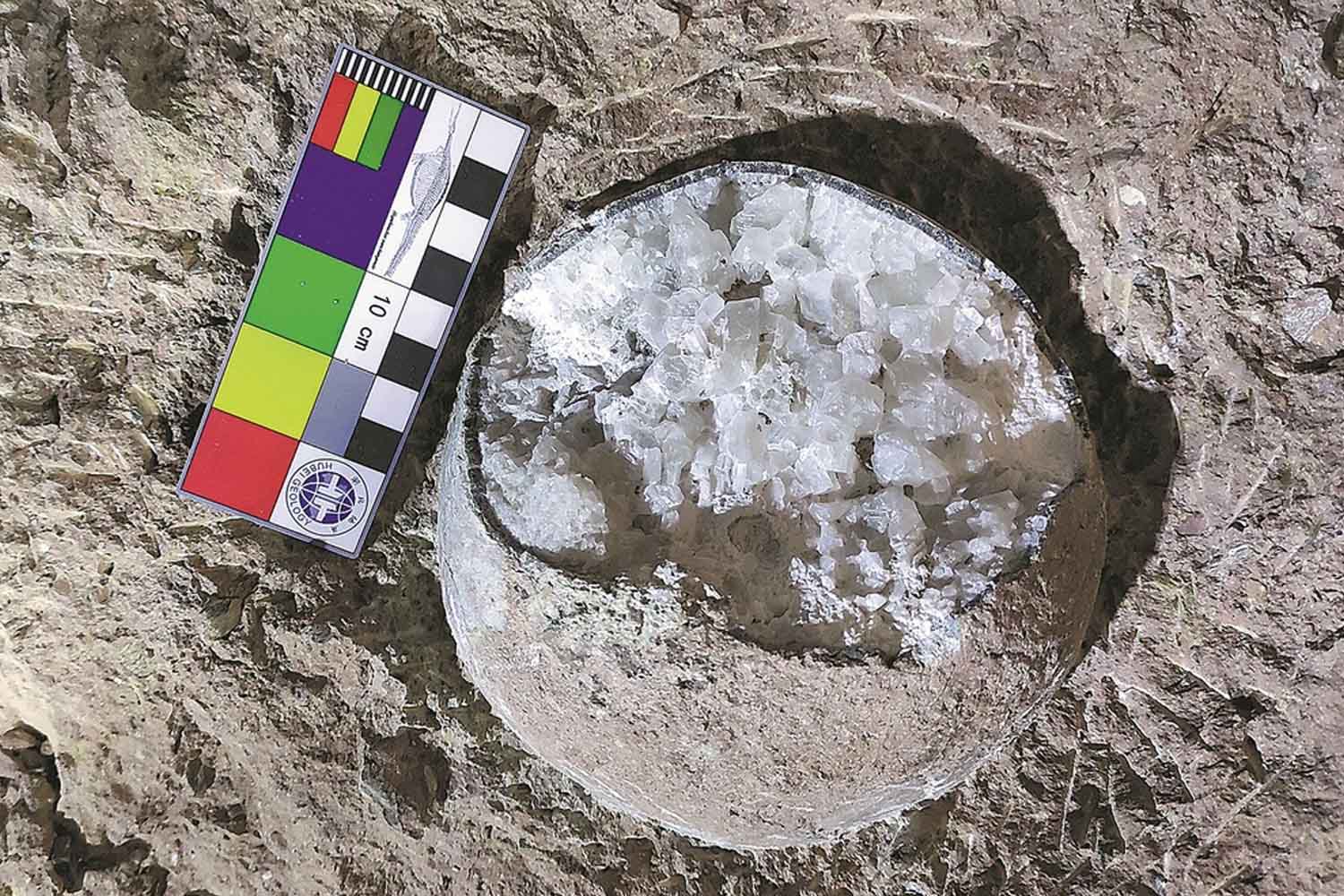
In the heart of eastern China, between layers of rock that preserve the memory of the end of the dinosaurs, two almost perfect fossil eggs they gave scientists a surprise that seems to have come from a mineralogy museum rather than a paleontological site. Inside, no embryo, no trace of bone. Alone bright calcite crystalsgrown slowly as in a geode, sealed by a shell deposited over 70 million years ago.
The discovery comes from Qianshan Basinin the Chinese province of Anhui, an area already known to scholars for its extraordinary ability to preserve fossils of animals and plants that lived between the Late Cretaceous and the Paleocene, right around the time of the mass extinction that wiped out non-avian dinosaurs from the Earth.
The eggs found have an almost spherical shape and a diameter of approximately 13 centimetresmore or less like a bowling ball. Externally they appear anonymous, grey, smoothed by time. But one of them, naturally fractured in the rock, revealed a surprising interior: aggregates of clear, sparkling calcite crystalsgrown neatly along the inner wall of the shell.
According to the researchers, the process was slow and silent. After deposition and burial, the original contents of the egg have degraded or dispersed. Over millions of years, groundwater rich in calcium carbonate they began to seep through the sediments, penetrating the empty cavity. Layer after layer, the calcite was deposited, transforming the egg into a sort of natural mineral treasure chestwhere biology has given way to geology.
A new species identified only thanks to its eggs
By analyzing the structure of the shell under the microscope, the research team led by paleontologist Qing He observed very precise characteristics: thick walls, compact columnar units and a uniform microstructurewith numerous tiny radial openings. Details that made it possible to classify these eggs within the Stalicoolithidae family and to define a new species, named Shixingoolithus qianshanensis.
Since no embryo is present, it is not possible to identify with certainty the dinosaur that laid them. However, size and shape suggest a herbivorous ornithopodan agile dinosaur, with a snout similar to that of a duck, up to nine meters long, which disappeared with the end-Cretaceous extinction.
Crystals that become climate archives of the past
At first glance, those crystals might just seem like an aesthetic curiosity. In fact, they enclose invaluable information on the environment of the past. Recent studies of other Chinese fossil eggs, also filled with calcite, have shown that the crystals can trap traces of uranium useful for radiometric dating. In one case, this method allowed us to precisely establish an age of approximately 86 million years.
By cross-referencing this data with the pore structure of the shell and with global climate reconstructions, the researchers discovered that dinosaur eggs responded to climate changemodifying porosity to regulate gas exchange in warmer or colder environments. In other words, these fossils can function as natural archives of the earth’s climateoffering a first-hand look at how past animals coped with periods of cooling and environmental instability.
Because this discovery speaks to us too
Eastern China is now considered one of the most important fossil hotspots in the world. In regions such as the Qianshan Basin or the famous Jehol biota, volcanic ash and very fine sediments have sealed entire ecosystems, preserving eggs, embryos, feathers and even stomach contents.
For those studying contemporary climate, these crystallized eggs are not just spectacular museum exhibits. They tell how life responded to slow but profound changeslong before the impact of the Chicxulub asteroid. A natural experiment that lasted millions of years which today can help us better understand the reactions of modern ecosystems in the face of global warming, extreme events and increasingly rapid environmental transformations.
The next time you happen to observe a gray stone behind a display case, remember that it could hide a sparkling story.
