
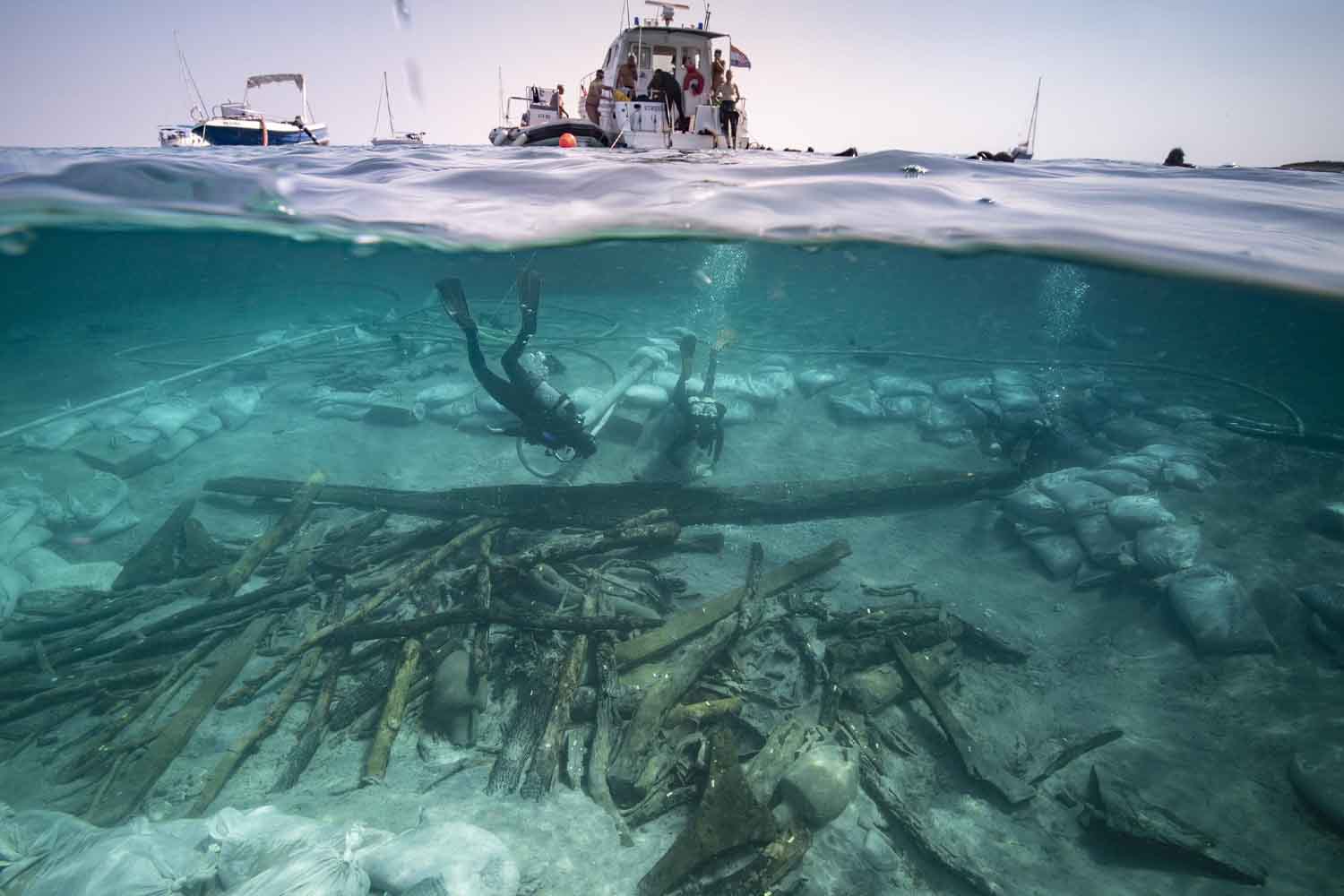
On board an ancient ship, maintenance was a real matter. The wood had to remain waterproof, withstand salt water, resist microorganisms and marine organisms capable of slowly consuming it. Before the great routes and loads, there was this silent work: closing, protecting, reinforcing. On the Roman wreck Ilovik-Paržine 1which sank about 2,200 years ago off the coast of present-day Croatia, those traces remained attached to the hull.
The ship, discovered in 2016 in the bay of Paržine, on the Croatian island of Ilovik, had already been studied for its structure and cargo, which also consisted of logs and amphorae. The new work focuses instead on protective coatings applied to wood. An often less visible part of naval archaeology, yet crucial to understanding how boats could undertake long journeys without losing efficiency along the route. The study places the wreck around the mid-2nd century BC and uses a combined approach, with molecular, pollen and statistical analyzes of waterproofing materials.
Pine pitch, beeswax and pollen trapped in the hull
To analyze the coating, the researchers took samples 10 samples from the hull and studied them with techniques capable of recognizing the organic components present in the mixture. The analyzes identified molecules characteristic of conifers: the main material was therefore heated conifer resin or conifer tar, the substance we know as pitch. It was a hydrophobic, adhesive, easily applied material used to protect wood from water and decay.
One sample, however, showed a different composition. At that point the covering was formed by pine pitch and beeswaxa mixture also known in the ancient world as lame. The addition of wax made the mixture more pliable and easier to spread when heated. Said in a very practical way: it helped the material adhere better and follow the movements of the hull, especially in the most stressed points.
The most interesting part comes from the pollen. Pitch, by its nature, retains what it encounters. Grains from the environment in which the coating was produced or applied were trapped inside that dark material. Analyzing them allows us to reconstruct, at least in part, the landscape around the shipyards or ship repair sites.
The pollen found on the wreck refer to a very varied environment: Mediterranean and Adriatic coasts and valleys, holm oak and pine forests, Mediterranean scrub with olive and hazel trees. The presence of alder and ash suggests areas close to watercourses, banks and humid environments, while fir and beech, present in smaller quantities, recall mountain areas compatible with the north-east of the Adriatic, where Istria and Dalmatia arrive very close to the sea.
This data helps to read the ship as a moving object, not as something that remained identical from the day of its construction to the shipwreck. In fact, the cladding appears to belong to multiple interventions. The stern and central part of the hull have the same type of coverage, while three distinct lots appear at the bow. Overall, the wreck probably preserves four or five different applications of protective material.
The ballast leads towards Brindisi, other layers look towards the north-eastern Adriatic
An earlier study of the ship’s ballast had indicated Brundisiumpresent-day Brindisi, as a possible construction site. The data must be read with caution, because it is a hypothesis based on the origin of the materials used as ballast, i.e. the stones used to stabilize the boat. However, an important clue remains: Brindisi, on the south-eastern Italian coast, was a strategic point for trade in the Adriatic and Mediterranean.
The pollen analysis seems to agree with this lead for some of the coverings. Some layers may have been applied near the Brindisi area, while others are compatible with the north-eastern coast of the Adriatic, closer to the place where the wreck was found. In practice, the ship may have received successive interventions throughout its operational life, using materials available in different locations.
The bow is the point that best tells this story. Three distinct coatings were recognized on that portion of the hull. It is an exposed area, subject to impacts, friction, maneuvers and continuous pressure. The fact that different applications appear there makes the idea of repeated repairs plausible. The ship was checked, patched up, protected again, then put back into the sea.
This discovery adds an important detail to the knowledge of ancient navigation. The ships were not only well built; had to be maintained. The waterproofing techniques, organic materials, the choice of mixtures and their application tell of practical knowledge, made of experience and adaptation. Pine pitch protected. The beeswax made the mixture more workable. The pollen, without wanting to, recorded the surrounding landscape.
The Roman wreck Ilovik-Paržine 1 it thus becomes a kind of material archive. It not only preserves a shipwreck, but also what happened before: the construction sites, the interventions, the hands that spread the pitch, the places crossed, the repairs necessary to continue the journey. A story that remained for centuries at the bottom of the sea, inside a dark layer that only looked like ancient dirt. The ship sank. The pitch continued to hold everything.
