
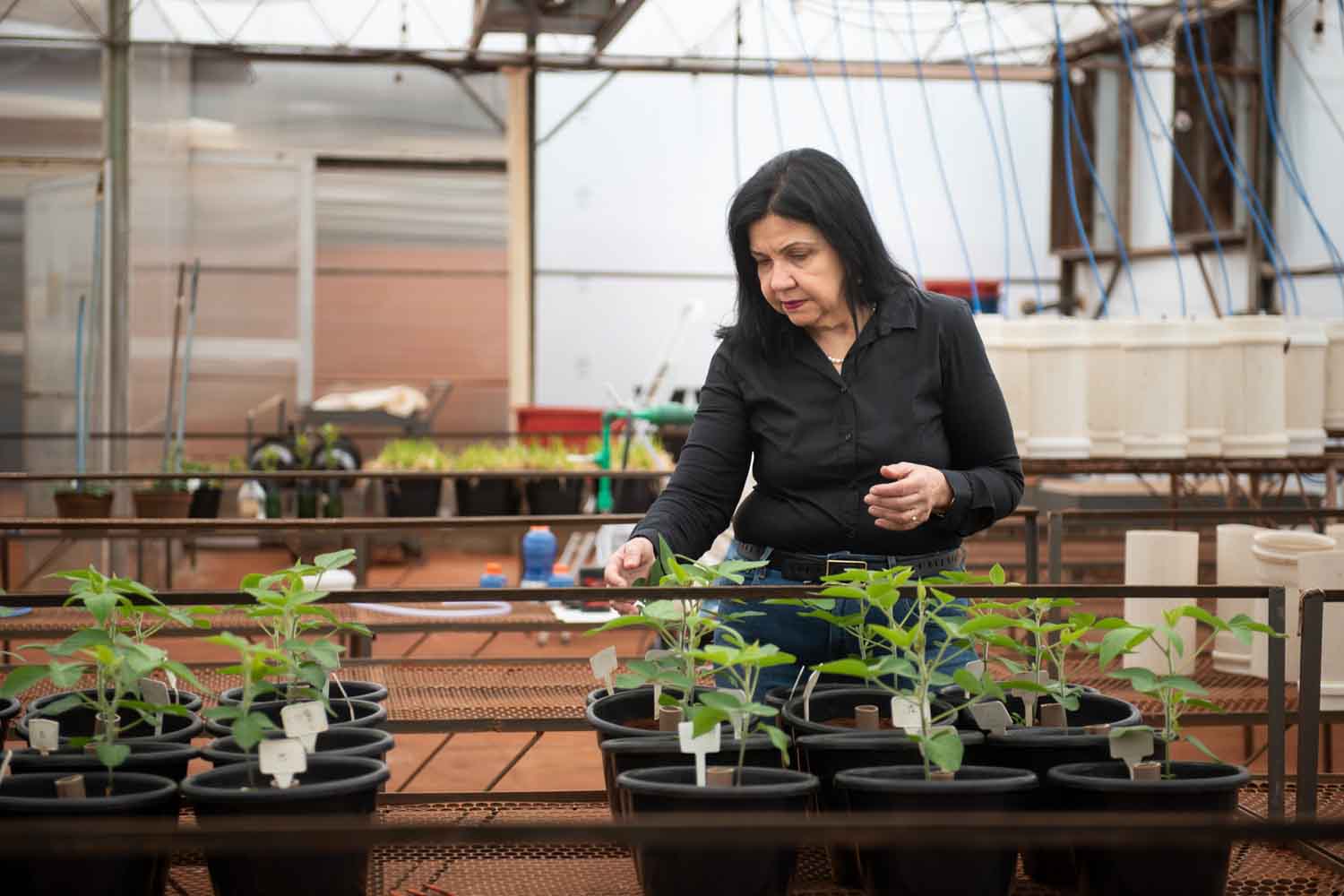
For decades we have been told that without chemical fertilizers modern agriculture could not survive. What if it wasn’t so? What if the solution was under our feet, invisible, silent, natural?
Mariangela Hungria’s story starts right from here: from the belief that the earth can do much more than we imagine. A Brazilian microbiologist, she has been studying biological nitrogen fixation for over forty years, a natural process that allows plants to feed themselves without depending on synthetic fertilizers. A work that today earned her the World Food Prize, considered the “Nobel of agriculture”.
And no, it’s not a laboratory discovery locked in a drawer. It is a revolution already underway.
How biological nitrogen fixation works
Nitrogen is essential for plant growth. The problem is that what is present in the air – despite being very abundant – cannot be directly used by crops. For this reason, for decades, industrial agriculture has been using synthetic nitrogen fertilizers, produced with enormous quantities of energy and fossil fuels.
This is where biological nitrogen fixation comes into play. Some soil bacteria, such as Bradyrhizobium they Azospirillumare capable of establishing a symbiosis with the roots of plants. In practice, they transform atmospheric nitrogen into an assimilable form. The roots host these microorganisms in small nodules and receive nourishment in return. It’s a perfect collaboration, developed by nature long before the chemical industry.
Mariangela Hungria, who has worked at Embrapa Soja since 1982, has developed and perfected microbial inoculants capable of making this process reliable on a large scale. Result? Less chemical fertilizers, fewer emissions and less costs for farmers.
And there’s another crucial aspect: nitrogen fertilizers release nitrous oxide, a much more potent greenhouse gas than carbon dioxide. Reducing its use means acting directly on the climate crisis. We’re not talking about theory. In Brazil, these technologies are applied on over 40 million hectares, mainly in soybean cultivation. A huge change.
In the 1980s, Brazil produced approximately 15 million tons of soybeans. Today it exceeds 170 million. An impressive leap. And no, it wasn’t achieved just by increasing fertilizers and pesticides. The spread of biological nitrogen fixation has played a central role, allowing yields to be increased without multiplying the environmental impact.
This means less dependence on energy-intensive inputs, fewer emissions linked to industrial production and economic savings which, overall, are worth billions of dollars for the Brazilian agricultural sector. It is concrete demonstration that sustainability and productivity are not enemies. They can walk together, if we invest in public research and soil science.
The World Food Prize and the message to the world
In 2025 Mariangela Hungria received the World Food Prize, becoming the first Brazilian woman to obtain this recognition. An award that celebrates not only a scientific career, but a vision: building more resilient agricultural systems, less dependent on fossil fuels and more in harmony with natural cycles.
His work also sends a clear message to Europe and Italy. At a time when we are discussing ecological transition, regenerative agriculture and the reduction of chemical fertilizers, biological nitrogen fixation is not a utopia. It is a technology already applied on millions of hectares. Perhaps we should go back to looking at the soil not as a simple support for crops, but as a living ecosystem. Inside that terrain there is an invisible network that works for us. It’s up to us to choose whether to ignore it or valorise it.
You might also be interested in:
