
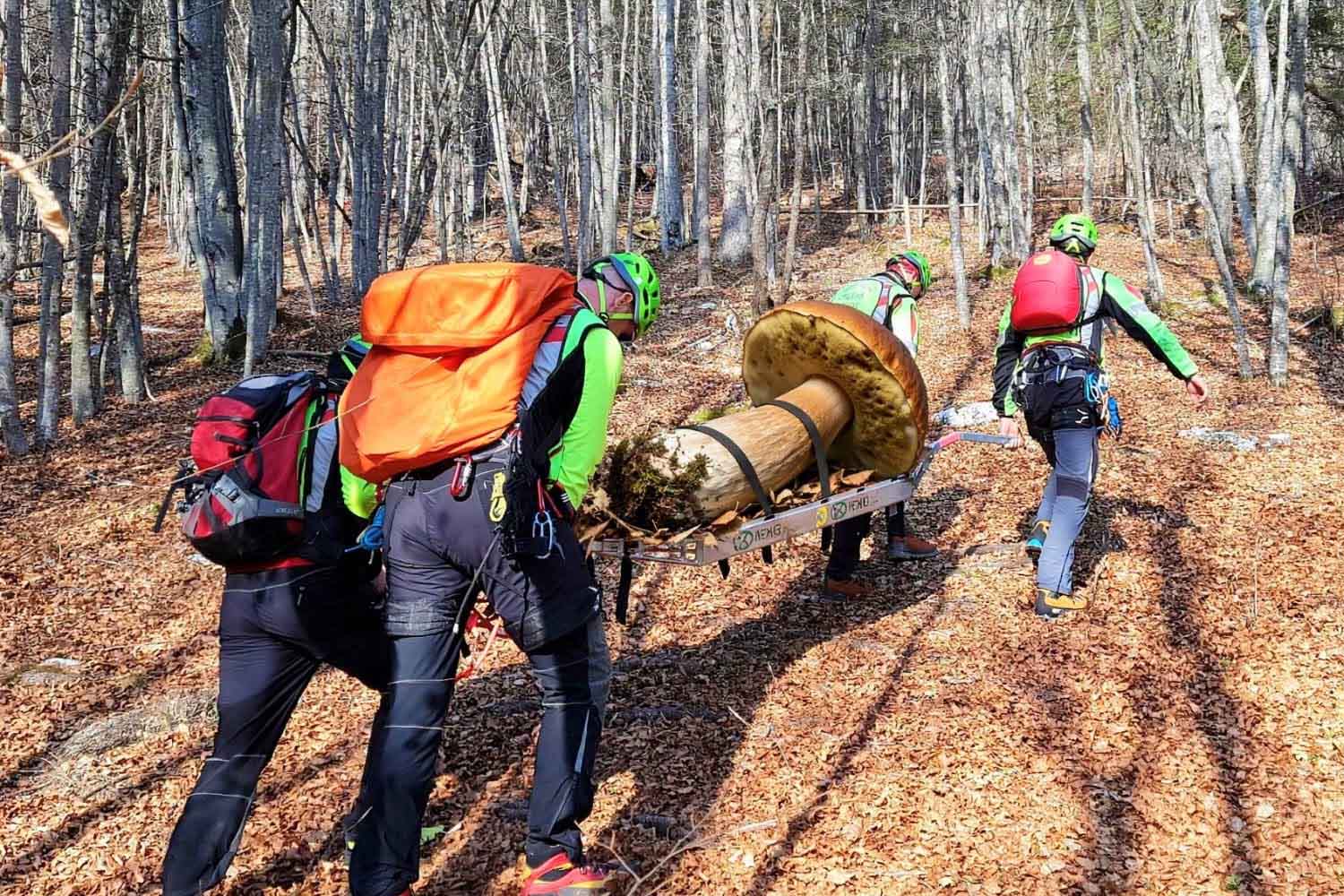
They placed him on the stretcher like a hiker to be picked up, only a huge brown hat peeks out from the blanket. The giant porcini mushroom is fake, the image was created with artificial intelligence by Denis Lunardi, station manager of the Altopiano dei Sette Comuni Alpine Rescue. The message that the Veneto Alpine and Speleological Rescue has entrusted to this small “porcine operation on a stretcher”, however, arrives at the right time: it rains, the mushrooms return and with them an increase in the number of people who enter the woods with their eyes fixed on the ground.
For once, therefore, there is loot on the stretcher. It’s better that way.
You look for the porcini mushroom by looking at the ground. And this is also how we get lost
When we talk about the dangers of mushroom picking, our thoughts immediately turn to poisonous species. In the woods the problem can arise well before dinner: falls, slips and loss of orientation are a very real part of the rescuers’ work.
National data from the National Alpine and Speleological Rescue Corps help to provide a measure. In 2024, 12,063 rescue missions were carried out; falls and slips represented 43.2% of the causes of interventions. Mushroom hunting appeared in 3.4% of the activities practiced by the rescued people. They are different categories and the two data should not be added or overlapped, but they explain well why a walk with the basket deserves some extra attention.
The mechanism is rather intuitive. Mushroom hunters tend to abandon the more linear paths, proceed slowly, change direction often and focus their attention on the ground immediately in front of them. And a surprisingly specific study has just arrived on searchers who get lost in the woods.
One study followed 300 missing foragers: 93% were collecting mushrooms
In 2026 Albert Martínez, Angel Blanch and Carles Comas published on Transactions in GIS the study Lost Gatherers in the 21st Century: Probability of Area, Spatial Behavior, Risk Factors and Vulnerability. The researchers analyzed 248 search operations involving 300 people missing in Catalonia between 2010 and 2022. In 93% of cases they were mushroom hunters.
The sample is Catalan, so it doesn’t automatically describe those who go for porcini mushrooms in the Venetian mountains. Some details, however, seem to be written on purpose next to the photo of the mushroom on a stretcher. The average age of the searched people was around 66 years and in 81.6% of cases the searcher was missing alone, even when he left with friends. 88.4% of the incidents simply involved people who had lost their bearings.
Then there is the telephone, or its absence. In the sample analyzed, 43% did not have a mobile phone with them and 85% did not have geolocation. The authors therefore define the observed profile as high risk and low in technology. The data on time is even more concrete: once more than 24 hours have passed since the disappearance, the probability that the person will be found with severe hypothermia or dead increases. The study doesn’t say that going mushrooming is dangerous in itself; shows how much orientation and the ability to quickly locate a person can weigh when something goes wrong.
Rubber boots and secret place: two traditions to be handled with care
The CNSAS has been insisting for years on a series of precautions that are much less fascinating than the perfect porcini mushroom, but more useful when the ground becomes slimy: suitable footwear, visible clothing, a planned itinerary, checking the weather conditions and someone who at least knows in which area we are headed.
Rubber boots, beloved because they keep out water and mud, can offer little ankle support and little grip on some steep, wet terrain. Better boots suited to the environment you intend to travel. Even a flashlight, whistle, water, a warm piece of clothing and a charged phone take up a much smaller portion of the backpack than we hope to fill with mushrooms.
Finally, there is the most sacred tradition of the mushroom farmer: the place of the porcini mushrooms is not told to anyone. Understandable if the aim is to protect the crop from competition. Much less brilliant if no one knows where to start looking for us. Communicating at least the area and the expected time of return can significantly shorten any intervention.
The same Catalan study reports that seekers, by nature of their activity, tend to move off the beaten path and indicates planning, outings in company, maps or GPS, checking the weather and sufficient equipment among the preventive measures.
In case of emergency you call 112 and follow the directions received without continuing to wander through the woods in an attempt to find your way back. The CNSAS also explains what information to provide during a rescue request: location, condition of the person involved, telephone number and all useful references to narrow down the search area.
The giant porcine can therefore enjoy his journey on a stretcher, which at least only exists digitally. The real ones stay where they are even if the slope is too steep, it’s getting dark or we lost the path a few minutes ago. The boletus can regrow. The ankle has a significantly longer season.
