
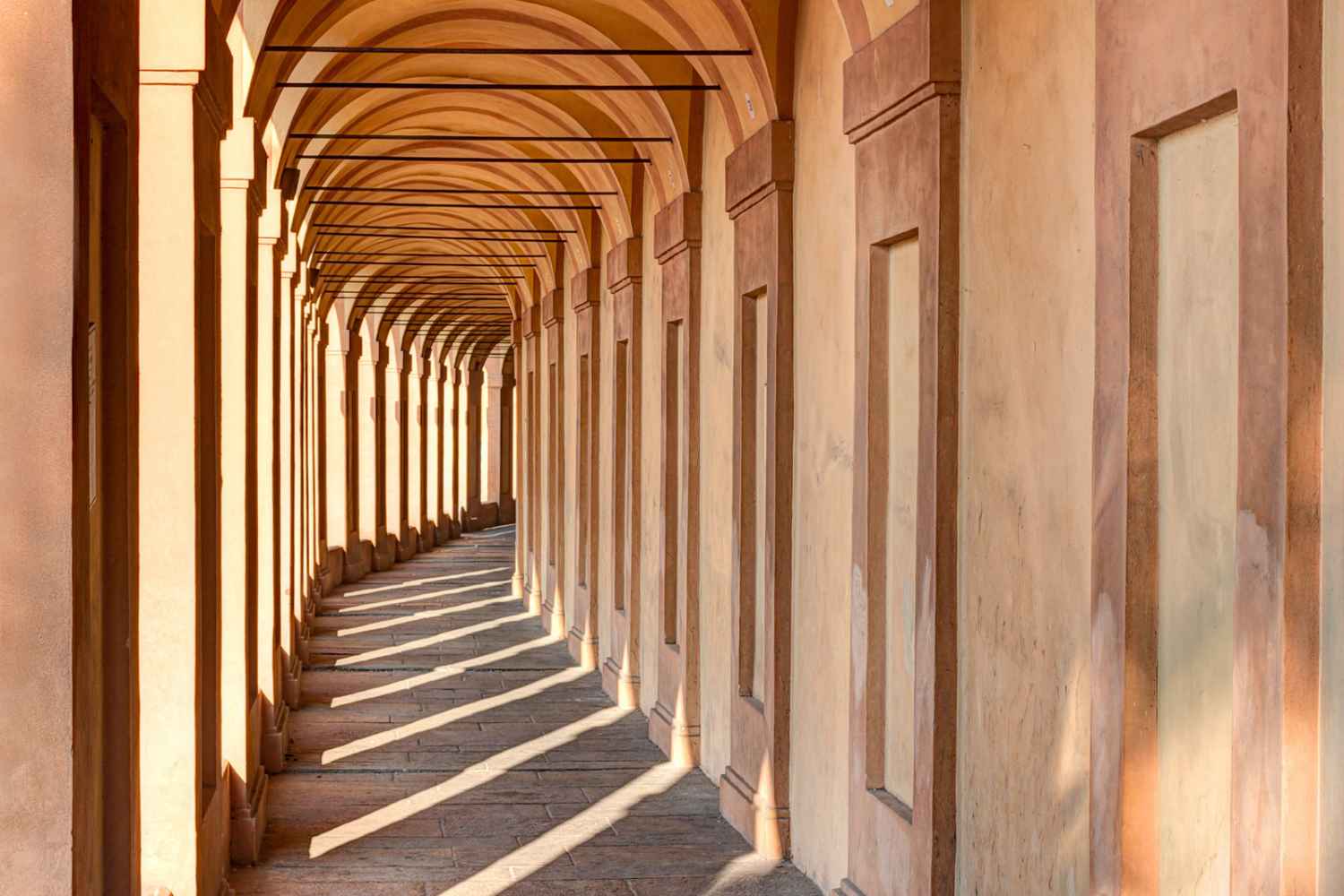
A covered route that crosses Bologna and climbs the hills, among hundreds of arches, panoramic views and centuries of history. It is the portico of San Luca, a unique place in the world that can be discovered with a splendid walk. There are places that are worth visiting at least once in your life, and others that manage to transform even a simple walk into a special experience. In Bologna, for example, there is a route that allows you to walk for almost four kilometers without ever leaving the shelter of a portico. You start from the city, cross hundreds of arches and, step by step, you reach a sanctuary overlooking the hills.
It is not just any portico: it is the longest portico in the world, an all-Italian record that belongs to the Portico of San Luca, one of the most recognizable symbols of the Emilian capital.
With its 3,796 meters of length, this extraordinary architectural route connects the Porta Saragozza area to the Sanctuary of the Madonna di San Luca, on Colle della Guardia. A walk that crosses over three centuries of history and which today represents one of the most evocative ways to get to know Bologna, far from the most crowded streets of the centre.
Where is the longest portico in the world and how to walk along it
The portico of San Luca is located in Bologna, in Emilia-Romagna, and starts from the Arco Bonaccorsi, near Porta Saragozza. From here begins an itinerary that gradually changes appearance: initially flat, it follows via Saragozza for about a kilometer and a half, before starting to climb towards the hills.
One of the most characteristic points is the Arco del Meloncello, an elegant elevated passage that crosses the road and marks the beginning of the hilly part. Built in the eighteenth century to a design by Carlo Francesco Dotti, it is one of the most photographed corners of the entire route.
From this point the walk becomes more challenging. The portico continues uphill, alternating ramps and steps, while the urban landscape gradually gives way to the greenery of the Bolognese hills. The destination is the Sanctuary of the Madonna di San Luca, which dominates Bologna from the top of Colle della Guardia. Once you reach the top, in addition to the satisfaction of having completed the route, you can admire the view of the city and the surrounding hills.
You don’t need to be an expert hiker, but it is advisable to wear comfortable shoes and bring water with you, especially in the warmer months. Those who prefer to avoid the climb can also reach the sanctuary by other means, including the San Luca Express tourist train.
Why does the portico of San Luca have so many arches? The history and legend of the number 666
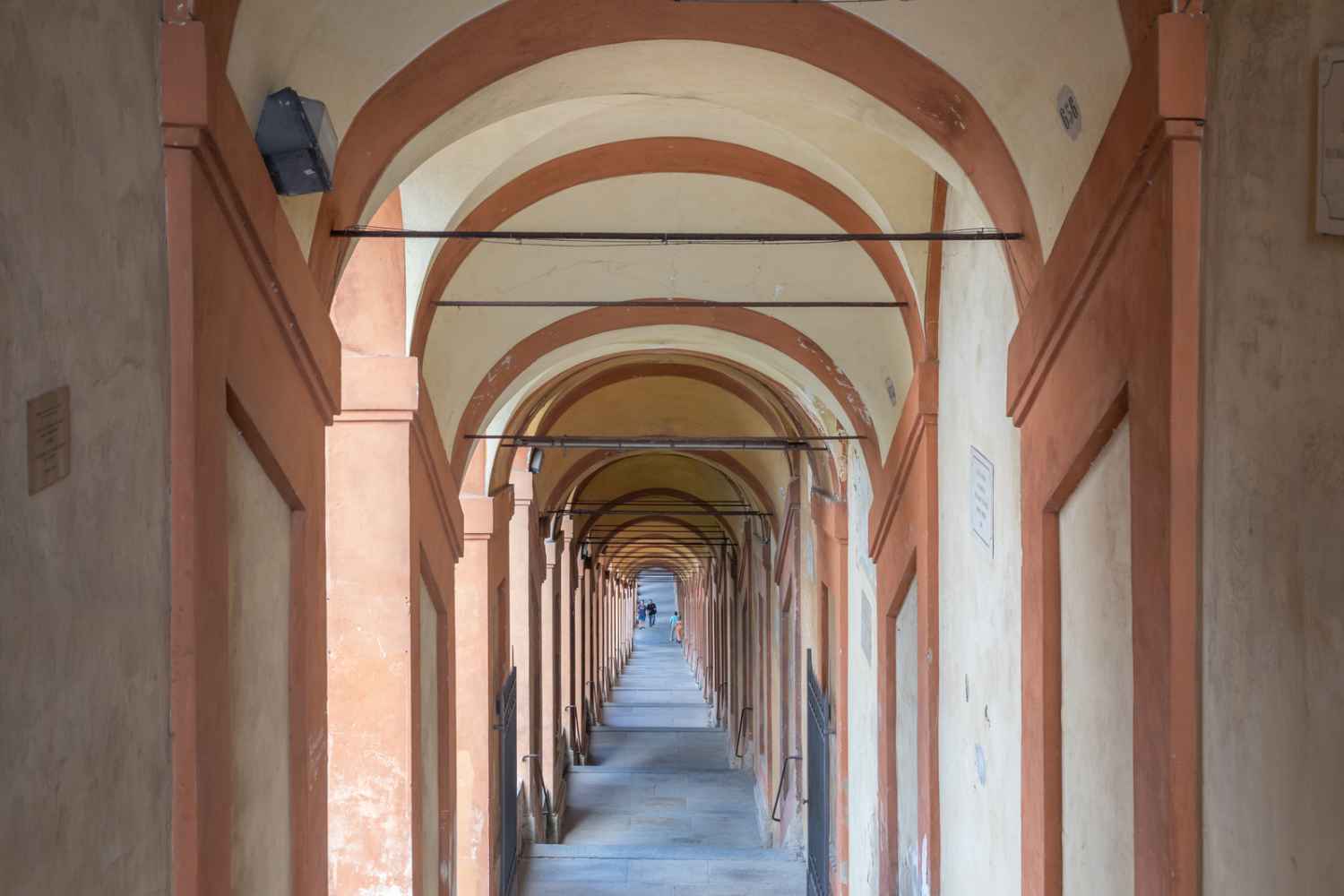
One of the most fascinating curiosities concerns the number of arches. The portico is traditionally described as a succession of 666 arches, even if the count is not unambiguous: some official sources indicate 664 and the Municipality of Bologna specifies that the actual number depends on the criteria used to count them.
But why 666? According to a legend, the number is not random. In Christian tradition, in fact, it is associated with evil, while the sinuous shape of the portico would be reminiscent of that of a snake climbing up the hill.
The sanctuary, located at the end of the route, would symbolically represent the Madonna defeating the serpent. This is naturally a popular interpretation, but it helps to make an already extraordinary work from an architectural point of view even more fascinating. The construction of the portico began in 1674, with the aim of protecting the faithful and religious processions from the elements. To reach the sanctuary, in fact, pilgrims had to face a long and partly steep route, often in the rain or the sun.
The work was created over the course of several decades, becoming over time not only a religious connection, but also a fundamental element of the city’s identity.
The porticoes of Bologna are a UNESCO World Heritage Site: this is why they are so special
The primacy of San Luca is not the only reason why Bologna is world famous for its arcades.
Throughout the city there are a total of 62 kilometres, of which around 42 are in the historic centre. A network of covered passages which, for centuries, has allowed inhabitants to move, meet, work and experience public spaces protected from the sun and rain.
In 2021 the Porticoes of Bologna were recognized as a World Heritage Site by UNESCO. The recognition concerns 12 groups of porticoes selected for their historical, architectural and social value, including that of San Luca.
Their particularity lies not only in the beauty of the buildings, but above all in the function they continue to perform.
Since the Middle Ages, porticoes have represented a meeting space between the private dimension of homes and the public dimension of the streets. Even today they host shops, commercial activities and social places, helping to make Bologna a particularly pleasant city to explore on foot.
An example of architecture which, long before we started talking about sustainable mobility, had already found an intelligent way to make pedestrian travel more comfortable and accessible in every season.
How to visit the portico of San Luca: the walking route and useful advice
If you are planning a visit to Bologna, walking at least part of the portico of San Luca is an experience worth including in your itinerary.
The advice is to start from Porta Saragozza and walk along the portico without haste, observing the details of the arches and stopping at the Arco del Meloncello.
The first part is also suitable for those who want a peaceful walk, while the final stretch requires a little more physical effort. In the summer months it is preferable to tackle it early in the morning or late afternoon, avoiding the hottest hours.
The porch offers precious shelter along much of the route, but this does not mean that the climb is without effort, especially when temperatures are high.
Once you reach the sanctuary, it is worth dedicating a few minutes to the view of the city, before choosing whether to walk the same route back.
The beauty of this itinerary is that it does not require tickets or reservations to walk along the portico: it is a public walk that allows you to discover one of the most particular architectural heritages in Italy. And perhaps this is precisely its charm. The longest portico in the world is not a monument to be observed only from the outside, but a place to cross, experience and share, exactly as the people of Bologna have done for generations.
