
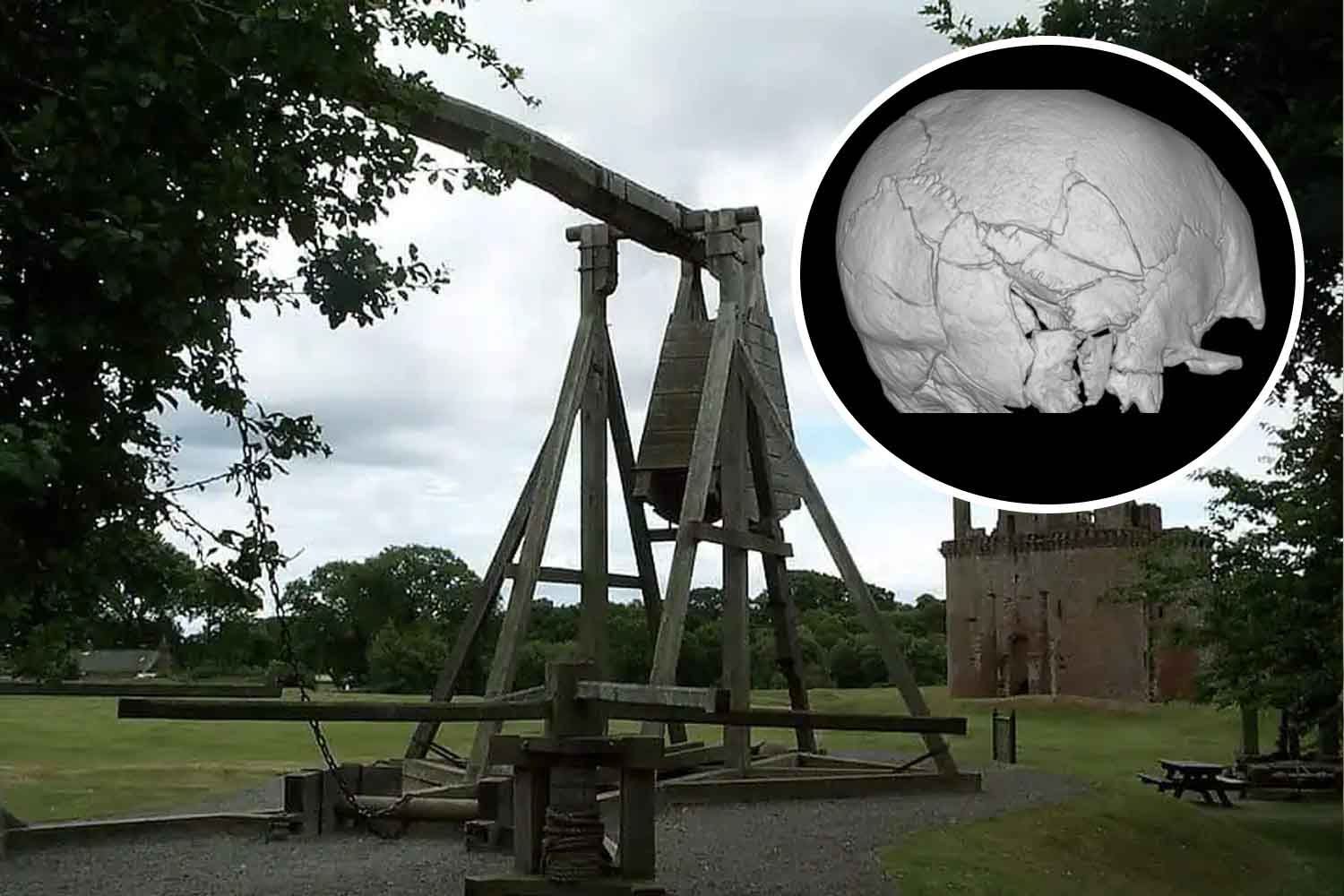
The shot came from behind. The skull cracked 61 pointsanother 57 fractures crossed the ribs and the damage continued along the shoulder, vertebrae and limbs. When researchers finished piecing together what remained of Skeleton 150, a young man who died more than seven centuries ago in Stirling Castle, Scotland, the count had reached 167 fractures. An enormous amount of energy was needed to produce them. The suspect is shaped like a stone thrown from a medieval catapult.
More precisely, scholars talk about a counterweight trebuchetone of the large siege engines capable of throwing boulders against walls and fortifications. In common language we can easily call it a catapult; the technical detail becomes interesting above all because in Stirling, in 1304, there was one that even had a name: War Wolf, the “War Wolf”.
@Wikimedia Commons – ©Jo Buckberry / University of Bradford
According to Jo Buckberry of the University of Bradford and Patrick Randolph-Quinney of Uppsala University, Skeleton 150 could retain the first known archaeological evidence of trauma caused by a trebuchet. The research was presented at the 25th European Meeting of the Paleopathology Association in Berlin and is available, for now, as a conference abstract: so we are faced with results presented at a conference, still without a complete peer-reviewed scientific publication.
The shot would have struck him while he was still standing
Skeleton 150 had between 22 and 34 years old. Buckberry and Randolph-Quinney re-examined nine individuals recovered from Stirling Castle for trauma related to the Scottish Wars of Independence. On the skeleton 150 they combined direct observation with radiographs, microscopy and micro-CT scans.
The bones tell something very different from a series of wounds accumulated during a clash. The fractures, distributed from the top of the skull to the knees, would have occurred around the time of death and they are all compatible with blunt trauma. The greatest concentration is found around the right shoulder and the back of the skull.
Their arrangement also suggests how the man was positioned: he was probably still alive and standing, with your weight on your legs and your forearms bent in front of your bodywhen he was struck by a single high-speed impact. Comparison with modern forensic cases leads in the same direction. Just one shot, in short. Pretty definitive.
However, the authors place an important caution alongside the reconstruction: there is a lack of directly comparable forensic cases. The bones show the force and general direction of the impact; which caused it.
In 1304 Stirling was under fire from 13 catapults
The location of the burial narrows the field of suspects quite a bit. In 1304 Edward I of England besieged Stirling Castleone of the last strongholds of the Scottish resistance. The fortress stood on a rocky spur that was difficult to conquer and the English king decided to solve the problem with a not very discreet quantity of medieval artillery.
According to the reconstruction of Historic Environment Scotland, they were lined up around the castle 13 catapults and trebuchets. For about three months they threw rocks and other projectiles at the fortifications day and night. Edward brought in materials from different parts of Scotland and even ordered churches to deliver lead from their roofs to build siege engines.
Inside the castle, about 25 men led by William Oliphant resisted. The walls still held, so Edward upped the ante further.
Five master carpenters and 50 workers they assembled enormous beams, winches and a gigantic counterweight. The War Wolf was born, one of the largest counterweight catapults in memory.
The mechanism exploited the fall of a large weight placed at one end of the arm to hurl the projectile placed at the other. When the War Wolf was almost ready, Oliphant tried to surrender. Edward refused to accept the surrender immediately: he had built that machine and intended to use it.
When the shot was fired, the bullet weighed approximately 140 kilograms. Historic Environment Scotland reports that it managed to breach part of the castle’s curtain wall. The dress rehearsal, evidently, was not contemplated.
The War Wolf is the perfect suspect. Almost too much
Skeleton in the castle, very high energy trauma, siege of 1304 and a gigantic catapult that launched 140 kilo stones: putting together the clues comes naturally.
The researchers, however, . In the abstract they recall that Edward I used several siege engines, including the famous trebuchet, and conclude that the fracture pattern is compatible with a single high-velocity impact. The transition from the “catapult” to the “War Wolf” remains a hypothesis.
And it also has a numerically cumbersome competitor: the other English machines had been bombarding Stirling for months, while the War Wolf arrived in the final phase of the siege. The most famous name is therefore also the one that risks taking all the limelight.
The discovery remains remarkable even without assigning the medieval murder to a precise catapult. The wars of the Middle Ages left sword cuts, puncture wounds and bullet wounds on skeletons. Here much of the body appears to have absorbed at almost the same instant a force designed to break a fortification.
For centuries the news has told these machines through what they managed to do to the walls. Skeleton 150 may have retained the other measure of their power: 167 fractures in a single body. The War Wolf can wait for the verdict. The catapult, most likely, was already there.
