
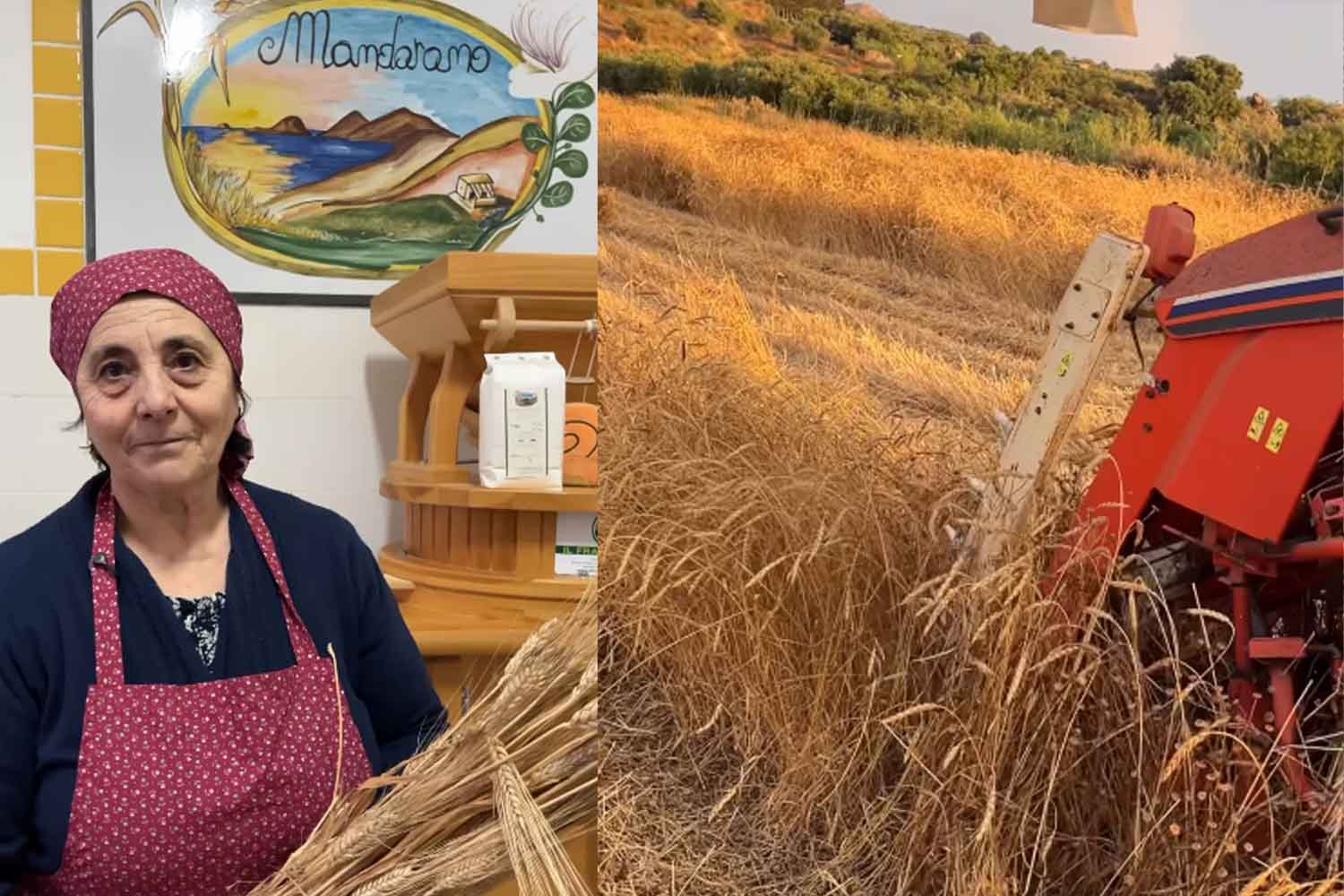
In Lipari they have opened what, with a lot of good will, we could define as a domestic seed bank: a jar with twenty ears of wheat inside. They had been preserved for decades by the grandfather of the Cincotta family. From those few seeds a patient multiplication began, harvest after harvest, until the Margherito returned to grow in the fields of the island. Today it ends up in flour, pasta and even a craft beer. In short, the jar has come a long way.
The story of the recovery is told by Antonello Cincotta, who after a period of work in Milan returned to Lipari and participated in the development of the Mandarano agricultural company. The family says that it all started with the twenty ears of corn kept by grandfather Antonino: the grains were sown in a small plot and the harvest used again as seed, season after season.
The result can be seen today above all on earth. A fact sheet from the Gusta il Territorio territorial project credits the company with the recovery of over ten hectares of uncultivated land in Lipari, also intended for the cultivation of traditional grains. Where there were brambles and abandoned plots, the ears of corn have returned.
View this post on Instagram
Margherito, however, had not disappeared from the registers
The jar, however, was not Margherito’s last refuge in the world. The rediscovery mainly concerns cultivation on Lipari. Margherito was already known, studied and preserved as a variety of Sicilian durum wheat.
In the National Register of Conservation Varieties the name registered is Bidì, SIAN code 19510, and “Margherito” appears among its synonyms. The person responsible for pure conservation is the Grain Growing Experimental Consortium Station for Sicily. In short, wheat had not disappeared: in Lipari, above all, its cultivation had disappeared.
Even the definition of “ancient grain”, widely used when talking about these crops, should be taken for what it is: a rather broad label. A study published in Agronomy describes Margherito more precisely as a historical variety of durum wheat, synonymous with Bidì, selected in Sicily before 1915 from material of North African origin. The work reconstructs two Sicilian selections associated with the names Margherito and Bidì.
Therefore no botanical variety remained unknown for forty years in a cupboard and suddenly returned to science. The interesting part is another: a small quantity of seed saved by a family made it possible to bring that cultivation back to an island where it had been abandoned.
From fields to pasta, and now also to beer
In the meantime, the project has stopped being just a recovery sowing. The Margherito grown in Lipari is transformed into flour and artisanal pasta; the local Brand Eolie network includes Mandarano among the companies that are recovering uncultivated land and working this variety on the island.
Margherì also arrived in 2026, a craft beer produced using wheat grown in Lipari. The company has also built rural tourism and tasting routes around the fields, bringing cultivation into a local economy that includes catering and hospitality. The grain, in essence, returned to the landscape and soon after ended up on the plate.
The figures released in the various public reconstructions are discordant: they go from a few quintals to several tons per year, with cultivated areas also indicated differently. Without consolidated company data, it is better to avoid turning a crazy number into a certainty.
Before the wheat there were brambles and let go of land
The recovery of the Margherito works above all because it fits into a much less romantic problem than grandfather’s jar: the agricultural land left unused. On the islands, working small, fragmented and often difficult to reach plots costs more and yields less than large intensive crops. When fields are abandoned, agricultural practices, cultivated varieties and pieces of landscape are lost along with production.
In Lipari the path went in the opposite direction. Wheat has also become the center of local initiatives dedicated to the harvest and conservation of traditional varieties. In 2024 Antonello Cincotta was indicated as spokesperson for the Ancient Grains community of the Aeolian Islands, with the involvement of the Graniculture Experimental Station and the local Slow Food network.
View this post on Instagram
It’s a small story, measured in hectares and not thousands of tons. Some lands have returned to cultivation, a historic variety has regained space on the island and a supply chain has been created around that cultivation. Grandfather Antonino’s jar wasn’t exactly a germplasm bank with cold rooms, catalogs and armored doors. Thankfully, it did the job pretty well.
