
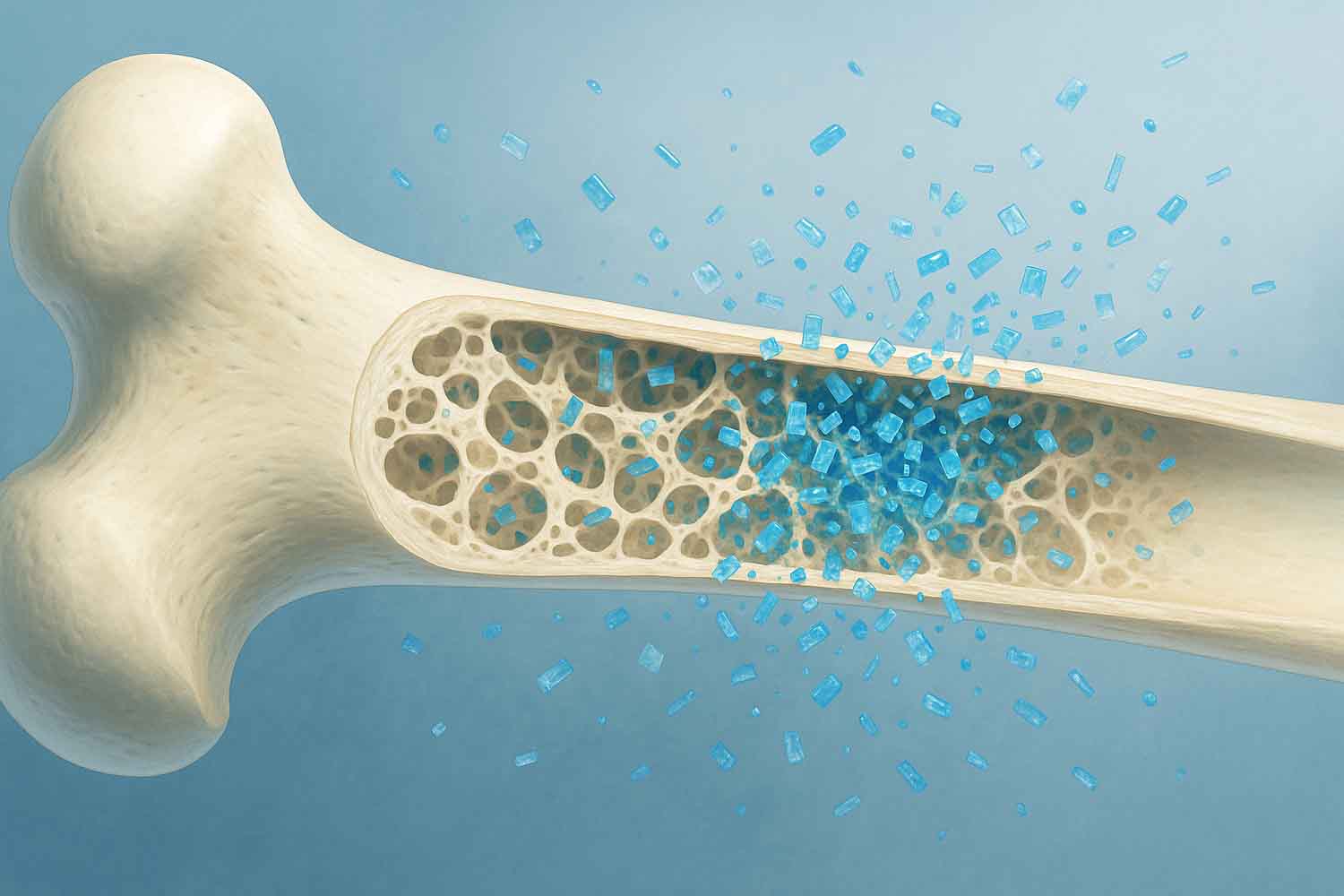
Microplastics are no longer just an environmental emergency: today they also represent a real threat to the human body. Over time, it has emerged that these tiny fragments – together with even smaller nanoplastics – manage to insinuate themselves practically everywhere: in water, in clouds, in the most delicate tissues, even in sperm and the placenta. Now science takes a step forward and addresses a question that until a few years ago seemed unthinkable: what happens when microplastics penetrate bones?
This is precisely the starting point of a study that reviewed dozens of already published research, revealing a picture that is anything but reassuring. By analyzing 62 scientific works, a Brazilian team funded by FAPESP and published on Osteoporosis International reconstructed the possible effects of these particles on the health of bone tissue. The result is a clear hypothesis: microplastics appear capable of altering bone metabolism, interfering with the natural balance between bone destruction and reconstruction and paving the way for fragility, deformities and fractures.
Microplastics in bones: what happens when they enter the marrow
Scientists have observed that microplastics, once infiltrated into bones, can disturb several fundamental mechanisms. The first concerns bone marrow stem cells, the biological laboratory where the cells destined to keep skeletal tissue healthy take shape. Here, the researchers explain, the particles appear to direct cellular differentiation towards a predominance of osteoclasts, i.e. the cells responsible for bone resorption.
Resorption itself is not harmful: it is the method by which the body eliminates old tissue to replace it with new bone. The problem arises when this process accelerates beyond the norm, exceeding the body’s ability to rebuild. At that point, the balance is broken: the bone structure thins, becomes fragile and vulnerable, exactly as happens in osteoporosis.
The studies cited in the Brazilian work describe a second mechanism, which emerged thanks to in vitro research: microplastics weaken the vitality of cells, anticipate cellular aging, disturb the normal ability of cells to differentiate and fuel a chronic inflammatory state. In short, in contact with bone tissue, they become a source of biological stress which alters the quality of the bone.
To confirm the seriousness of the phenomenon there are also several experiments on animals. In these models, prolonged exposure to microplastics accelerated the aging of osteoclasts, resulting in compromise of bone microstructure and the development of dysplasias, deformations that can precede marked weakening and fractures.
The research doesn’t stop here. The same group that signed the scientific review is now working on a study aimed at understanding whether microplastics can aggravate existing metabolic bone diseases, such as osteoporosis or osteopenia. A question that becomes urgent, considering that microplastics do not spare any ecosystem and accumulate, day after day, in our organisms.
On microplastics you might also be interested in:
