
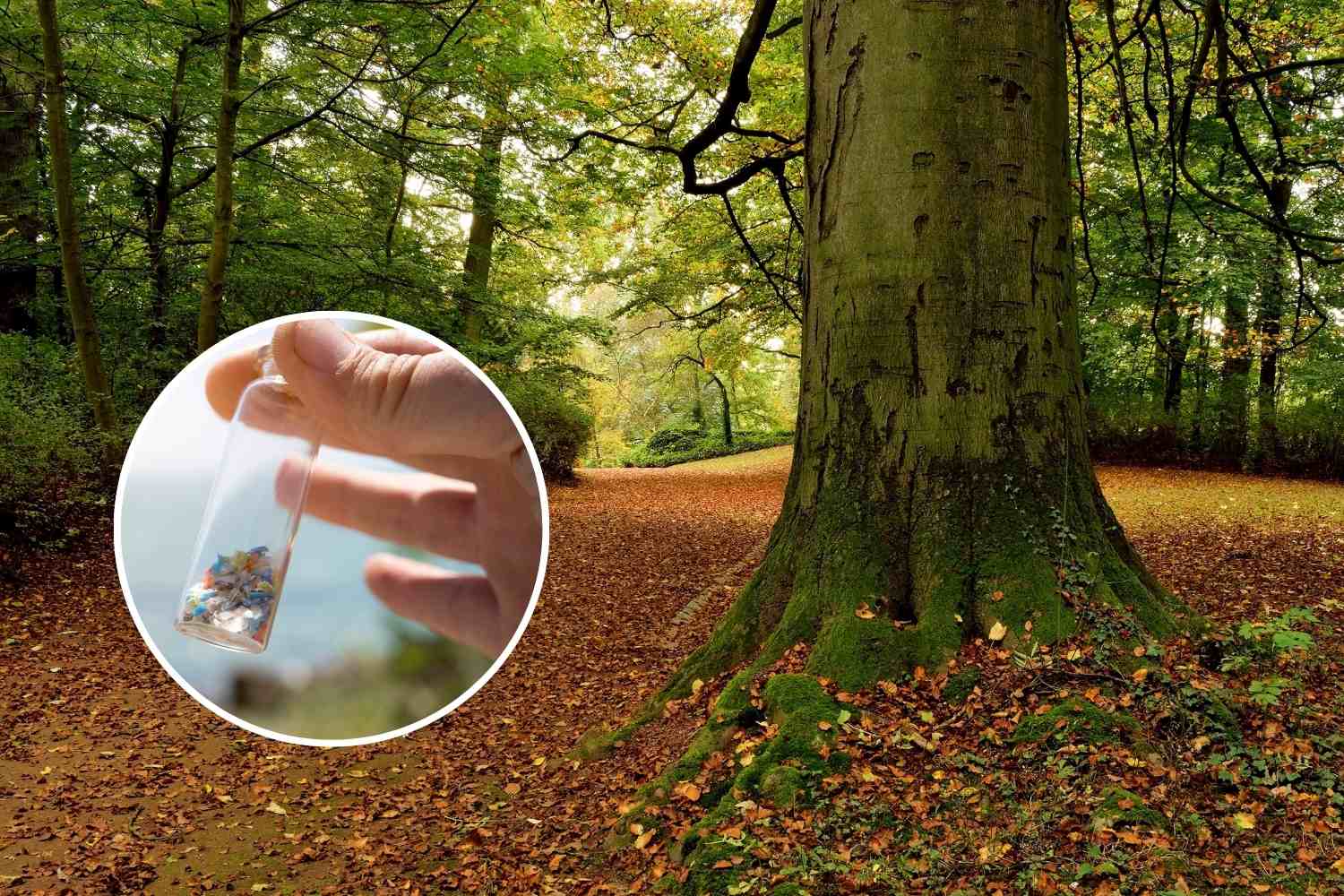
Imagine escaping the city to take refuge in a forest, thinking of finally breathing clean air. Too bad that, according to a new study byUniversity of Leedsyou could inhale more microplastics there than in the center of a metropolis.
The research, just published on Environmental Pollution, it completely overturns our certainties: the woods are accumulating concentrations of microplastics higher than those in urban areas. Up to 500 particles per day per square meter in Oxfordshire woodland, double that in the city of Oxford.
And experts warn that this phenomenon is very worrying for the possible effects on human health, because the smallest microplastics can be inhaled and accumulate in the body, transforming what we thought was a corner of uncontaminated nature into a surprising pollution hotspot.
The woods are no longer a “clean” refuge
If until recently woods and forests were considered oases of pure air, the new study forces us to review this idea. In fact, trees, with their thick foliage and extensive leaves, function as gigantic natural filters that capture the tiny plastic particles traveling in the air and deposit them on the ground.
The higher concentration of very small particles, invisible to the naked eye, highlights how not even green spaces are immune from plastic pollution and highlights the potential risks to human health.
The study monitored three areas in Oxfordshire, England: the rural woodland of Wytham Woods, the suburban town of Summertown and the city of Oxford. Surprisingly, the researchers found up to 500 microplastics per day per square meter in the forest, while in the city of Oxford the values reached a maximum of around 270 particles/m²/day: almost half of the forest. This shows that, against all expectations, forests can accumulate more microplastics than some urban areas.
Gbotemi Adediran, professor of geochemistry of earth surfaces and responsible for the study, explains:
Our research shows that rural environments are not necessarily safe from airborne microplastics. Trees, in particular, influence the deposition of particles from the air.
Invisible but dangerous
The size of the particles found is the most alarming detail. Most measured just 25-50 micrometers, the equivalent of a large bacterium, smaller than a pollen grain. Up to 99% of the microplastics collected were completely invisible to the naked eye.
This microscopic size is exactly what makes the phenomenon so insidious, such small particles can easily be inhaled, enter the lungs and potentially accumulate in the body. The health effects are still largely unknown, but scientists’ alarm is clear.
The types of plastic then vary based on the location. In the woods, PET dominates, that of bottles and food containers. In suburban areas, polyethylene bags prevail. In the city, the EVOH of industrial and automotive packaging.
A journey of thousands of kilometers
Microplastics can remain suspended in the atmosphere for weeks, traveling even thousands of kilometers before settling. Wind, humidity, rain and temperature determine where and when they will fall.
The researchers found that windy days significantly increased particle deposition. Intense rains, paradoxically, reduce the total number but favor the fall of larger fragments. High humidity, however, enhances the deposition of smaller microplastics, precisely those most dangerous for inhalation.
Adediran concludes:
The widespread presence of microplastics raises health concerns, regardless of whether you live in a city or a rural village.
Finally, the conclusions of the study read:
Our findings highlight the importance of further research to unravel the relationships between environmental factors and microplastic deposition. Future studies will focus on the long-term effects of polymer types, particle size distribution, and local weather conditions on microplastic dynamics in different ecosystems. Such research is critical to guide the development of effective strategies to mitigate the impact of microplastics on the environment and public health.
Although the long-term effects on the human body remain to be fully clarified, reducing the use of single-use plastic and improving recycling are concrete steps we can take today. Because if microplastics have colonized even the most remote woods, it means that the problem has already exceeded all limits.
Sources: Environmental Pollution / School of Earth and Environment
