
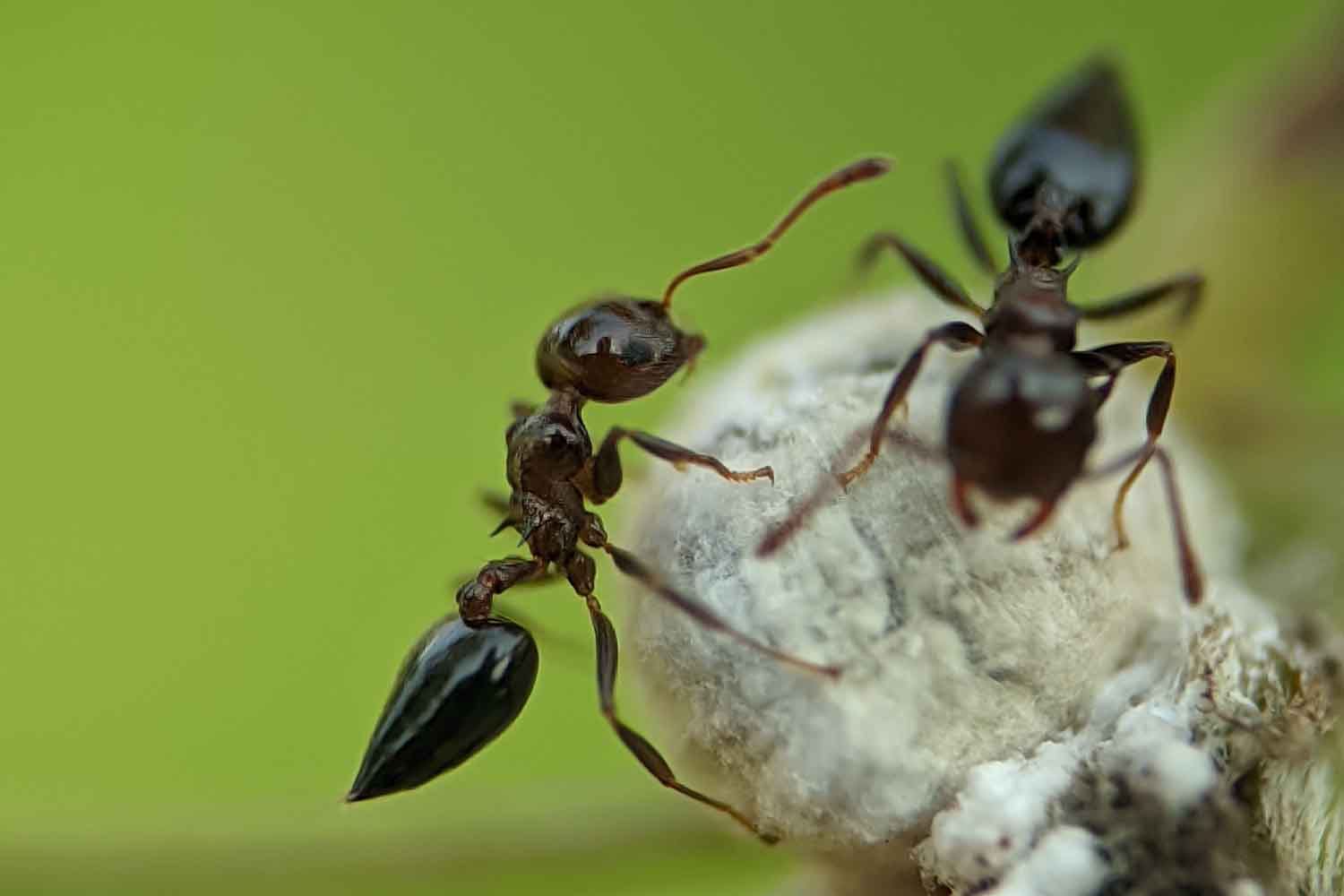
An ant colony can find the shortest route to food without maps, meetings or a CEO ant. Some leave, try different routes and leave behind traces of pheromones. The most efficient routes are traveled more often and therefore strengthened; the worst ones, little by little, vanish.
It’s one of many cases where insects can make surprisingly effective collective decisions with tiny brains and very limited information. Ants, bees, locusts, cockroaches and gnats don’t hand us a six-legged self-help manual. However, they offer some interesting clues on how to manage alternatives, mistakes, indecision and even people who think differently from us.
The ants try several paths, then abandon the worst ones
The ant mechanism was observed experimentally as early as the late 1980s. In a study on Argentine ants, the insects could collectively select the shortest route between the nest and the food through pheromone trails. None knew the entire route. However, the ants that traveled a shorter route returned earlier and re-deposited their chemical signal. That route thus ended up attracting more traffic, while the others progressively lost importance.
Optimization algorithms were also born from this strategy. Marco Dorigo and colleagues developed theAnt Systemusing precisely the idea of exploring different solutions and strengthening those that work best. For us it might sound almost trivial: try, gather information and abandon unpromising options. Then we open twenty-seven tabs to choose a hotel and suddenly the ants seem less simple.
The bees argue by dancing and wait for enough consensus
When a swarm needs to find a new home, several scout bees set out in search of suitable sites. Once they return they communicate the position and quality of the place through the famous waggle dancethe dance with which they can indicate direction and distance. Other explorers verify the proposals and also report information. A study on the nest choice process showed how much the decision depends on the interaction between site quality, distance and recruitment of other bees.
Then the quorum arrives. The experiments of Thomas Seeley and P. Kirk Visscher on Behavioral Ecology and Sociobiology have shown that the swarm prepares to depart when a sufficient number of explorers converge on the same site. By experimentally delaying that threshold, the start was also delayed.
First the alternatives, then the checks, then a threshold high enough to be able to move. Without the need for unanimity, which would probably block even a hive.
The locusts do something even stranger: they stop
Among the most curious results is the one published in 2026 on Advanced Science. By studying young locusts marching in groups, researchers have observed that moving from one direction to another can go through a phase in which many individuals temporarily stop moving.
That momentary neutrality makes the consensus less rigid. The authors then tested a similar mechanism with human participants asked to choose between two alternatives or to abstain. When abstention was possible, groups were more easily able to break away from a previous consensus and reach a new one.
It doesn’t mean that indecision is always a virtue. The experiment involves very specific conditions. However, it suggests something less intuitive: faced with two already compact sides, temporarily exiting the dispute can make the system easier to move. Every now and then what he doesn’t choose right away might not be the problem in the meeting.
Cockroaches also have personalities, and the group can use it
Cockroaches don’t all behave the same way. Some are more exploratory, others more conservative. In 2020 a study published in Behavioral Processes used simulations based on their aggregation behaviors to understand how much these individual differences mattered. Models with a greater variety of behaviors better reproduced what happens in real animals, and, under some conditions, diversity accelerated group formation.
We’re in the modeling business here, so no one has proven that putting three incompatible personalities in the same work chat produces collective wisdom. The interesting fact is more sober: individuals who react differently to the same environment can increase the possibilities available to the group. Uniformity, at least for cockroaches, doesn’t always seem like a great idea.
Midges slow down when the choice is difficult
Even Drosophila melanogasterthe fruit fly, spends more time making complicated decisions. In a study published in Scienceresearchers trained midges to distinguish different odors. The more similar the alternatives became, the more time it took to choose. A little winged version of the tradeoff between speed and accuracy.
What happens inside the animal also changes its decisions. Experiments published on Biology Letters they observed a judgment bias: After a stressful condition, flies were less likely to approach an ambiguous stimulus. The authors point out that this does not allow us to attribute conscious emotions comparable to ours to them.
Hunger changes the cards again. A study on Scientific Reports showed that animals deprived of food intensify their search and are more willing to face unfavorable conditions in order to reach a nutritional source. The decision, therefore, depends on the information available and also on the state of those who have to process it.
Insects arrive at the same problem by following very different paths: ants explore, bees verify, locusts can suspend choice, cockroaches exploit individual differences, midges slow down when the alternatives are too similar. None of them know they are teaching us a lesson. This is probably also why they can do it without opening a podcast.
