
Good news for those who dream of a dip in the crystal clear waters of the Mediterranean or a swim in an Alpine lake: the quality of European bathing water continues to be very high.
According to the new Bathing Water Report 2025, published by the European Environment Agency (EEA), 96% of the monitored sites meet the minimum standards required by the European Union and just 1.5% were classified as “poor” quality.
A result that demonstrates the progress made in recent decades in the protection of water resources, but which also hides profound differences between countries and between different natural environments. In fact, if coastal waters continue to record excellent numbers, rivers and lakes still show fragility that deserves attention.
The ranking of the cleanest waters
The classification of bathing water is mainly based on the presence of two indicator bacteria: Escherichia coli and intestinal enterococci.
Taking first place in the ranking is Cyprus, which can boast an extraordinary result: 100% of its bathing water was judged “excellent”. Immediately behind we find Greece (97.1%), Bulgaria (96.9%) and Austria (96.5%), countries that confirm particularly high water quality.
Excellent results also for Lithuania and Slovenia along the coasts, even if the quality of inland waters had a negative impact on the overall score.
- Cyprus 100%,
- Greece 97.1%,
- Bulgaria 96.9%,
- Austria 96.5%,
- Luxembourg 94.1%,
- Denmark 92.4%,
- Germany 90.9%,
- Italy 89.8%,
- Malta 88.8%,
- Lithuania 86.7%,
- Spain 86.6%,
- Croatia 86.2%,
- Latvia 84.7%,
- Finland 84.5%,
- Switzerland 84.4%,
- Romania 84%,
- Portugal 82%,
- Czech Republic 79.7%,
- Ireland 78.4%,
- Sweden 77.7%,
- Slovenia 75.5%,
- France 74.4%,
- Holland 70.9%,
- Slovakia 70%,
- Belgium 67.9%,
- Hungary 64%,
- Poland 58.7%,
- Estonia 56.9%,
- Albania 16.8%
The data, relating to 2025, includes seas, lakes and rivers.
@EEA
And Italy?
Even though it is not among the top 5 in the European ranking, Italy would continue to record very positive results. In recent years most of its bathing waters have been classified as excellent, especially along the coasts, confirming the high quality of many seaside resorts in the country.
Where the worst waters are
Estonia, the Netherlands and France record a share of water classified as “poor” above 3%. Even more significant is the figure for Albania, which has the lowest percentage of excellent water in Europe: just 16.8%. Estonia (56.9%), Poland (58.7%), Hungary (64%) and Belgium (67.9%) also fall below the 70% excellent water threshold.
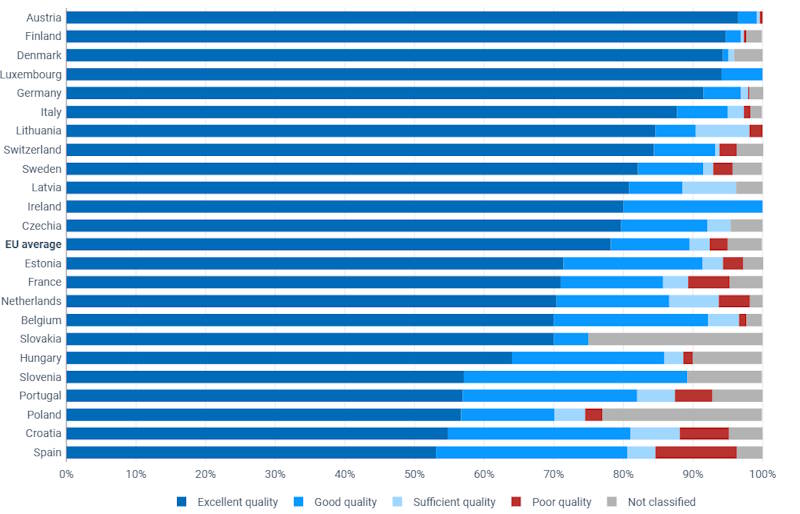
If we consider lakes and rivers exclusively, the picture changes further. Spain is the country with the most critical issues: over 11% of internal waters are classified as poor and only 53.1% reach the level of excellence.
Slovenia, Portugal and Croatia also show less encouraging results regarding internal waters.
Because rivers and lakes are more vulnerable
The report highlights an important difference: marine waters are generally cleaner than inland waters. 88% of Europe’s coastal waters were rated excellent, compared to 78% of lakes and rivers.
@EEA
The reasons are multiple. Many inland rivers and basins in Central Europe are small and have limited water exchange. This makes them particularly sensitive to the increasingly frequent extreme events caused by the climate crisis.
Heavy rains can cause pollutants to wash away from urban and agricultural areas, while periods of drought reduce the natural ability of waterways to dilute contaminants.
Rivers remain Europe’s weak point
Only 47% of the approximately 1,200 river sites monitored in Europe reached the excellent quality level in 2025. The causes are often rooted in the past. The European Environment Agency recalls how industrialization and rapid urbanization have left a heavy footprint on European river ecosystems for decades.
Added to these historical pressures are today urban discharges during extreme weather events, agricultural runoff rich in fertilizers and pesticides and the input of contaminants from livestock.
Despite this, the report also highlights an encouraging sign: thanks to European water quality policies, many urban rivers are slowly coming back to life. In several European cities it is once again possible to swim in waterways that until a few decades ago were considered biologically compromised.
The 2025 data show a Europe that has been able to invest, but also how fragile this heritage is: climate change, urban expansion, intensive agriculture and the growing pressure on water resources make it increasingly clear that water quality cannot be taken for granted.
Every river recovered, every lake protected and every stretch of coast returned to bathing demonstrate that environmental policies work when they are applied continuously. But they also remind us that clean water is not just a natural resource: it is a right, a public health safeguard and one of the most concrete indicators of the health of the ecosystems on which our very lives depend.
HERE is the full report.
