
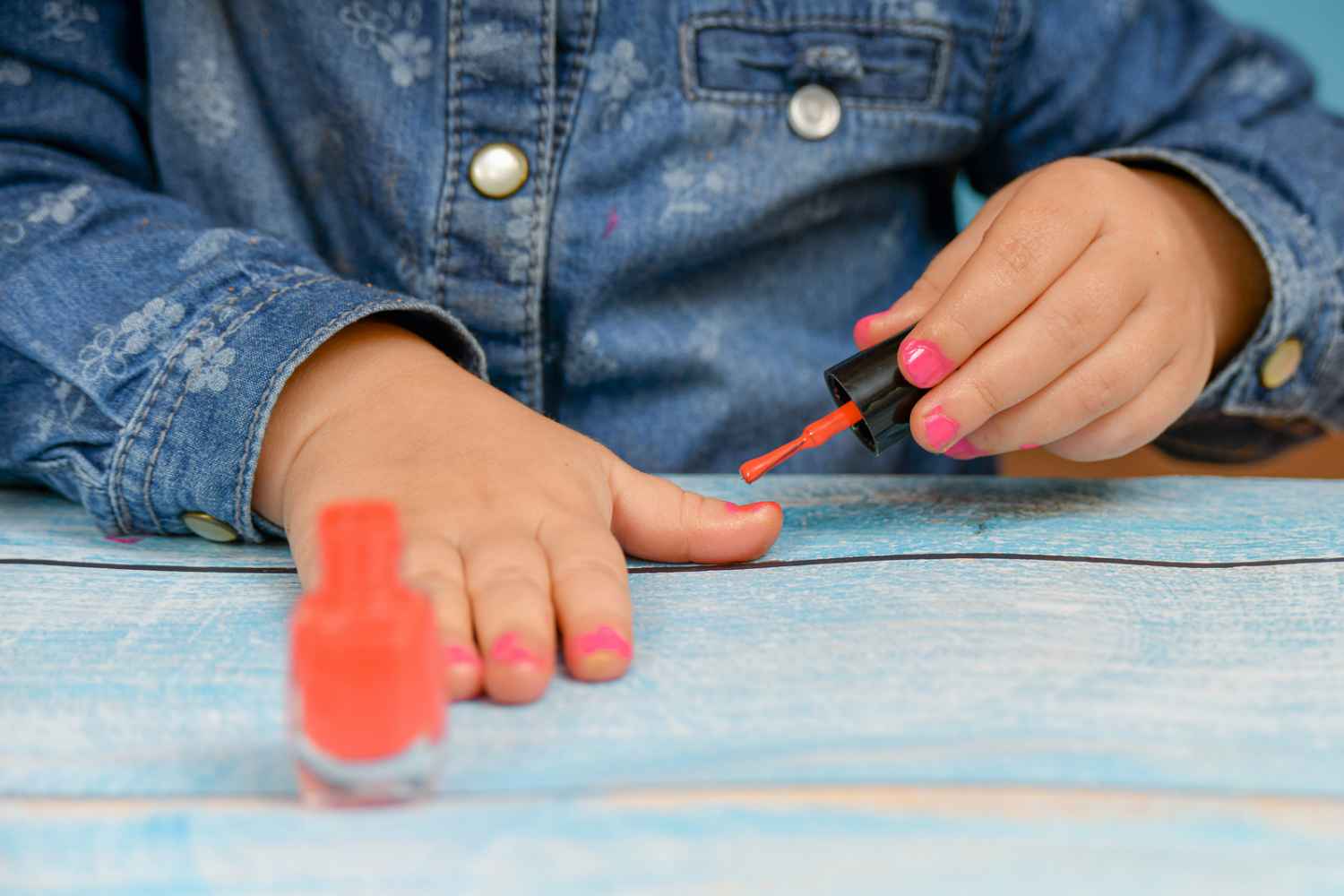
Children’s nails require a little more attention, including solvents, possible allergies and irritants, which is why it is better to avoid nail polishes for adults and choose products suitable for their age.
All it takes is a moment of distraction in front of the mirror, the mother puts on nail polish, the little girl watches curiously and shortly after comes the inevitable request: “Will you put it on me too?”. Maybe just the bright red one, full of glitter or fluorescent pink. And what do you want it to be, after all, a little color on your nails?
Yet, the nail polish that we adults use is not necessarily suitable for children. Not because a single application must cause damage, but because the composition of these products, the methods of use and above all the behavior of the little ones can increase the possibility of irritation, allergies and accidental exposure.
Then there is an aspect that we often underestimate: children frequently put their hands in their mouths, bite their nails and can remove the enamel with their teeth. And so what was supposed to be a simple game risks turning into unwanted exposure to substances that are not intended to be ingested.
Why adult nail polish is not the best choice for children
©123rf/tomatostick
Traditional glazes are mixtures of pigments, substances that form a resistant film and solvents that allow the product to spread and dry.
When applied correctly, on healthy nails, and according to the manufacturer’s directions, they are generally considered safe for their intended use. The problem arises when they come into contact with the skin, are used improperly or accidentally end up in the mouth.
The U.S. Food and Drug Administration (FDA) reports that some ingredients in nail products may cause irritation or allergic reactions. These include certain resins and substances used to make nail polish more resistant and adherent. In small children, who may move during application and immediately raise their hands to their face, avoiding contact of the product with the skin is more difficult.
It does not mean that every nail polish is dangerous, it means, rather, that a cosmetic formulated for the needs of an adult should not automatically be considered suitable for a child.
What happens if the child bites his nail polish?
It’s probably one of the most important questions: children, especially younger ones, have a habit of putting their fingers in their mouths, biting their nails or peeling off small portions of enamel with their teeth.
This way they can ingest tiny fragments of the product. According to the Poison Control Center at the Children’s Hospital of Philadelphia, accidental ingestion of small amounts of nail polish most often causes no or mild effects, such as mouth irritation, nausea or gastrointestinal upset.
This data is important to avoid alarmism: accidentally biting a painted nail is not equivalent to serious intoxication. The case is different in which a child directly ingests the contents of a bottle, especially if we do not know the quantity ingested. In these situations it is necessary to promptly contact a Poison Control Center, providing the name and, possibly, the composition of the product.
Prevention remains the simplest choice: keep nail polish and solvents out of the reach of children and do not use decorative products on the nails of those who continually put their hands in their mouths.
Also pay attention to allergies: the color is not always the problem
One of the most concrete risks associated with nail products concerns contact dermatitis. Redness, itching, swelling around the nails and small blisters may be signs of a reaction to one of the ingredients. And it is not certain that the irritation only appears on the hands: by touching the face, a sensitized person can also transfer certain substances to the eyelids and other delicate areas. Semi-permanent nail polishes, gels and systems for nail reconstruction deserve particular attention.
The British Association of Dermatologists has drawn attention to allergies to methacrylates, substances used in many artificial nail products and gels. The risk of sensitization increases especially when the uncured product comes into contact with the skin.
For this reason, gels, reconstructions and semi-permanent nail polishes should not be considered a game to be offered to children, not even for a special occasion.
If irritation, itching or swelling appears after application, it is advisable to discontinue use, remove the product appropriately and contact your pediatrician or dermatologist.
The case of banned substances in nail polish: what has changed in Europe
In recent years, European legislation has also intervened on some ingredients used in nail cosmetics.
From 1 September 2025, the European Union will ban the use of TPO in cosmetic products, short for Trimethylbenzoyl Diphenylphosphine Oxide, a substance used mainly in some gels and nail products that cure under UV or LED lamps.
The ban was introduced by EU regulation 2025/877, after the classification of TPO as a category 1B reproductive toxicant.
As clarified by the European Commission, from September 2025 cosmetic products containing TPO can no longer be marketed or used in professional treatments within the European Union. This does not mean that all nail polishes on the market contain dangerous ingredients, nor that TPO was present in every traditional product.
However, it is an example of how important it is to know the formulation of cosmetics and not to assume that each nail product is equivalent to another.
And to remove nail polish? Solvents also deserve attention
There is another step that we often forget: after putting on nail polish, sooner or later you have to remove it. Traditional solvents can be harsh on skin and nails, especially if used frequently.
Acetone, for example, is effective at removing nail polish but can cause dryness and irritation. Even products sold as acetone-free are not automatically delicate: they may contain other solvents capable of drying out the skin. The American Academy of Dermatology recommends moisturizing your nails after removing nail polish, because many solvents tend to dehydrate them.
Furthermore, nail polish removers must be used in well-ventilated environments and stored away from children.
The National Capital Poison Center reminds us that ingesting solvents can have far more serious consequences than accidentally ingesting tiny amounts of nail polish. They should therefore not be left available to children, not even during play.
So are there nail polishes suitable for children?
Yes, there are nail polishes on the market designed specifically for little ones, often water-based and designed to be easily removed, sometimes without resorting to traditional solvents.
This does not mean that they are all equally safe or that they can be used at any age. Before purchasing it is important to check that the product is actually intended for children, read the age indications, check the ingredients and respect the instructions for use. It is better to prefer, when age-appropriate, easily removable formulations, avoiding gels, false nail glues and treatments that require UV or LED lamps.
Also pay attention to the words natural, non-toxic or without chemical substances: they alone do not guarantee that a nail polish is harmless, hypoallergenic or suitable for ingestion. And if your child suffers from atopic dermatitis, eczema or has already experienced reactions to cosmetics, it is prudent to ask your pediatrician or dermatologist for advice before using them.
The simplest advice? Let’s let it be a game, but with some precautions
There is nothing wrong with a little girl or boy’s desire to imitate adults. Play, dressing up and curiosity about colors are part of growing up. But precisely because it is a game, there is no reason to necessarily use adult cosmetic products. If we want to give the little ones a colorful manicure, it is better to choose a product suitable for their age, use it occasionally, under the supervision of an adult, and check that it can be removed without aggressive treatments.
For very young children, especially when they still have the habit of constantly putting their hands in their mouths, the most prudent solution is to simply avoid nail polish. After all, you don’t need to share all of mom’s makeup bags to have fun together in front of the mirror.
