
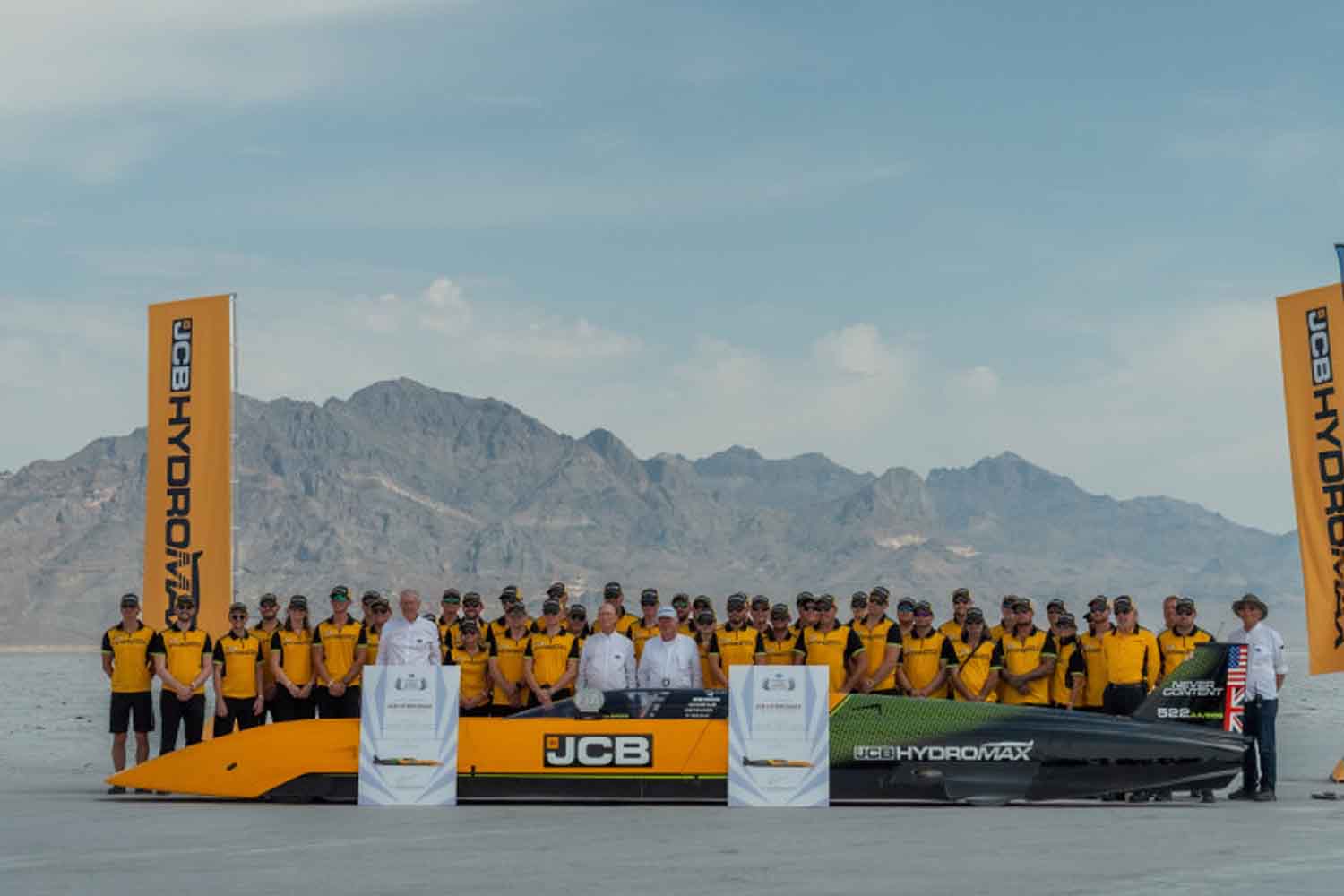
To push a hydrogen car up to 653,909 kilometers per hour, JCB stuck two engines derived from those of its construction machinery inside an arrow almost ten meters long. Then he loaded 250 kilos of ice to keep the temperatures at bay and entrusted the steering wheel to Andy Green, who is quite familiar with speed records.
On the Bonneville Salt Flats in Utah, the JCB Hydromax thus set a new provisional FIA world record for a hydrogen-powered internal combustion engine vehicle. Provisional is an important word: the performance has been verified by the International Automobile Federation, but has yet to be ratified by the FIA Land Speed Records Commission.
©FIA
The official figure is slightly different from the 653.908 km/h circulated in the first news: the FIA indicates 406.320 miles per hour, equivalent to 653.909 km/h. The previous reference recognized by the Federation for a hydrogen internal combustion engine belonged to the BMW H2R from 2004: 185.5 miles per hour, approximately 298.5 km/h. More than surpassed, it is left far behind.
The record was born from two races in opposite directions
At Bonneville a sprint on the straight isn’t enough. FIA regulations require two passes over the flying mile, made in opposite directions, and the result is calculated on their average. The Hydromax recorded 400.623 mph on the first pass, about 644.7 km/h, and 412.135 on the second, about 663.3 km/h. Final average: 406.320 mph. According to JCB, the two runs were completed within the time required by the rules.
Supervising the feat were FIA officials together with the Automobile Competition Committee for the United States and Bonneville specialists. Technical checks, safety inspections and timing have therefore entered the official procedure, with independent recording of the performance.
The result comes a few days after another quick pass on the salt. During Bonneville Speed Week the same car had already reached an average of 368.347 miles per hour, approximately 592.8 km/h, achieving the SCTA record for its class. It was still the warm-up: for the FIA attempt the engines were brought up to full power.
Two 800 horsepower engines and a mountain of ice
The Hydromax measures approximately 9.75 meters and uses two 4.8-litre, four-cylinder hydrogen internal combustion engines, one in front and one behind the pilot. Each was boosted to around 800 horsepower, for a combined output of 1,600 horsepower. The mechanical basis comes from JCB engines intended for construction equipment, including the driveshaft, although the units installed on the car have been extensively modified to withstand a record attempt. The technical characteristics of the Hydromax have been published by JCB itself.
Power goes to all four wheels via two six-speed sequential transmissions. The cooling also has little of the usual: no large open air intakes in the body, which would have increased aerodynamic resistance. The Hydromax carries full tanks of ice on board and uses around 250 kilograms of ice for each trip. The pistons alone require one liter of cooling oil per second. The turbochargers, meanwhile, spin over 150 thousand times per minute.
Salt also causes problems. Channels have been created under the nose that expel it laterally, because the one raised by the wheels can increase the resistance under the car. The chassis is lighter than that of the Dieselmax with which JCB set the diesel record in 2006 and, according to the company, the entire body offers around 10% less aerodynamic drag.
The record measures speed, sustainability requires other accounts
JCB also presents the undertaking as a demonstration of the environmental potential of its engines and speaks of “zero emissions” operation. The formulation deserves a few more bolts. Burning hydrogen avoids CO2 from the carbon in the fuel at the exhaust, because there is simply no carbon in hydrogen. A combustion engine, however, continues to work at high temperatures and can produce nitrogen oxides, NOx. The United States Department of Energy also reminds us: quantity and control depend on the combustion strategy and the relationship between air and fuel.
Then there’s everything that happens before the hydrogen reaches the tank. Its climate footprint depends on how it is produced. The International Energy Agency calculates very different emissions between hydrogen obtained from fossil fuels without reducing CO2 and hydrogen produced through electrolysis powered by low-emission electricity. Global low-carbon production still represents a very small share of the total.
In the materials on the record published by the FIA and in the JCB data sheets the hydrogen gas used by the car is described, but the origin of the hydrogen used in the attempt is not specified. The record therefore demonstrates with remarkable clarity that two hydrogen combustion engines can take a car above 650 km/h. To transform that speed into a measure of overall emissions requires information that the chronometer, however precise, cannot provide.
Andy Green still remains far from Andy Green
For the British driver it is a return to terrain that has already been extensively explored. In 2006 Green drove the JCB Dieselmax at Bonneville to 350.092 miles per hour, 563.4 km/h, setting the world record for a diesel vehicle, which is still unbeaten. Twenty years later he returned to the same desert with hydrogen and added almost 91 km/h.
However, the record that makes any other Green’s speed vaguely smaller remains. In 1997, on the Black Rock Desert in Nevada, he drove the ThrustSSC to 1,227.985 km/h, Mach 1.016: the first supersonic land record and still the absolute FIA record.
That number is still right where Green left it nearly three decades ago. By comparison, the Hydromax’s 653.909 km/h seems almost moderate. Just for comparison.
