
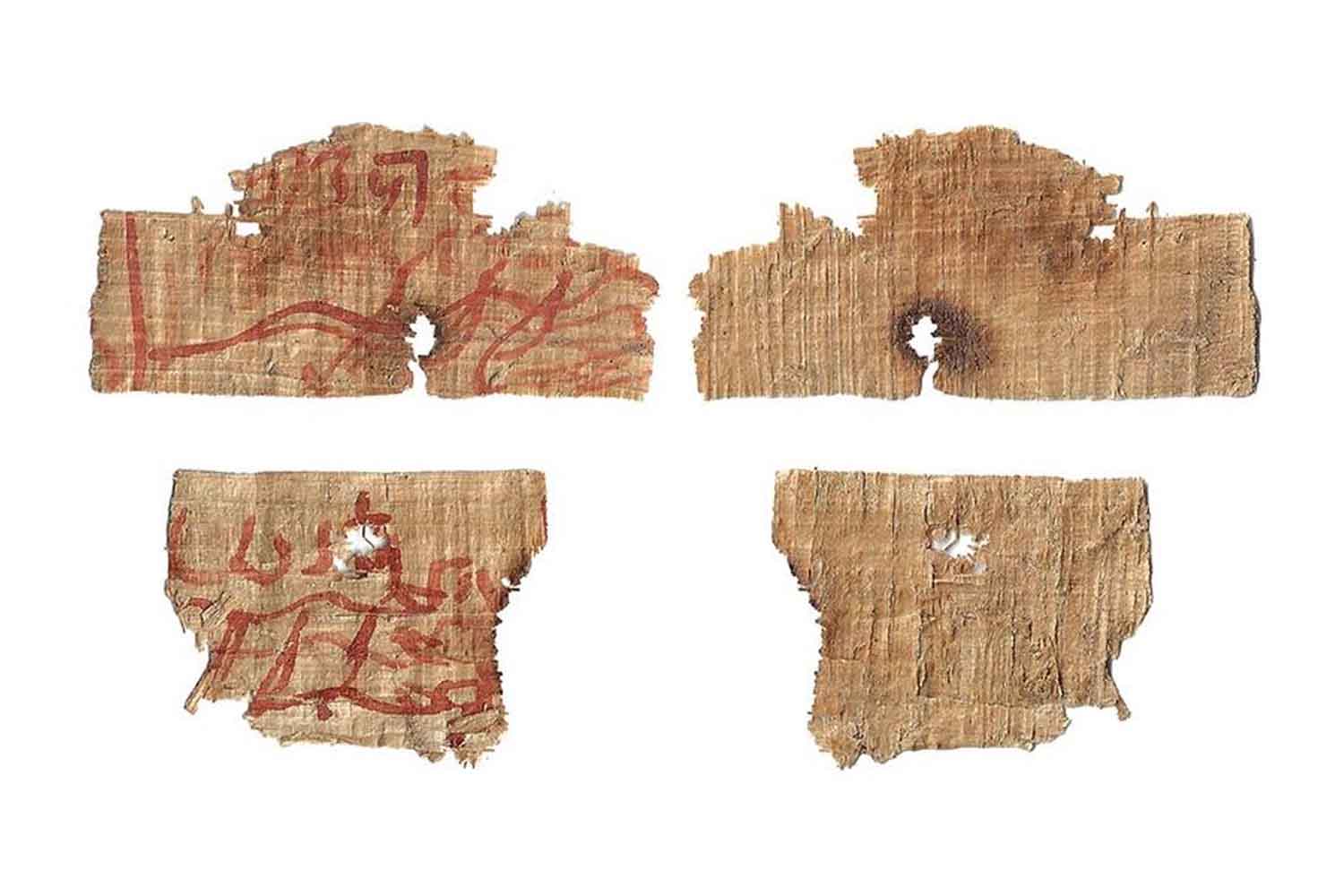
A snake drawn in red ink, three knives crossing its body and an inscription bearing its name. All on a piece of papyrus destined to be trampled, spit on, pierced and set on fire. Something, however, escaped the fire.
In Egypt, among the accumulated waste approx 3,400 years ago near the funerary temple of Pharaoh Thutmose IIIin the ancient city of Thebes (now Luxor), around forty charred papyrus fragments were recovered, no larger than half a postage stamp. They belonged to one of the most famous curse rituals of ancient Egypt, that of Apophi.
They were studied by Egyptologists Fredrik Hagen, Carina Kühne-Wespi and Myriam Seco Álvarez, authors of research published in the journal Zeitschrift für Ägyptische Sprache und Altertumskunde. The discovery documents the execution of the ritual about a thousand years before the writing of the manuscript which handed down the instructions and reveals a rather curious detail: the ancient Egyptians prepared the curses in series.
Cursing a snake to make the Sun rise
According to Egyptian mythology, every night the sun god Ra crossed the underworld in his boat. He was there waiting for him Apophi, a gigantic serpent who embodied chaos and tried to hinder their journey. Ra’s victory would have allowed the Sun to rise again, ensuring the survival of the cosmic order.
Humans could lend a hand to the deity through magic. Rituals were celebrated in the temples during which the serpent was reproduced on papyrus with red ink or in the form of a wax statuette. A rather aggressive treatment was given to his image: the physical destruction of the figure, accompanied by the recitation of magical formulas, was supposed to neutralize Apofi’s powers.
The ritual, however, also lent itself to resolving decidedly more earthly matters. It could be used to protect oneself from diseases, poisons and bad weather, to ensure personal success or to curse the pharaoh’s enemies. If necessary, even your own.
The curses were prepared in series
Observing the fragments recovered in Thebes, the researchers identified two types of depictions: those dedicated to Apophi and those addressed to the so-called “Sons of the Rebel”. On several papyri, thin red lines that delimited the drawings are still visible.
The scribes, therefore, could prepare an entire sheet of papyrus divided into small squares, each containing an image and the related inscription. The individual squares, originally a few centimeters large, were then cut out to be used during ceremonies. To strengthen this interpretation there is also a papyrus from a later period, examined as part of the same research, on which several panels containing depictions of the serpent are still visible. A sheet of curses yet to be cut out, so to speak.
Even for wax figurines there were tools that allowed them to speed up production, such as molds depicting the figures to be cursed. The preparation of the materials therefore suggests that the ritual was a recurring practice in Egyptian religious lifeso much so as to justify a certain organization of work.
To curse someone you could turn to a scribe
Until today, the instructions of the Apophi ritual were known mainly through the Bremner-Rhind Papyrus, a manuscript from the late 4th century BC preserved in the British Museum in London.
The finds from Thebes have made it possible to compare those ancient instructions with what remains of the ceremonies actually celebrated during the New Kingdom, over a thousand years before the writing of the manuscript. And magic, apparently, had also found space outside the temples. As Fredrik Hagen, professor of Egyptology at the University of Copenhagen, explained, even literate people who did not belong to the clergy had access to magical knowledge and could exercise the role of magicians and healers.
One could therefore turn to a scribe for protectionreceive help against an illness or place a curse on someone. The concerns of the individual citizen thus found space in the same religious universe in which they fought, every night, to make the Sun rise.
What the ancient Egyptians threw away
The discovery is also interesting for the place where it occurred. Over the centuries, Egyptology has paid enormous attention to the statues, monuments, inscriptions and magnificent reliefs of the temples. Definitely less to their landfills. Yet, in the same deposit where the remains of the curses were found, archaeologists also recovered fragments of the temple’s administrative archive, precious documents for reconstructing its economy, the organization of work and the management of religious offerings.
The daily life of the ancient Egyptians also passes through these wastes: the duties of the priests, accounting, illnesses, the fear of bad weather and, evidently, some enemies to wish for an unfortunate fate. To learn a little better about the life of the Egyptians, this time, it was necessary to rummage through their garbage.
