
The Earth risks becoming increasingly drier. By 2100, arid lands, i.e. those areas in which the available water is insufficient compared to the quantity that can be lost through evaporation and transpiration of plants, could cover over 40% of the planet’s emerged land.
This is the prediction contained in a new study published in the scientific journal Environmental Research Letterswhich updated the global map of drylands and analyzed how they might change in the coming decades under the pressure of global warming.
A transformation as silent as it is enormous: the frontiers of deserts could advance, transforming today’s wetter territories into fragile environments, putting ecosystems, agriculture and human communities in difficulty.
What are drylands
Not all arid lands correspond to deserts. The term includes different categories of environments characterized by severe water scarcity:
Scientists classify these areas through an indicator called the aridity index, which relates the amount of precipitation to the potential loss of water through evaporation and plant transpiration.
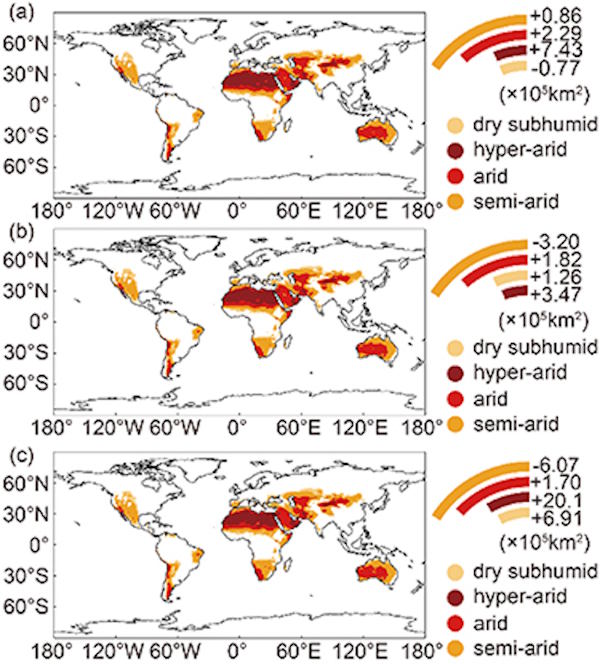
According to the study, between 1994 and 2023, drylands already covered approximately 38.58% of the planet’s land surfaces (excluding Antarctica). Today’s analysis, however, predicts that, between 2071 and 2100, this percentage could rise to 39.31-40.28% of the Earth’s surface, depending on the future scenario of greenhouse gas emissions.
Spatial distribution of global drylands and their climate zones.
(a) Reference period 1994–2023
(b) Percentage of each climate zone
@Environmental Research Letters
The map of the areas most at risk
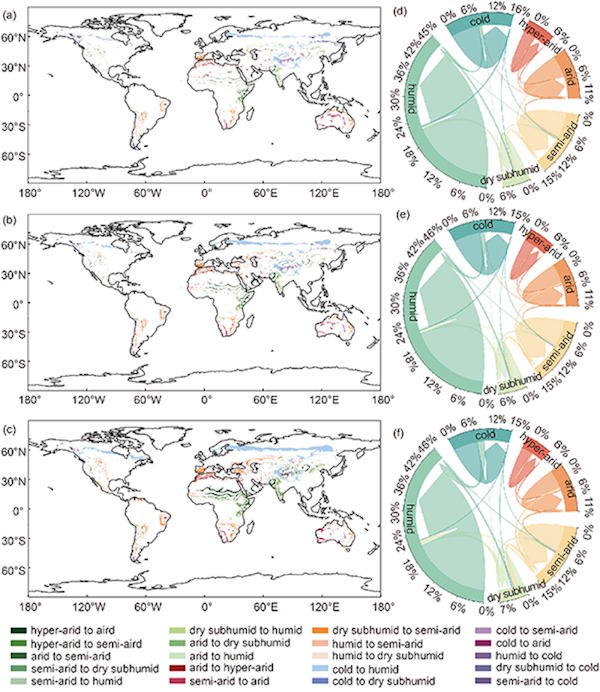
Dryland expansion will not be uniform, as some regions will be much more exposed than others. According to the researchers, the most marked changes could concern:
Australia
Australia, already the driest inhabited continent on Earth, could face the most significant transformations. Rising temperatures, reduced precipitation in some areas and increased evaporative demand on the atmosphere could push many areas towards even drier conditions.
Brazil
Brazil is also listed among the countries that could undergo important changes. The advance of arid conditions could especially affect some inland regions, worsening problems already linked to the loss of vegetation, soil degradation and the vulnerability of ecosystems.
@Environmental Research Letters
Africa
Many African areas are already exposed to desertification, particularly in regions close to the Sahara and in areas where agriculture and water availability are closely linked. Dryland expansion could increase pressure on crop yields, water resources and food security.
Asia
China, Central Asia and the Middle East are already home to vast arid areas. According to projections, some of these areas could become even more extreme
@Environmental Research Letters
The role of CO₂
The study also introduces a less intuitive element: the increase in the concentration of carbon dioxide in the atmosphere, the main cause of climate change caused by human activities, could have a temporarily mitigating effect on some estimates of aridity.
The reason concerns the behavior of plants: when CO₂ increases, plant organisms can reduce the opening of the stomata, small pores on the leaves through which gas exchange takes place. This can decrease water loss through transpiration. As a result, some traditional estimates of evapotranspiration may overestimate dryland expansion.
The researchers therefore used a model that also takes into account this effect of CO₂ on plants, but of course this does not mean that the increase in CO₂ is good news. In fact, the effect on plant transpiration does not cancel out the overall impacts of global warming: increase in temperatures, extreme events, loss of biodiversity and alteration of water cycles.
An increase as big as Algeria
Even in the most conservative scenario, dryland growth would be enormous. The maximum scenario predicted by the study corresponds to an expansion of approximately 2.37 million square kilometers compared to the reference period 1994-2023. To get an idea of the size, it is a surface area comparable to that of Algeria or about 30% of Australia.
A new band of territories where life becomes more difficult, where growing crops will be more complex and where ecosystems will have to adapt quickly. A real wake-up call that requires only one thing: urgently prepare valid adaptation strategies.
