
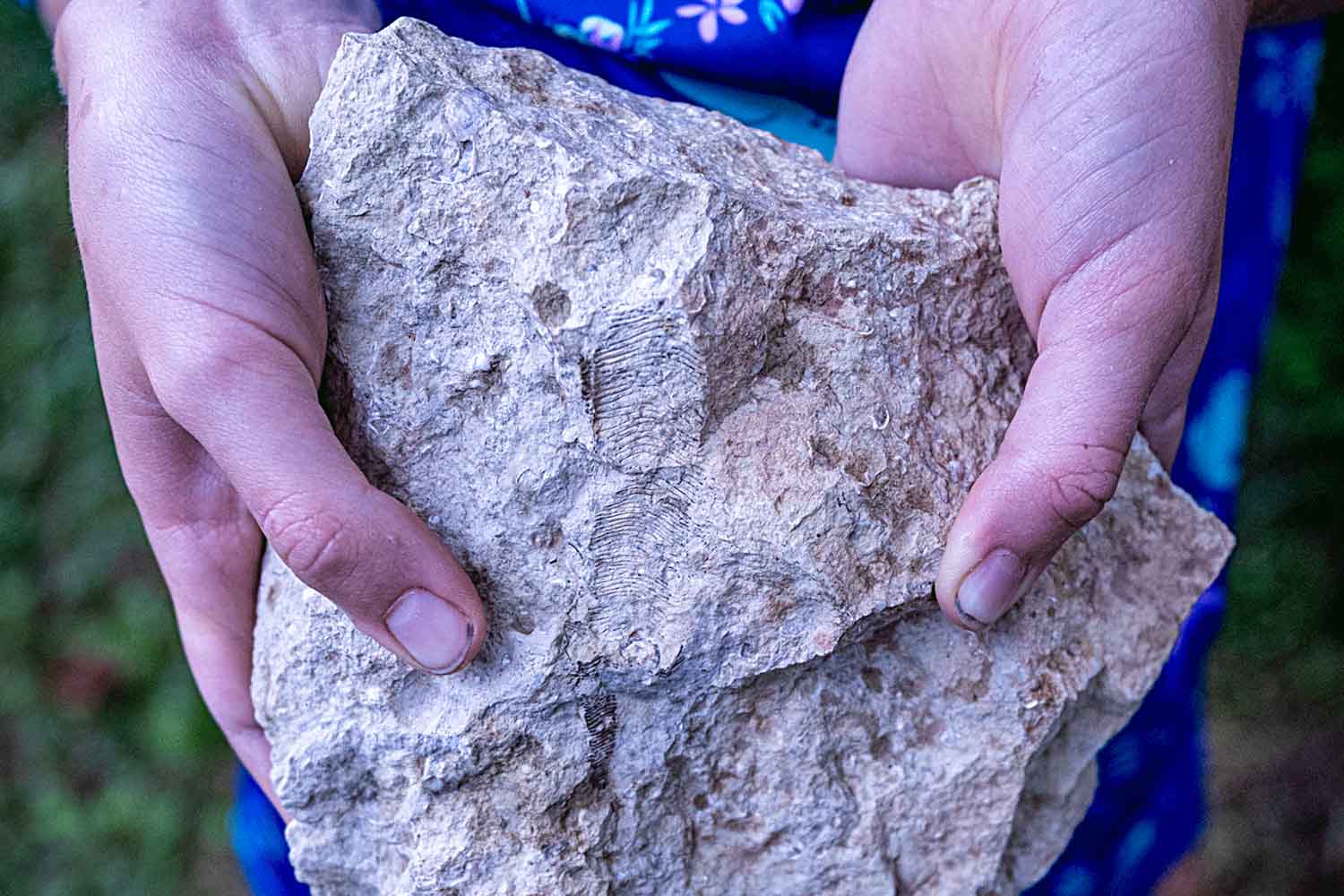
Leo Youngdahl is six years old, with a passion for fossils and a certain habit of collecting stones. During an excursion to Schramm Park, in the US state of Nebraska, he spotted a rather large one and turned it around, hoping to find some traces of the prehistoric animals that he likes so much. A footprint about seven centimeters long appeared on the surface, belonging to an animal that lived in a time when that part of the United States was submerged by the sea. A fossil dating back to approximately 350 million years ago, belonging to a group of marine animals of which no new findings have been known in Nebraska for over 55 years.
The discovery, which occurred at the end of summer 2026 and was made public on October 13 by Nebraska Game and Parks Commissionsurprised even park experts. Leo, on the other hand, had initially thought of the scales on the belly of a snake.
He was looking for a common fossil, he found a very rare one
That day Leo was participating in Rafting and Rocks, an educational activity organized in the Schramm Park State Recreation Area, near the town of Gretna. The boy, a resident of Eagle, hoped to find a crinoid, a marine animal belonging to the echinoderms, the same large group as starfish. Crinoids are relatively common in rocks in the area. Leo had seen them before and knew what to look for. However, when he turned that stone over, he found something different in front of him: a regular succession of small signs, arranged like the spines of a fish bone.
He then showed the artifact to Kelly Ekue, an environmental education specialist at the Schramm Education Center. The woman has been accompanying visitors to discover fossils for over seven years and knows well the six main types found in the park. That one, however, didn’t look like any of the six. The footprint was larger than usual and had an almost fish-like appearance. A rather strange detail, considering that the rocks emerging at that point preserve fossils of marine invertebrates.
Ekue photographed the stone and sent the image to a geologist. The photograph also reached Shane Tucker, paleontologist at the University of Nebraska State Museum, and Bob Diffendal, geologist and professor emeritus at the University of Nebraska-Lincoln. The identification confirmed that Leo had found a conulariid, an extinct marine animal related to jellyfish. And to think he was looking for a crinoid.
An ancient relative of jellyfish that lived 350 million years ago
Conulariids were rather particular animals. They had a soft body enclosed in a thin external structure, generally elongated and with four sides, similar to an inverted pyramid. Their skeleton had thin ribs that, under certain conditions, could leave recognizable imprints in the sediments. Just like the one Leo found, with its characteristic herringbone design.
These animals populated the ancient seas hundreds of millions of years ago, but their fossil remains are particularly rare in Nebraska. The soft body and thin external structure could deteriorate before the sediments managed to preserve traces of it. According to the Nebraska Game and Parks Commission, the other known specimens in the state were discovered more than 55 years agoin the Louisville and Weeping Water areas.
Leo’s find therefore adds new evidence to local paleontological history. And it comes from a stone chosen almost by chance among the many scattered in the park. Today, Nebraska is best known for its great plains and farmland. About 350 million years ago, however, the territory in which Schramm Park is located was occupied by a salty sea, populated by numerous invertebrates.
The emerging rocks date back to that period and still retain traces of the organisms that lived in those waters. The age attributed to the fossil, preserved in the limestone, also derives from the geological context of the site. Most of the artifacts seen in Schramm Park are smaller than a dime. The one discovered by Leo, however, measures almost seven centimeters. Enough to attract the attention of a six-year-old and, shortly thereafter, that of paleontologists.
The fossil will remain in the park, Leo will continue searching
The discovery especially struck Kelly Ekue, amazed by the fact that the child recognized something unusual and decided to show it to a competent person. Leo, for his part, said he was particularly happy with the size and conservation of the find. He had never found such a large and complete fossil. They also told him that it was a rarer find than a mammoth bone.
The stone will remain at Schramm Park, where it will be used during educational activities to tell visitors about the animals that populated Nebraska’s ancient seas. The little enthusiast will continue his explorations, showing the most interesting discoveries to Heidi Swanson, naturalist at the nearby Platte River State Park.
For those wishing to try the same luck, the park allows you to observe the rocky outcrops, but prohibits the use of picks and shovels and reminds you that some natural finds cannot be taken away. Better bring a camera. Leo, meanwhile, has already found something that adults busy searching for fossils in the same place have probably wanted to see for a long time.
