

An artificial intelligence that builds with Lego starting from simple commands in natural language: no, it is not science fiction, but a concrete project, signed by Carnegie Mellon University. The researchers, combining skills in engineering and AI, have developed Legogpta system capable of transforming texts into Perfectly stable Lego structuresas if they were thought by a miniature structural engineer. And all this starting from a linguistic model developed by Meta.
In their study, published on the platform Arxivscientists explain how they reconfigured a Large Language Model (LLM) To transform it from a generator of words to brick generator. A simple and powerful idea: to exploit the potential of natural languages to create concrete objects. The result? One that can build castles, bridges, towers or anything else suggests the imagination … but always taking into account gravity, physical forces and structural stability.
How legogpt really works, brick by brick
To achieve this, the team worked on Llama-3.2-1b-Insstructa LLM developed by Meta. Instead of predicting the next word in a sentence, Legogpt provides for the Next brick to position in a construction. An apparently trivial replacement, but which required a complex adaptation work, especially to include a Additional mathematical module capable of calculating the physical seal of the entire structure.
The system is not based only on intuition: it was trained on 47,000 Lego structures already stablewith descriptions generated by another Ai. In this way, he learned to recognize what makes a truly feasible project. During the design, each brick is tested: If its insertion generates instability, it is removed and replaced, until the right combination is found.
This recursive approach is what allows the system to guarantee reliable results. Without the Rollback function, only the 24% of the structures It was stable. With active optimization, the Percentage of success rose to 98.8%. A difference that, for those who have ever tried to build with Lego, means going from a tower that collapses as soon as you touch it with a model that really resists.
Robots, colors and comparison with other systems
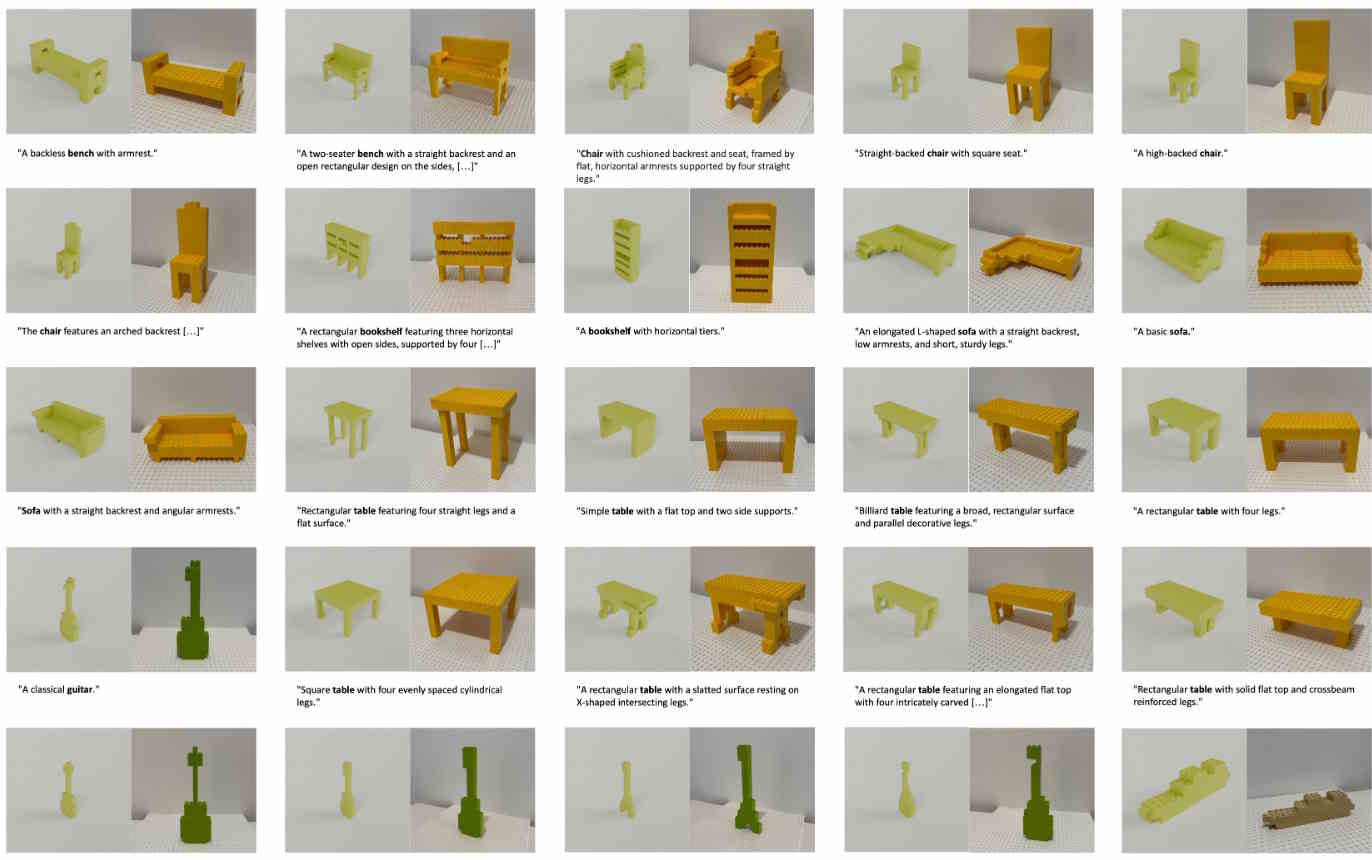
But Legogpt did not stop there. The researchers added Functions of color and texturemaking the buildings not only stable, but also beautiful to see. To test its effectiveness, they were used Two robotsprogrammed to physically build the projects generated by the AI. And some prototypes have also been assembled by hand, confirming that the system also works out of the screen.
The comparison with other models to 3D design dedicated that legogpt has shown generates a much higher percentage of stable structures. Which opens interesting scenarios not only for education and the game, but also for architectural design, prototyping and even sustainability: building in digital structures that are truly achievable structures it could reduce waste and failed tests in the real world.
One brick at a time, the future of the design takes shape. And this time, fantasy also has solid foundations.
