
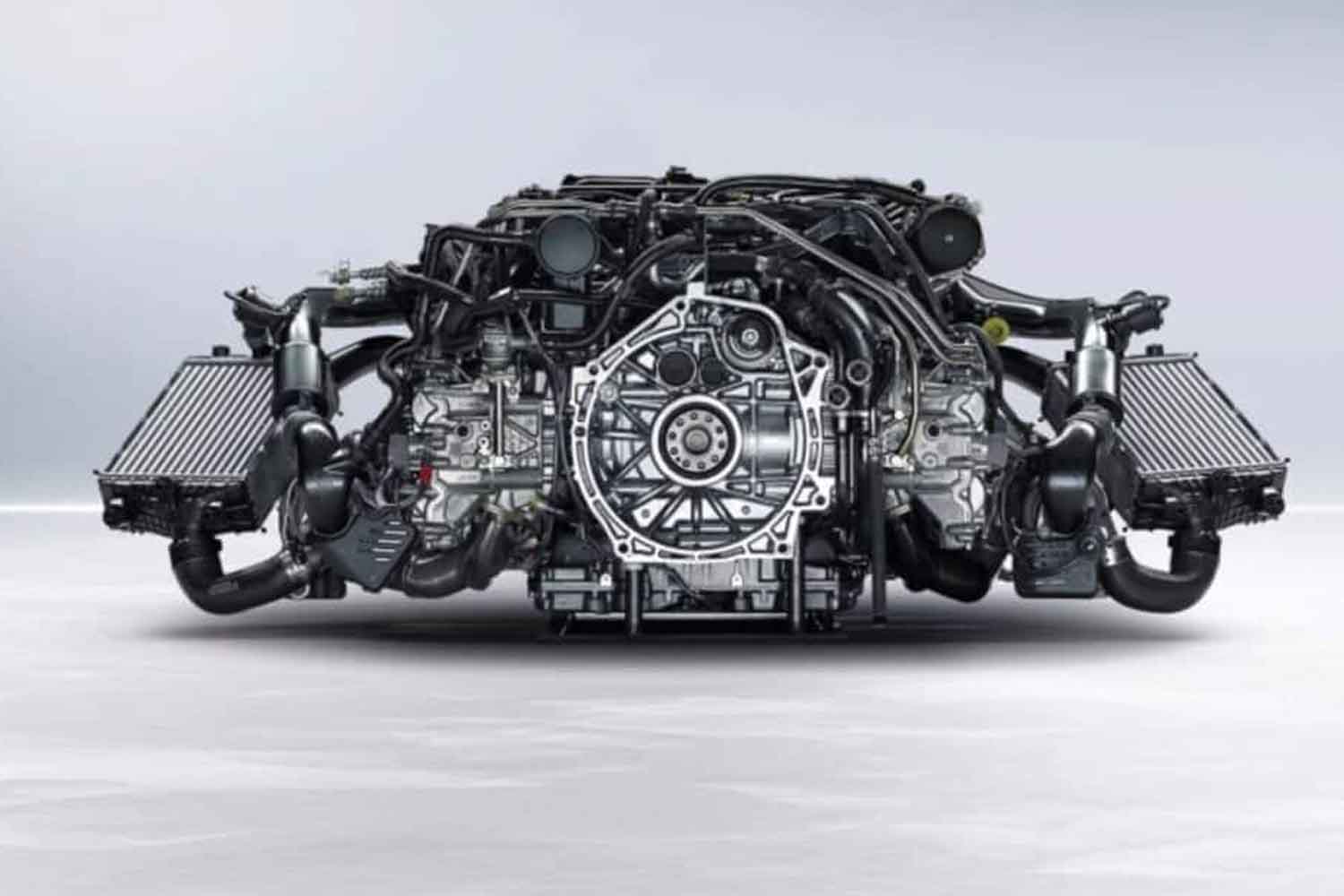
In an era in which the automotive seems to speak only the language of electricity and promises to hydrogen, Porsche takes a completely different path. Does it clearly: presenting A six -stroke internal combustion enginean absolute first for industry. It is not a salon concept, but a concrete technology, ready for the street. The German company does not run to fashions, but reopens the discussion on combustion with a radical project, which overturns the traditional four -stroke cycle and tries to make room for a new idea of thermal engine.
The six -stroke engine of Porsche It is not an update, it is a total rewriting of the rules. The operating cycle changes completely: instead of the usual aspiration-compression-discopio-scaric sequence, now we find suction, compression, burst, compression, burst, unloading. Two compressions and two phases of expansion for each cycle.
The result? More couple, more power, more thermal efficiency. According to the data released, you arrive at a yield between 45 and 50%, against 30% of a four -stroke engine. A difference that does not go unnoticed.
The secret lies in the internal mechanics: the engine tree leaves the classic on-game movement to adopt Two concentric trajectoriesthanks to a planetary gear system. The pistons, in turn, move with Two higher and two lower dead pointsthus varying the compression relationship dynamically. The system succeeds in extract more energy From the air-carburant mixture, with more frequent combustion and greater yield.
Thermal engine yes, but within the environmental limits
If to talk about internal combustion engines today can play anachronistic, Porsche does not pretend anything: The new engine is designed to respect current environmental standards. The official documents of the project speak clearly: energy efficiency is one of the hinges of the six -stroke.
It is not the first time that someone tries to build an engine of this type. Prototypes like that of Bruce Crower (which used steam injections) or the Double piston bear head They had tried to bring the six -time road. Nobody really succeeded. Porsche, with a century of experience behind him, found a way of make the concept really work.
It is not just a more efficient engine, but also of a concrete alternative to hydrogen vehicles and hybrid models. In some tests, this engine has both beaten in terms of thermal yield.
While the electric car world continues to monopolize communication, Porsche decides to reopen the debate. The message is clear: combustion is not dead, it can evolve and coexist with environmental attention.
Of course, there is no shortage of suspicions. Some hypothesize that it is only a defensive patenta way to block any moves of competitors. The German company has not yet announced when (and if) we will see a standard model with this engine. But the fact that it is in the phase of road tests is enough to rekindle the interest, especially among whom.
Porsche’s six -stroke: proposes an alternative. And it does so starting from a simple, almost forgotten idea: to rethink the mechanics to do better, without throwing everything that already works.
Porsche changes the narrative on the car
While public policies and market trends push towards electrical or hydrogen solutions, Porsche breaks the choir and puts the center in the center mechanical research. The new six -stroke is not nostalgia, it is a serious attempt by update the thermal engine to the contemporarywith numbers that can hold comparison.
Will it be enough to convince those who only look at the electric? Difficult to say. But the fact remains that A house like Porsche has decided to invest time and resources to rewrite the enginenot only to improve it, but to rethink it at the base. And this, in a sector that is often limited to following the flow, is news.
