
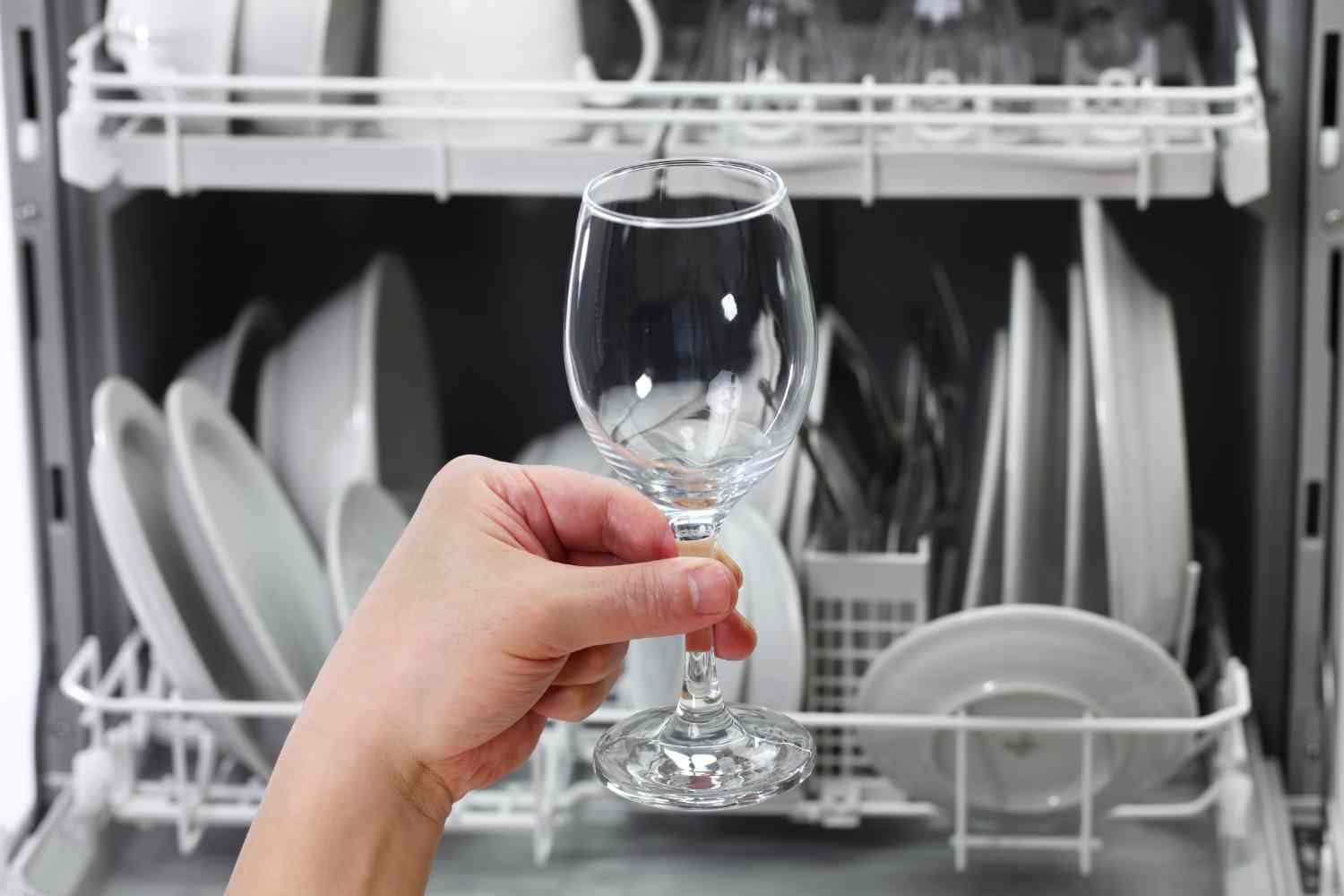
Have you ever opened the dishwasher and find your glasses covered by an annoying opaque white patina? You are not alone. This phenomenon is much more common than you might think and, above all, has a precise scientific explanation.
It is not dirty: it is the limestone of the hard water
The first thing to clarify is that that whitish patina is not residual dirty as many could think. Instead, these are mineral deposits, mainly limestone, which are formed when the water used by the dishwasher is particularly “hard”.
Hard water contains high concentrations of mineral salts, in particular calcium and magnesium. During the washing process at high temperatures, these minerals tend to precipitate and deposit on the surfaces of the glasses, creating that feature opaque patina that makes our glasses with an uninviting appearance.
The main causes of the problem
Lack of glitter
Brilliant is a fundamental additive in the dishwasher washing process. Its main function is to reduce the surface tension of the water, allowing better drying and preventing the formation of stains and halos. When the brilliant is insufficient or completely absent, the water does not slip away correctly from the surfaces, leaving the mineral deposits behind it.
Excess of detergent
Paradoxically, the use of too much detergent can also cause this problem. The excess detergent is not completely rinsed and can react with the minerals present in the water, forming compounds that are deposited on the glasses in the form of white film.
Hardness of the local water
In some areas of Italy, water is naturally harder due to the geological composition of the territory. Regions with soils rich in limestone tend to have more mineralized waters, making the problem more frequent and persistent.
How to solve the problem
Check and top up the glitter
Check the level of the glitter regularly in your dishwasher. Most modern appliances have a bright indicator that reports when rabbocco is needed. If you are not sure where the glitter container is located, consult the manual of your dishwasher.
Correctly dose the detergent
Use the amount of detergent recommended by the manufacturer, without exceeding. Often “more” does not mean “cleaner”, on the contrary it can create the opposite effect. For particularly hard waters, there are specific detergents that take into account this feature.
Consider a water softener
If the problem persists despite the corrections, you could evaluate the installation of a water softening system. Many modern dishwashers have already integrated a system of this type, which only needs to be supplied with specific rooms.
Periodic cleaning of the dishwasher
Do not forget to regularly clean your dishwasher with specific products or natural remedies such as white vinegar, which helps to remove mineral deposits from the internal pipes.
Remember that that white patina, despite being unsightly, is not harmful to health. It is simply the result of a natural chemical-physical process that can be easily controlled with the right precautions.
We also recommend you:
