
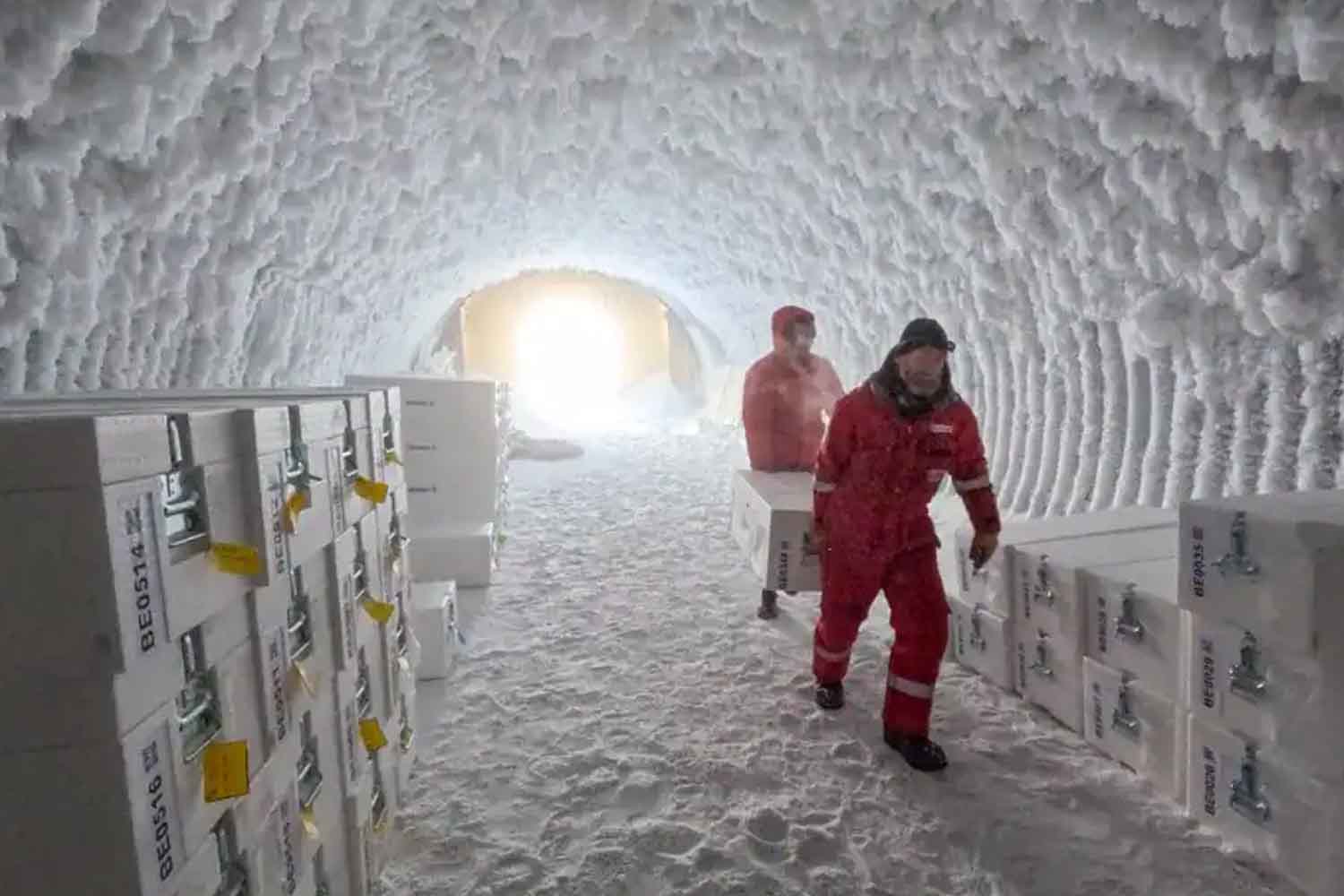
In the heart of a freezing laboratory in Cambridge, England, something extraordinary is being made. It is not any experiment, but a real journey through time. Scientists of British Antarctic Survey they are working on Ice carrots taken in AntarcticaThat they contain air that was trapped up to 1.5 million years ago.
These blocks of ice, just arrived in Europe after a journey that starts from the heart of the Antarctic continent, they are melted slowly, millimeter after millimeterto study as the climate on earth was like in such a remote past as the evolution of modern man.
An unprecedented European project
The ice carrots were extracted at 2,800 meters deep In a remote place called Little Dome Cabout 40 kilometers from the Franco-Italian Concordia scientific base on the Eastern Antarctive plateau. There, teams of scientists worked in extreme conditions for Four consecutive seasonslouting the meter ice after metro.
All this is part of the European project Epica Beyond – Oldst Icewhich involves 10 countries and 12 research institutes. The goal is ambitious: extend our climatic archivenow stopped at 800,000 years ago, up to 1.5 million years in the past.
Why is it important? Because around a million years ago, the climate of the earth suddenly changed rhythm. Before, The glaciations arrived every 41,000 years. Then something happened: they started lasting 100,000 years. But nobody knows exactly why.
The answers could be right there, In the air bubbles that have been trapped in the icewhich contain greenhouse gases like carbon dioxide and methanebut also Traces of volcanic ashes, dust, marine salts and marine microorganisms. Studying these elements will help to understand how and why the climate has turned.
The data will help us predict how the climate will change today
The ice is not analyzed everything in one place. Some samples have already arrived in Germany and Switzerlandbut The most sophisticated analyzes are done in Cambridgewhere there is one of the few workshops in the world capable of studying this material with ultra sensitive tools.
Here the scientists dissolve the ice in a controlled way using a technique called “Continuous flow analysis”which allows you to detect dozens of chemical elements simultaneouslyeven in minimal quantities. An example? The ICP-MS spectrometerwhich can detect beyond 20 metals on trackincluding rare elements.
What exactly are they looking for? Evidence of how temperatures varied, the winds, the extension of marine ice and the productivity of the oceans in the past. Crucial data, because according to some evidence, During that period the CO₂ levels may have been similar to those of todayyet the climate behaved differently, as he explains Liz Thomaswho guides the research team:
Our climatic system has crossed many changes. To understand them, we have to look back in time.
A distant past can help save the future
Today, climate change is an evident reality: ice that melts, seas that rise, record temperatures. But what happened in the past, when the CO₂ levels were as high as today, but but The changes took place much more slowly?
According to scientists, during the middle Pleistocene the planet may have experienced conditions similar to the current ones, but with an evolution that lasted thousands of yearsnot decades as it is happening now. This comparison between past and present could help to understand how the climate will react in the coming years.
The ice carrots are as long as Eight Eiffel Tour put one above the other. And the work will be long. Each section will be dissolved, analyzed, filtered, with shifts from Maximum 15 minutes in the freezer roomwhere temperatures are so low that Alarms and emergency exits are planned.
One of the most exciting scenes is told by James Vealean engineer who participated in the perforation:
When I held that ice of over a million years old, I realized that I was touching something unique. I had to be very careful not to drop it.
